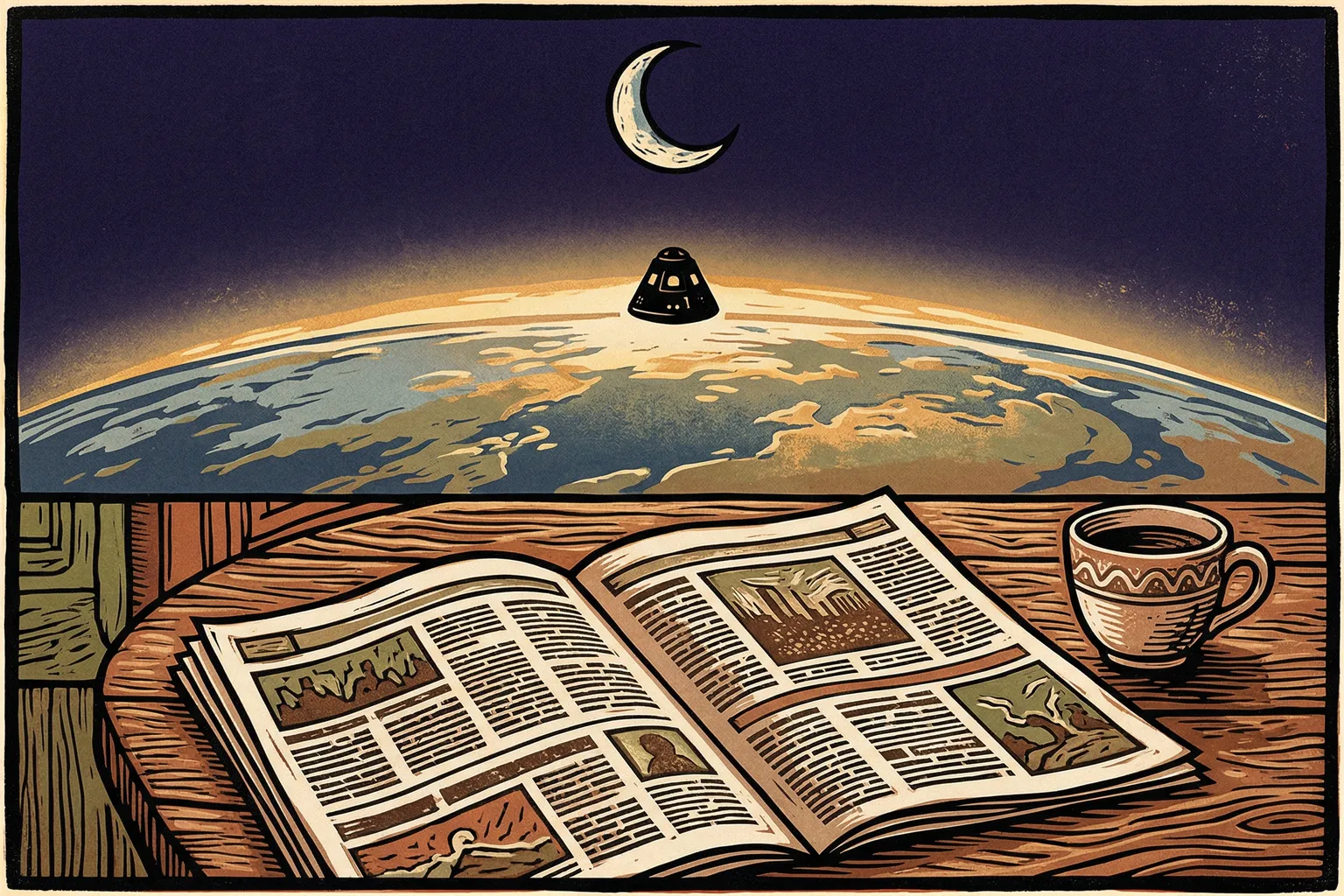
Four astronauts aboard NASA’s Orion capsule are approaching the moon today, five days into a mission that will send them farther from Earth than any human being has ever traveled. Artemis II launched from the Kennedy Space Center last Wednesday evening and, if all goes according to plan, will trace a figure-eight path around the moon before returning to a Pacific Ocean splashdown later this week, NPR reported.
The crew includes a Canadian astronaut, the first from that country to fly to the moon. The entire journey is expected to take just under ten days.
The last time humans traveled to the moon was December 1972, when Apollo 17 commander Gene Cernan scratched his daughter’s initials in the lunar dust and said, “We leave as we came and, God willing, as we shall return, with peace and hope for all mankind,” according to NPR. It took fifty-three years to make good on that promise. Jeff Spaulding, NASA’s senior test director, said the reality of it set in during the final countdown. “That’s when it really starts to hit home that, you know, we really got a shot at making it today,” Spaulding said at a pre-launch briefing. “And I know a lot of people are thinking the same thing, because you can hear a pin drop in that firing room as you count from 10 down to T-zero,” NPR reported.
Artemis II is a flyby, not a landing. The crew won’t touch the surface. But the mission is a necessary step toward NASA’s goal of returning boots to the moon and eventually building a permanent base there. The last time the country committed to something like this, in 1961, it took eight years to land. This time, it took more than half a century to get back in the capsule.
The war in Iran entered its sixth week Monday, and the distance between what the president says is happening and what the evidence shows is happening continues to widen.
President Trump addressed the nation last Wednesday and said he expected the conflict to end within two to three weeks. “We’ll be leaving very soon,” he told reporters in the Oval Office, adding that gas prices would then “come tumbling down,” NPR reported. Secretary of State Marco Rubio echoed the timeline, saying the main goal of preventing Iran from building a nuclear weapon had been achieved, according to NPR.
Rubio listed the objectives: the destruction of Iran’s air force and navy, the “severe diminishing” of its missile capability, and the destruction of its factories, NPR reported. Regime change, previously touted by the administration, wasn’t mentioned.
On the ground, the war doesn’t look like it’s winding down. Iran struck a Saudi base last week, injuring as many as twenty U.S. service members. Iranian drones hit fuel depots at Kuwait’s international airport. A missile hit an oil tanker leased to QatarEnergies. The Pentagon says 13 U.S. service members have been killed and more than 300 wounded, according to NPR.
Pakistan and China issued a joint statement calling for talks, a halt to fire, an end to attacks on civilian infrastructure, and reopening of the Strait of Hormuz, NPR reported. China is Iran’s biggest customer for oil. Pakistan has positioned itself as a potential mediator.
Today is April 6. On this date in 1917, the United States entered the First World War after months of insisting it wouldn’t. President Wilson had won reelection five months earlier on the slogan “He Kept Us Out of War.” The parallel is imperfect, as all historical parallels are. But the distance between what a president says about a conflict and what the conflict becomes isn’t a new problem.
The story that deserves more attention than it’s getting: the World Food Program says tens of thousands of tons of food aid are stuck in ports as a consequence of the war. Carriers can’t use the Strait of Hormuz and are choosing not to use the Suez Canal out of concern for attacks there, too. The WFP says this is adding a month to shipping time and costing more because of fuel price spikes, NPR reported.
The agency’s estimate is stark. If current conditions continue through June, 45 million additional people will fall into acute hunger around the world, reaching 363 million globally, according to NPR. That’s not a projection about the war itself. It’s a projection about the supply chain the war has disrupted. The people who will go hungry aren’t in Iran. They’re in countries that depend on shipping routes that no longer function the way they did two months ago.
The Supreme Court heard oral arguments last Wednesday in what will almost certainly produce a historic ruling on birthright citizenship. At issue is whether President Trump’s executive order, signed on his first day in office, can bar automatic citizenship for babies born in the United States to parents who entered the country illegally or who hold temporary visas, NPR reported.
The Fourteenth Amendment says, “All persons born or naturalized in the United States and subject to the jurisdiction thereof, are citizens of the United States.” It was ratified after the Civil War to reverse the Dred Scott decision, which in 1857 declared that Black people, enslaved or free, couldn’t be citizens. In 1898, the Supreme Court ruled in United States v. Wong Kim Ark that a man born in San Francisco to Chinese immigrant parents was an American citizen by birth. That precedent has stood for 128 years.
The ACLU’s Cecillia Wang, arguing against the executive order, told the justices, “The idea, that actually goes back to the founding, is that in America we do not punish children for the sins of their fathers, but instead we wipe the slate clean,” according to NPR. The Trump administration’s solicitor general, D. John Sauer, argued that Wong Kim Ark’s parents had legal status because they had a permanent residence, making the case distinguishable.
When Justice Brett Kavanaugh asked how hospitals would determine whether parents were in the country illegally, or what states would do with newborns who weren’t granted citizenship, Sauer’s answer was, “Federal officials will have to figure that out,” NPR reported.
A ruling is expected before the court’s term ends in late June.
Israel intensified operations in Lebanon this week and announced its intention to maintain control over parts of southern Lebanon after the broader regional conflict ends, the New York Times reported. Israel has issued sweeping evacuation warnings and, according to the Times, pressed some Christian and Druse community leaders to expel Shiite Muslims from their towns.
Israel occupied parts of southern Lebanon once before, from 1982 to 2000. That eighteen-year occupation became one of the defining grievances that fueled Hezbollah’s growth into a major regional force. The question of whether a second occupation would produce a different result is one that history has already answered once.
Tiger Woods said last week he is stepping away from golf to seek treatment, four days after his vehicle crashed in Florida and he was arrested on suspicion of driving under the influence, NPR reported. “This is necessary in order for me to prioritize my well-being and work toward lasting recovery,” Woods said in a statement, according to NPR.
Deputies found two hydrocodone pills in his pocket and reported his eyes were bloodshot and glassy. Woods told them he had taken prescription medication earlier in the morning and had been looking at his phone before hitting a trailer, NPR reported. He showed no signs of alcohol but refused a urine test. He will miss the Masters for the second straight year.
Woods is fifty years old. He has had seven back surgeries and more than twenty surgeries on his right leg, including after the 2021 Los Angeles crash that damaged his leg so badly doctors considered amputation. In 2009, after a different crash, he stepped away for four months and came back at Augusta. This time, he isn’t making promises about when he’ll return.
Augusta National said in a statement, “Although Tiger will not be joining us in person next week, his presence will be felt here in Augusta,” according to NPR.
And in Kinshasa, the Democratic Republic of Congo declared a national holiday after its national soccer team qualified for the World Cup for the first time in 52 years, the BBC reported. The last time Congo played in a World Cup was 1974, when it competed under the name Zaire.
That 1974 team is remembered for a moment of confusion or protest, depending on who tells the story: defender Mwepu Ilunga broke from the wall during a free kick and booted the ball downfield before it was taken, earning a yellow card that became one of the most replayed clips in World Cup history. The team lost all three group matches and didn’t score a goal.
This is a country of more than 100 million people that has endured decades of conflict, political instability, and economic hardship. Soccer is one of the few things that can bring the entire nation into the streets for the right reasons. Tuesday, it did. The celebrations in Kinshasa lasted through the night. The 2026 World Cup begins in June in the United States, Mexico, and Canada. Congo will be there. That’s the day.