The Supreme Court ruled Thursday that Colorado’s ban on conversion therapy for minors “regulates speech based on viewpoint,” striking down the law and opening the door for similar challenges in more than twenty states, NPR reported.
The case involved Kaley Chiles, an evangelical Christian counselor who wanted to provide talk therapy to teenagers seeking to, in the language of her complaint, “reduce or eliminate unwanted sexual attractions, change sexual behaviors, or grow in the experience of harmony with one’s physical body.” Colorado’s law prevented her from doing so.
“As applied to Ms. Chiles, Colorado’s law regulates the content of her speech and goes further to prescribe what views she may and may not express, discriminating on the basis of viewpoint,” the majority wrote, according to NPR.
Justice Ketanji Brown Jackson dissented. “Stated simply, the majority has failed to appreciate the crucial context in which Chiles’s constitutional claims have arisen,” she wrote. “Chiles is not speaking in the ether; she is providing therapy to minors as a licensed healthcare professional,” NPR reported.
Every major medical organization in the country has repudiated conversion therapy, on the grounds that it doesn’t work and often leads to depression and suicidal thoughts in minors, according to NPR. California became the first state to ban the practice in 2012. In the fourteen years since, more than twenty states followed. The question the court answered Thursday wasn’t whether conversion therapy works. It was whether a state can prevent a licensed counselor from talking about it. The majority said no. What happens next will unfold in legislatures and lower courts across the country, one challenge at a time.
A U.S. journalist was kidnapped in Baghdad after threats by Iran-backed militias in the region against American citizens, NPR reported. The journalist was identified as Shelly Kittleson by Al-Monitor, a Middle Eastern news site she has reported for. Iraqi security forces intercepted a vehicle, arrested one suspect linked to the Iran-backed militia Kataib Hezbollah, and are searching for Kittleson and other suspects.
The State Department said it had warned Kittleson of threats. “The State Department previously fulfilled our duty to warn this individual of threats against them and we will continue to coordinate with the FBI to ensure their release as quickly as possible,” said Dylan Johnson, the assistant secretary of state for global public affairs, according to NPR. The statement didn’t condemn the kidnapping or express concern. The Committee to Protect Journalists called on “Iraqi authorities to do everything in their power to locate Shelley Kittleson, ensure her immediate and safe release, and hold those responsible to account,” NPR reported.
In 1985, Terry Anderson, the chief Middle East correspondent for the Associated Press, was kidnapped in Beirut by Hezbollah. He was held for nearly seven years, the longest-held American hostage in Lebanon. Anderson was a wire service reporter doing his job in a war zone. Kittleson is a freelance reporter doing hers. The geography has shifted. The vulnerability hasn’t.
Separately, three Indonesian U.N. peacekeepers were killed in southern Lebanon this week, NPR reported. Two died Monday in a roadside explosion. A third was killed the day before when a projectile hit a U.N. base. Jean-Pierre Lacroix, the head of U.N. peacekeeping, told the Security Council, “There has been a worrying increase in denials of freedom of movement and aggressive behavior,” according to NPR. The U.N. hasn’t assigned blame and is investigating.
Defense Secretary Pete Hegseth, returning from an undisclosed trip to visit troops in the Middle East, told reporters he “spoke to Air Force and Navy pilots on the flight line who every day both deliver bombs deep into Iran, but also shoot down drones defending their base,” NPR reported. The Pentagon says 13 U.S. service members have been killed and more than 300 wounded in what it calls Operation Epic Fury. Hegseth repeated the administration’s claim that negotiations with Iran are underway, though Iran denies it. “In the meantime, we’ll negotiate with bombs,” Hegseth said, according to NPR.
President Trump signed an executive order seeking to create a list of confirmed U.S. citizens eligible to vote in each state and to use the U.S. Postal Service to “verify” mail ballots, NPR reported. Trump said he believes the order is “foolproof.” Election law scholars said he doesn’t have the authority. The Constitution assigns the running of elections to the states, with Congress able to set broader policy. The president’s role isn’t mentioned.
A previous executive order on elections, signed about a year ago, has already been blocked by federal judges who said the president lacks the constitutional authority to set voting policy, according to NPR. NPR also reported that the Justice Department has been seeking voter data from states and plans to share it with the Department of Homeland Security to search for noncitizens, and that some U.S. citizens have been inaccurately flagged by the system used to do so.
A federal judge ruled that President Trump’s executive order to defund NPR and PBS violated the First Amendment and is “unlawful and unenforceable,” NPR reported.
Judge Randolph D. Moss of the U.S. District Court for the District of Columbia wrote that “the First Amendment draws a line, which the government may not cross, at efforts to use government power, including the power of the purse, to punish or suppress disfavored expression,” according to NPR. He said the executive order “singles out two speakers and, on the basis of their speech, bars them from all federally funded programs.” Moss added, “It is difficult to conceive of clearer evidence that a government action is targeted at viewpoints that the President does not like and seeks to squelch,” NPR reported.
The ruling may have limited immediate effect. Congress already voted to claw back the $1.1 billion set aside for public media, and the Corporation for Public Broadcasting, the congressionally chartered entity through which federal dollars reached public media outlets for more than fifty years, said last August it would close its doors, according to NPR. But the ruling establishes that a future Congress could resume funding if it chose to, and that local public media stations have the right to make their own programming decisions without government pressure.
White House spokesperson Abigail Jackson called it “a ridiculous ruling by an activist judge attempting to undermine the law,” NPR reported.
A federal judge ordered construction on President Trump’s White House ballroom to stop until Congress authorizes its completion, NPR reported.
This is the story that isn’t getting the attention it probably should. U.S. District Court Judge Richard Leon wrote, “The President of the United States is the steward of the White House for future generations of First Families. He is not, however, the owner!” according to NPR. The project, designed to seat 1,000 guests at an estimated cost of at least $300 million, involved tearing down the East Wing of the White House and replacing it with a ballroom funded by private donations.
The Commission of Fine Arts, an architectural review panel now composed primarily of Trump allies, had voted to approve the project despite not seeing the final design, NPR reported. The commission received more than 2,000 public comments. According to staff, 99 percent were negative.
Leon delayed enforcement of the injunction for 14 days, expecting an appeal. The National Capital Planning Commission is set to vote on the project Thursday. The question isn’t whether a president can renovate the White House. Presidents have been doing that since John Adams moved in and complained about the plaster. The question is whether a president can tear down a wing of a building that belongs to the American people, replace it with something that seats 1,000, and fund it with private money, all without asking Congress. Judge Leon said no.
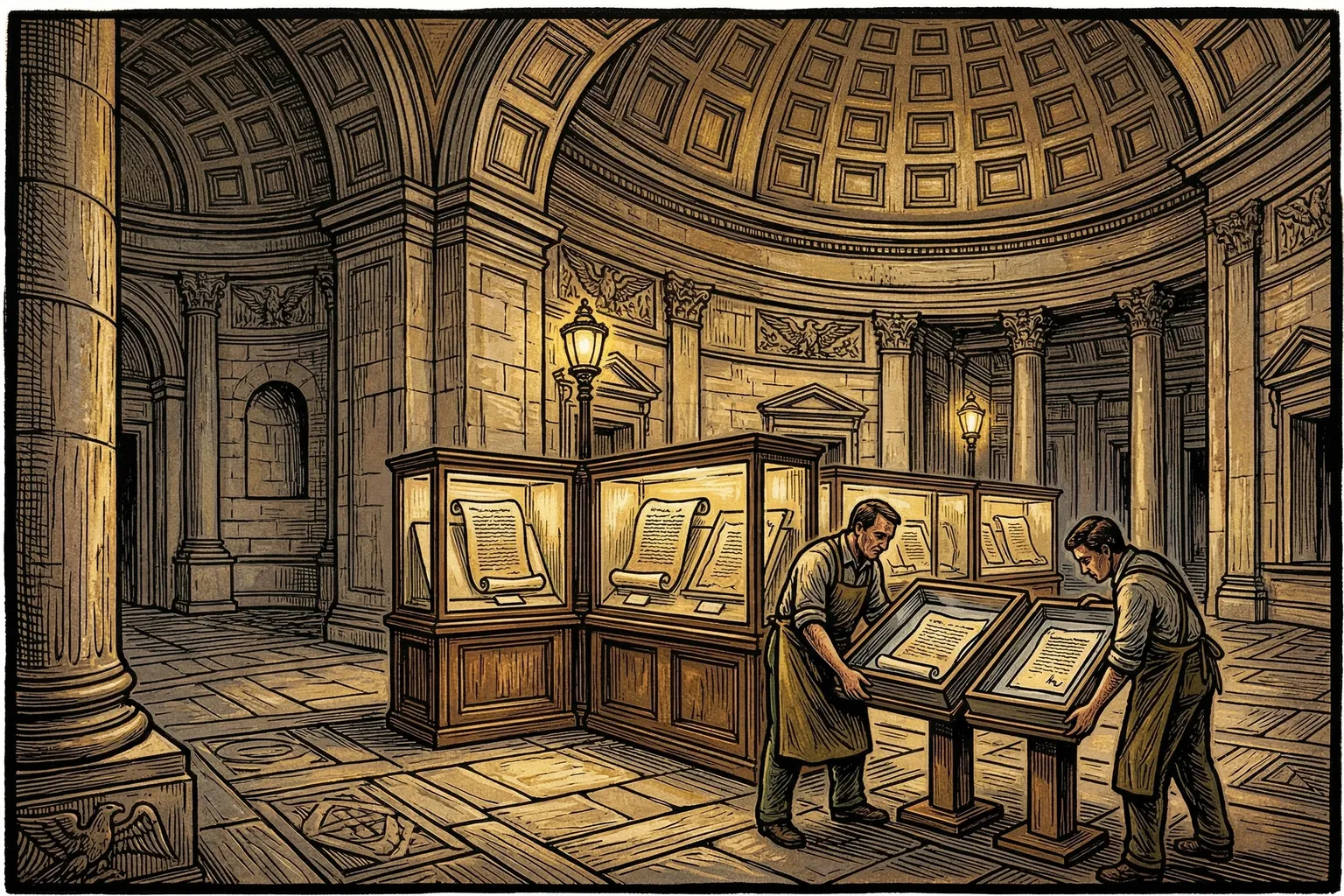
And at the National Archives in Washington, the Emancipation Proclamation and the 19th Amendment have been placed in the rotunda alongside the Declaration of Independence, the Constitution, and the Bill of Rights, the New York Times reported. They are the first permanent additions to the rotunda in nearly 75 years.
The rotunda opened in 1952 with three documents under glass. For three quarters of a century, visitors walked in and saw the founding texts of the republic. Now they’ll see two more: the document that Abraham Lincoln signed on January 1, 1863, declaring “that all persons held as slaves” within the rebellious states “are, and henceforward shall be free,” and the amendment ratified on August 18, 1920, declaring that the right to vote “shall not be denied or abridged by the United States or by any State on account of sex.”
The founding documents told the country what it intended to be. The two new additions tell the country what it took to get closer. That’s the day. The Archives are a little more complete.