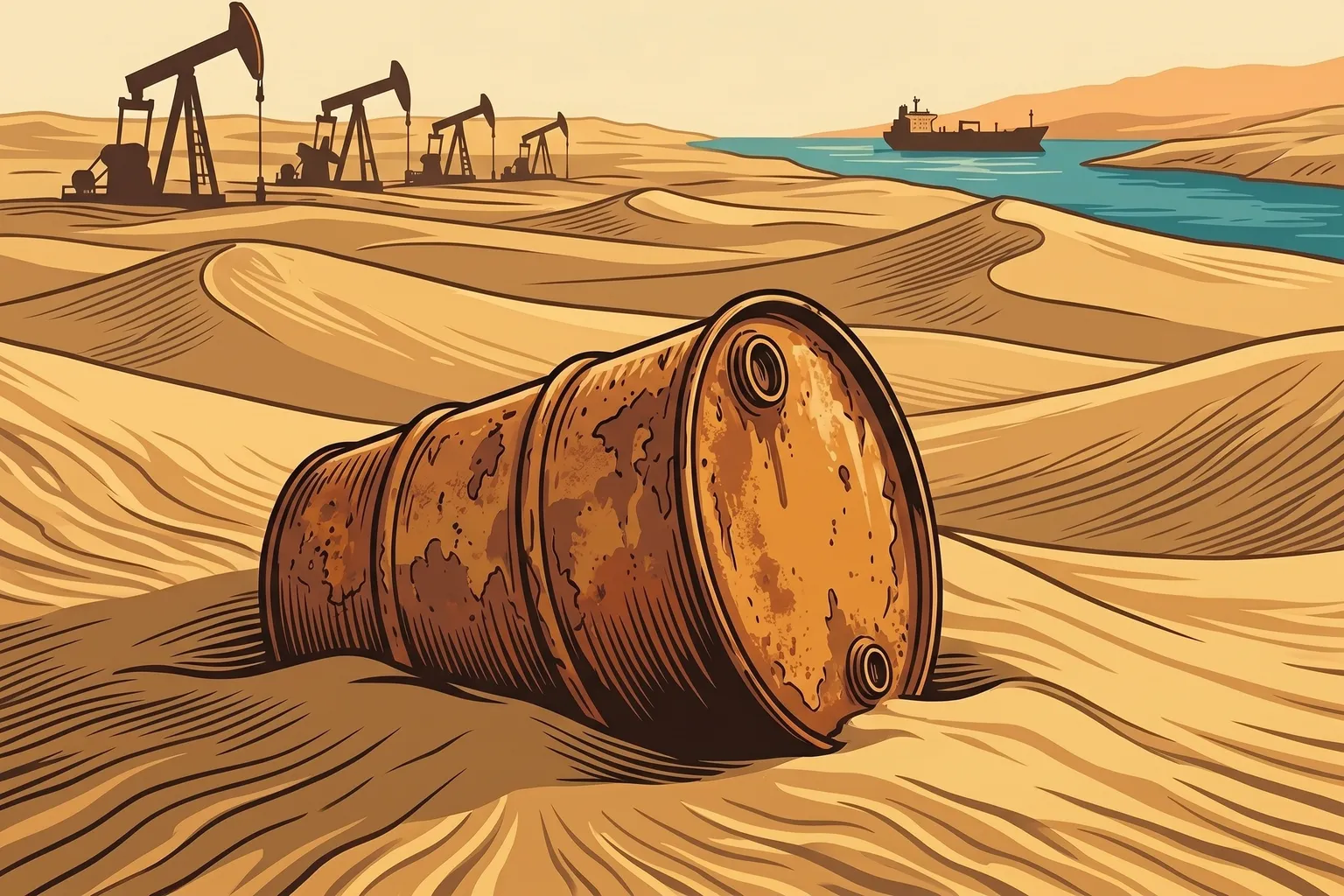
The United Arab Emirates announced Tuesday that it will leave the Organization of the Petroleum Exporting Countries and its wider alliance, OPEC+, effective May 1. The exit ends fifty-nine years of membership for Abu Dhabi, which joined the cartel in 1967, four years before the UAE existed as a nation, NPR reported.
The UAE is OPEC’s third-largest producer, behind Saudi Arabia and Iraq. Energy Minister Suhail Al Mazrouei called the decision “purely a policy move” based on the country’s national interest, The National reported. The UAE wants to expand production capacity to five million barrels per day by 2027, a target that OPEC quotas wouldn’t allow, Bloomberg reported.
OPEC was founded in Baghdad in September 1960 by five nations: Iran, Iraq, Kuwait, Saudi Arabia, and Venezuela. In October 1973, the organization imposed an oil embargo on the United States and other nations supporting Israel during the Yom Kippur War. Oil prices quadrupled. Americans waited in line at gas stations for the first time in their lives. For a decade after that, OPEC could move global markets with a single production announcement. Qatar left in January 2019. Now the UAE. The organization that once set the price of oil for the world is losing its third-largest producer during a war in the region where it was founded.
President Trump said on social media Tuesday that Iran had “just informed us that they are in a ‘State of Collapse,’” without citing evidence or identifying who conveyed the message, Time reported. He said Iran wants the U.S. naval blockade of the Strait of Hormuz lifted “as soon as possible,” ABC News reported.
The statement came as his administration considers Iran’s latest proposal to reopen the strait while deferring nuclear talks to a later stage. Sources told CBS News the president is unlikely to accept a deal that doesn’t address Iran’s nuclear program up front, CBS News reported.
German Chancellor Friedrich Merz weighed in Monday, telling students in the German town of Marsberg that Iran is “obviously negotiating very skilfully” and that “an entire nation is being humiliated by the Iranian leadership, especially by these so-called Revolutionary Guards,” Al Jazeera reported. The national average price of gasoline is $4.04 per gallon, according to GasBuddy data. The strait has been closed since late February. The war is two months old.
Education Secretary Linda McMahon appeared before the Senate Appropriations subcommittee Tuesday in her first Capitol Hill hearing this year. The administration has proposed a $2.3 billion cut to the Education Department’s fiscal 2027 budget, NPR reported.
Much of the session focused on TRIO, a group of federal programs that serve more than 800,000 low-income and first-generation college students each year on a budget of $1.2 billion. The programs date to 1965. McMahon told the committee that by the program’s own metrics, “TRIO is a failure,” NPR reported. The pushback was bipartisan. Nearly every Democrat on the committee raised the issue, along with Republican Senators Susan Collins of Maine, Mike Rounds of South Dakota, and John Boozman of Arkansas.
TRIO was created during President Lyndon Johnson’s War on Poverty. Its premise was straightforward: getting to college shouldn’t depend on whether your parents went. Sixty-one years later, the question of what the program should do is back on a committee calendar.
In southwestern Colombia, the death toll from Saturday’s bombing on the Pan-American Highway in the municipality of Cajibio has risen to twenty-one, Al Jazeera reported. Dissident members of the former FARC guerrillas are suspected. Their leader, known as Ivan Mordisco, refused to join the 2016 peace deal with the Colombian government.
Rebel groups have staged twenty-six attacks with explosives and drones since Friday, NPR reported. Colombia holds its presidential election in May. The 2016 agreement ended fifty-two years of armed conflict and earned President Juan Manuel Santos the Nobel Peace Prize. Not all fighters accepted the terms.
The war in Ukraine entered its 1,526th day on Wednesday. Ukrainian forces recorded 189 combat engagements in the past twenty-four hours, Euromaidan Press reported. Russia’s total personnel losses since February 24, 2022, have reached approximately 1,328,820, including 1,180 in the past day, according to the Ukrainian General Staff.
Drones operated by Ukraine’s Special Operations Forces struck a storage base for Iskander missile systems in occupied Crimea overnight, Euromaidan Press reported. Separately, Ukrainian intelligence revealed that Russia is preparing to recruit at least 18,500 foreign fighters into its armed forces this year, the Kyiv Independent reported.
And at Great Ormond Street Hospital in London, a six-year-old girl named Saffie Sandford can see her parents’ faces in the dark.
Saffie was born with Leber’s congenital amaurosis, a rare genetic condition caused by a fault in the RPE65 gene that prevents cells in the eye from making a protein needed for vision. Children with the condition have almost no sight in low light and limited vision in daylight. She received a gene therapy called Luxturna in her first eye in April 2025 and in her second eye in September 2025, University College London reported.
Researchers at UCL and Great Ormond Street published results in JAMA Ophthalmology showing that treating younger children with the therapy can improve sight and strengthen visual pathways during a critical window of brain development. The study followed fifteen children treated at the hospital between 2020 and 2023, Great Ormond Street Hospital reported.
Her family called the results “life-changing,” ITV News reported. It is Wednesday. An oil cartel lost its third-largest producer. A strait that carries a fifth of the world’s oil is still closed. And in London, a girl who was born without sight can see. That’s the day.