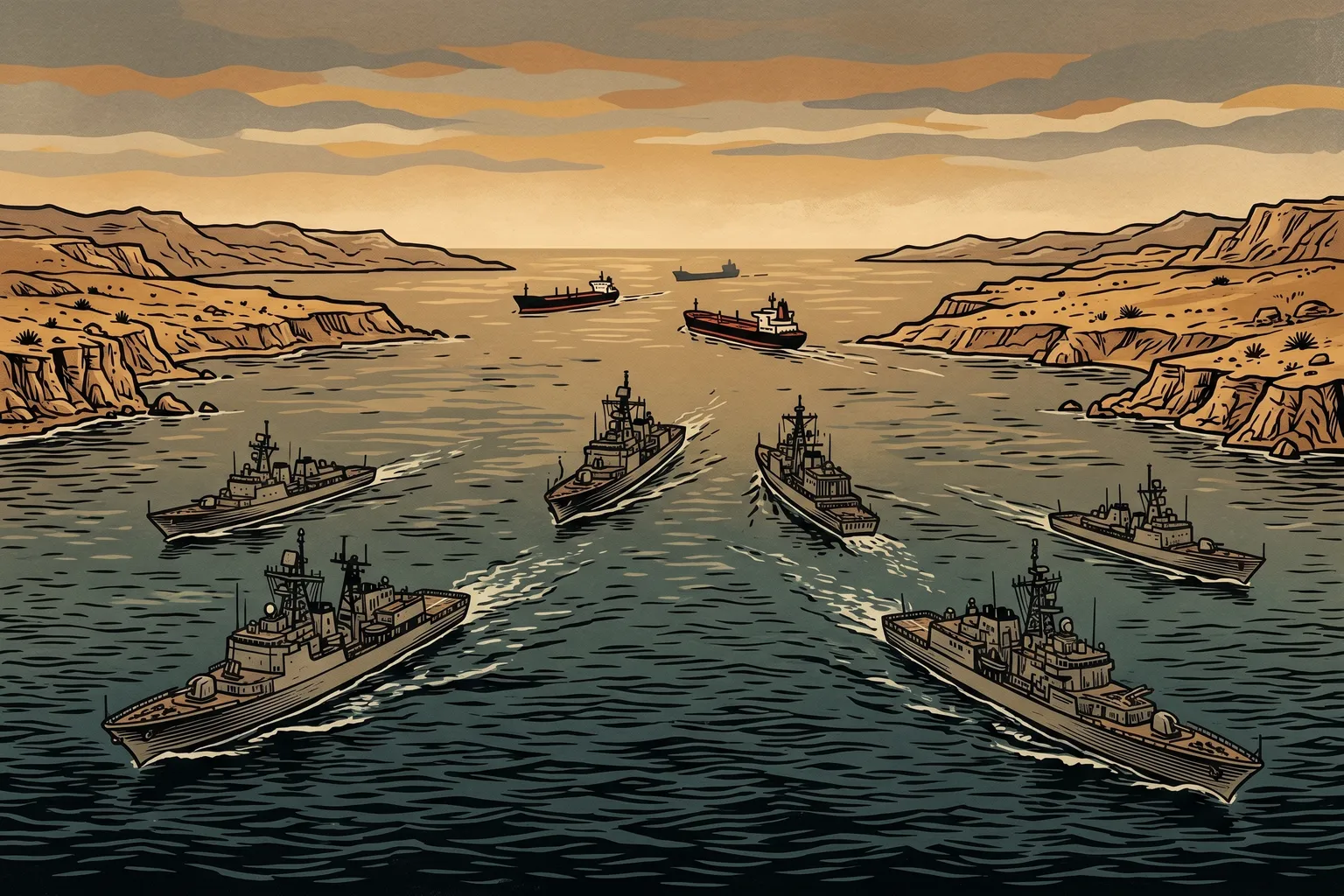
The United States Navy is blockading Iranian ports. The operation began at 10 a.m. Eastern on April 13, one day after peace talks in Islamabad collapsed without a deal. More than 10,000 American service members and twelve warships are enforcing the blockade, which applies to all vessels entering or departing Iranian ports on the Persian Gulf and Gulf of Oman, NBC News reported. In the first twenty-four hours, no ships made it through. Six merchant vessels turned around.
President Trump announced the blockade after 21 hours of talks between American and Iranian delegations produced no agreement. The sticking points are the same ones that have defined this conflict since March: Iran’s nuclear program and the Strait of Hormuz. The United States proposed a twenty-year suspension of all Iranian nuclear activity. Iran countered with five years. Neither side moved, according to Al Jazeera. Vice President Vance led the American delegation of three hundred. Iran sent seventy-one officials led by parliamentary speaker Mohammad Bagher Ghalibaf.
But both sides are going back. On April 14, the White House confirmed that American and Iranian teams were returning to Islamabad for a second round of talks, CNBC reported. The two-week ceasefire expires tomorrow, April 21. Mediators have discussed a forty-five-day extension, according to Axios. President Trump said “something could be happening” over the next two days, CNN reported.
The last time the United States Navy conducted a major sustained operation against Iran in the Persian Gulf was Operation Earnest Will, which ran from July 1987 to September 1988. That operation escorted Kuwaiti tankers through the Strait of Hormuz during the Iran-Iraq War. More than thirty warships patrolled the region over fourteen months. Iran used mines and small boats to harass convoys. The operation ended when Iran accepted a UN ceasefire. Thirty-nine years later, American warships are in the same waters, enforcing a different kind of pressure on the same country, over some of the same questions. The Strait of Hormuz hasn’t moved.
In Hungary, sixteen years of Viktor Orban’s rule ended on April 12 with a sentence he delivered himself: “The election result is painful for us, but clear.”
Peter Magyar’s center-right Tisza party won 138 of 199 parliamentary seats on 53.6 percent of the vote. Orban’s Fidesz party took 55 seats with 37.8 percent. Turnout was 77 percent, the highest in Hungary’s post-Communist history, NPR reported. Magyar, who built his campaign on anti-corruption and a return to European norms, won a two-thirds supermajority that gives him the constitutional authority Orban spent a decade and a half accumulating.
The implications extend well beyond Budapest. Orban had blocked a 90 billion euro EU loan to Ukraine. Magyar said he won’t stand in the way of it, Bloomberg reported. Orban had been the EU’s most reliable obstacle to unified foreign policy. His departure removes that obstacle. It also removes the last European leader whom both Donald Trump and Vladimir Putin could count as an ally. The Council on Foreign Relations called it a door opening for Europe and closing for Russia, according to CFR. Whether Magyar governs differently than he campaigned remains the question that all two-thirds majorities eventually answer.
The story that deserves more attention than it’s getting: a forty-eight-year-old surveillance law expires today.
Section 702 of the Foreign Intelligence Surveillance Act allows the U.S. government to collect digital communications of foreign nationals located outside the country without individual warrants. Congress last reauthorized it on April 20, 2024, for two years. That extension runs out today, according to the Brookings Institution. The House is scheduled to vote this week on an eighteen-month extension. It isn’t clear whether Republican leadership can deliver the votes, CNN reported.
The law exists because of what happened in 1975. That year, the Senate formed the Church Committee to investigate intelligence abuses by the CIA, FBI, and NSA, including surveillance of Martin Luther King Jr. and the monitoring of American citizens’ political activities. Congress responded by passing the Foreign Intelligence Surveillance Act, signed by President Carter on October 25, 1978. It created the secret FISA Court and established rules for when and how the government could conduct surveillance. Section 702, added in 2008, expanded those authorities for foreign intelligence collection. The debate hasn’t changed much since 1978. Supporters say the tool is essential, particularly during active military operations like the one in the Persian Gulf right now. Critics, from both parties, say the safeguards meant to protect American citizens from warrantless surveillance have eroded, NPR reported. A surveillance law born from revelations of government overreach is expiring while American forces are blockading a foreign country’s ports. The timing is the kind of thing that writes itself, except nobody seems to be writing it.
In Spain, applications for the largest migrant amnesty in the country’s recent history open today.
Prime Minister Pedro Sanchez’s government finalized a decree on April 14 that allows undocumented immigrants who arrived before January 1 and can prove at least five months of residency to apply for a one-year work and residency permit. The government estimates half a million people are eligible. Analysts say the actual number is likely higher, ABC News reported. Sanchez called it “an act of justice and a necessity” and bypassed parliament, where a previous amnesty attempt had stalled, by using an executive decree that amends existing immigration law, according to Al Jazeera. The EU Commission had already raised concerns about the measure in February. The application window closes June 30.
The International Monetary Fund released its April World Economic Outlook on April 14 and cut global growth projections for 2026 to 3.1 percent, down from 3.4 percent in 2025. Global inflation is now forecast at 4.4 percent, up 0.6 percentage points from the January estimate, according to the IMF. The revisions are driven largely by the disruption in the Strait of Hormuz and the broader economic effects of the Iran conflict.
The regional numbers tell the sharper story. The IMF cut its forecast for the Middle East and Central Asia by two full percentage points, to 1.9 percent. Iran’s economy is now projected to contract by 6.1 percent, a downward revision of 7.2 points. Saudi Arabia’s growth forecast fell from 4.5 to 3.1 percent. The U.S. forecast was shaved to 2.3 percent. The eurozone dropped to 1.1 percent, Al Jazeera reported. Under the IMF’s severe scenario, in which the conflict persists and deepens, global growth falls an additional 1.3 percentage points. The reference forecast assumes the war is short-lived. That assumption will be tested this week.
And this. Fewer Americans are dying from drug overdoses than at any point in years, and the decline is unlike anything researchers have seen before.
As of October 2025, roughly 71,542 people died from overdoses in the United States over a twelve-month period, according to provisional data from the Centers for Disease Control and Prevention. At the peak, in August 2023, the twelve-month total was nearly 113,000, NPR reported. That is a decline of more than 41,000 deaths per year. It is the longest consecutive period of decline ever recorded.
Researchers at Northwestern University called the progress “unprecedented and historic” in a recent paper in the American Journal of Public Health. The primary driver appears to be a drop in fentanyl potency, likely the result of crackdowns on precursor chemical trafficking, according to STAT News. Deaths from opioids fell so sharply that for the first time in decades, stimulants like cocaine and methamphetamine now kill more Americans than opioids do. New synthetic compounds are appearing on the street and could reverse the trend. Researchers are watching. But right now, today, 41,000 people per year who would have died two years ago are not dying. The number is real. It doesn’t solve the crisis. It does mean the ground moved in the right direction, by a distance nobody predicted.
That’s the day.