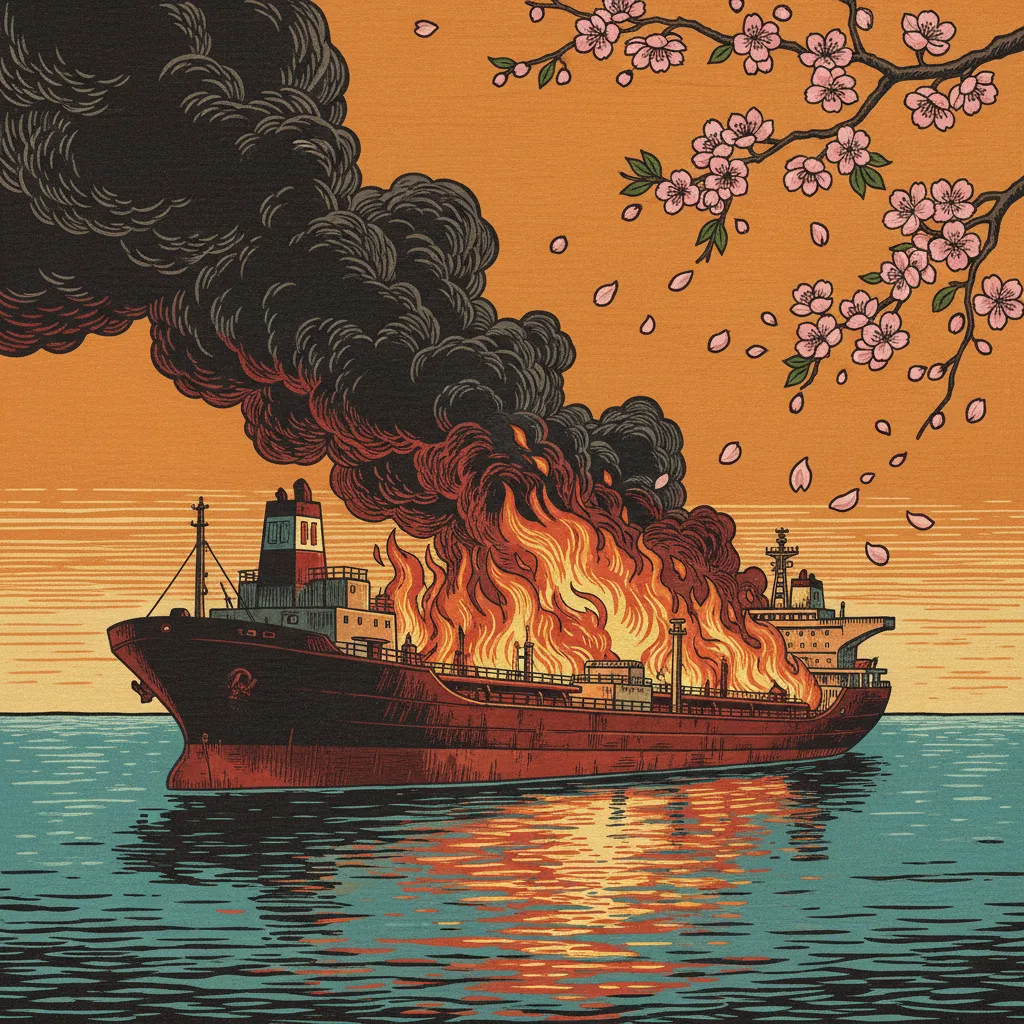
Iran attacked and set fire to a Kuwaiti oil tanker off the coast of Dubai overnight, expanding the war into the shipping lanes of Gulf states that have tried to stay out of the fight, NPR reported. The UAE Ministry of Defense said it was defending against missiles and drones fired by Iran. Saudi Arabia also reported drone attacks overnight. Dubai officials said the blaze was extinguished “with no oil spill occurring or any injuries recorded.”
Iran’s foreign minister said the strikes targeted American positions, not “brotherly” countries, according to NPR. The distinction didn’t hold. Kuwait, the UAE, and Saudi Arabia aren’t parties to this war, but they are now absorbing its consequences. Iran has partially reopened the Strait of Hormuz to some commercial traffic, but the gesture comes after five weeks of disruption to one of the most important shipping corridors on earth.
President Trump said Monday the United States may try to seize Iran’s Kharg Island oil terminal or “blow it up,” and threatened to destroy Iranian electric plants, oil wells, and “possibly all desalinization plants” if Tehran didn’t fully reopen the strait, NPR reported. White House press secretary Karoline Leavitt said Trump still wants a negotiated deal before an April 6 deadline, saying “what Tehran says publicly differs from what it tells U.S. officials in private.” U.S. Central Command said Admiral Brad Cooper met with Israeli military leaders and “discussed progress made during ongoing operations to eliminate Iran’s ability to project power in meaningful ways outside its borders.”
Spain closed its airspace to American military planes involved in the Iran war, and at least 15 in-flight refueling aircraft left two jointly operated bases in southern Spain, according to NPR. Secretary of State Marco Rubio told Al Jazeera, “We have countries like Spain, a NATO member that we are pledged to defend, denying us the use of their airspace and bragging about it.” Trump said he would cut off all trade with Spain if the government didn’t reverse course. The Dalai Lama, in a statement, said, “History has shown us time and again that violence only begets more violence and is never a lasting foundation for peace,” NPR reported.
In 1987, during what became known as the Tanker War, Iran and Iraq attacked commercial shipping in the Persian Gulf for months. The United States launched Operation Earnest Will, escorting reflagged Kuwaiti tankers through the strait. Thirty-nine years later, Kuwaiti tankers are burning again, and the question is the same one it was then: how far the damage spreads before someone finds a way to stop it.
The national average price for a gallon of regular gasoline hit $4 on Tuesday, the New York Times reported. USA Today reported the all-time record could be broken this week if the trend continues, USA Today reported. Gas last crossed $4 in the spring of 2022, after Russia’s invasion of Ukraine disrupted global oil markets, and peaked at $5.02 that June. This time the cause is the war in Iran. Brent crude remains above $115 a barrel, up more than 50 percent since the conflict began in late February.
Fresh food distributors have begun adding fuel surcharges to deliveries, the Times also reported. Diesel, which powers the trucks that move most of America’s food supply, has risen faster than gasoline. The surcharges will show up in grocery prices within weeks.
In 2008, when gas hit its previous inflation-adjusted record, food prices rose 5.5 percent in a single year, according to the Bureau of Labor Statistics. The mechanism hasn’t changed. Oil gets expensive, then everything that moves by truck gets expensive, and that means almost everything. Americans spent the first two months of this year debating tariffs and trade policy as potential drivers of inflation. The war rearranged that conversation in five weeks. The pump price is the one voters notice first, and $4 is the number that makes them notice.
Russia is attempting to disconnect its population from the global internet, the New York Times reported. The effort, which has intensified over recent weeks, involves blocking virtual private networks, restricting access to foreign platforms, and enforcing a national intranet that routes traffic through state-controlled servers. Moscow and St. Petersburg have experienced repeated blackouts. Russians describe their phones becoming useless, Al Jazeera reported. NBC News reported growing signs of public discontent over the restrictions, NBC News reported.
Russia has been building toward this for years. The Kremlin passed its “sovereign internet” law in 2019, creating the legal and technical infrastructure to isolate Russian internet traffic from the global network. The law was tested sporadically. What’s happening now isn’t a test. The war in Ukraine, which began in 2022, accelerated the government’s desire to control the information environment, and the current crackdown represents the most extensive effort yet to make that control total.
Iran, which is fighting its own war and dealing with its own internet shutdown now in its 32nd day, offers a parallel. NetBlocks, the global internet monitor, reported that “extended digital isolation is bringing new challenges for Iranians, from expired domains and accounts to unpatched servers on a degrading national intranet,” according to NPR. Iran arrested 46 people for selling Starlink internet connections, NPR reported. Two countries, two wars, two governments reaching for the same tool: if you can’t control what people know, cut the wire.
In the 1950s and 1960s, the Soviet Union spent enormous resources jamming Voice of America and Radio Free Europe broadcasts. The signals got through anyway. The technology has changed. The impulse hasn’t.
Democrats flipped two state legislative seats in Florida special elections, including a state senate seat in Hillsborough County won by Brian Nathan, an electrician, the New York Times reported. Democrats also won a seat in the district that includes Mar-a-Lago, President Trump’s residence, the Florida Phoenix reported. Both districts had been held by Republicans.
Special elections are small, and reading national trends into them is a habit that overpromises and underdelivers. But the pattern matters. Florida has been trending Republican for years. Trump carried the state twice. Republicans control both chambers of the legislature and every statewide office. Flipping two seats in a single night, one of them in the president’s home district, is the kind of result that gets noticed even by people who don’t normally pay attention to state legislative races.
In 2017, Democrats won a series of special elections in traditionally Republican districts across the country. Analysts debated what the results meant. Then came the 2018 midterms, and Democrats gained 40 House seats. Special elections don’t predict the future. They do suggest which direction the energy is moving, and in Florida this week, it moved left.
The Equal Employment Opportunity Commission, the agency Congress created through the Civil Rights Act of 1964 to protect workers from discrimination, is directing significant resources toward cases involving discrimination against white men, NPR reported. Chair Andrea Lucas, appointed by President Trump, posted a video on X asking, “Are you a white male who’s experienced discrimination at work based on your race or sex? You may have a claim to recover money under federal civil rights laws. Contact the EEOC as soon as possible.” The video received more than six million views and was shared by Vice President Vance.
Lucas sent a letter in late February to Fortune 500 leaders warning that diversity, equity, and inclusion policies may be illegal. She told NPR, “We are the Equal Employment Opportunity Commission, not the Equitable Employment Outcomes Commission,” NPR reported. The agency sued Coca-Cola Beverages Northeast over an off-site networking event for female employees, though women make up about 15 percent of that company’s workforce. It obtained a $500,000 settlement from a Planned Parenthood affiliate over charges of harassment of white employees. Lucas told NPR, “The answer to the old boys’ club is not a new girls’ club.”
Former EEOC Chair Charlotte Burrows, whom Trump fired before her term expired, called the shift “a real radical effort to advance one ideological perspective,” NPR reported. The commission had more than 3,000 employees at its peak in the early 1980s. It now has about 1,740, with hundreds departing since January 2025. The EEOC was created specifically because Congress recognized that discrimination in employment was systemic and that workers who experienced it needed a federal agency to enforce their rights. What constitutes discrimination, and against whom, is now the contested question.
A DACA recipient who was deported has returned to the United States after a federal judge found she was unlawfully removed, the Washington Post reported. Maria de Jesus Estrada Juarez is among a growing number of immigrants who arrived as children, received protection under the Obama-era Deferred Action for Childhood Arrivals program, and have now been targeted for removal. The program, created by executive action in 2012, has protected approximately 580,000 people who were brought to the country as minors and met requirements including continuous residence and no serious criminal record. Courts have consistently ruled that DACA recipients cannot be deported while their protections are active. The judge found that’s what happened here.
DACA has been legally contested since the day it was created. The Supreme Court blocked the Trump administration’s first attempt to rescind it in 2020, ruling that the process was arbitrary and capricious, not that the program itself was constitutionally required. The program sits on executive authority, which means it can be strengthened or weakened by whoever holds the office. Estrada Juarez’s case is about something narrower: whether the government followed its own rules. The judge said it didn’t.
And in Tokyo, the cherry blossoms are blooming.
They bloom every spring, of course. That’s what cherry trees do. But the timing varies, and in Japan, where the bloom is a national event tracked with the attention Americans give to election night returns, the question of exactly when the first petals open isn’t trivial. This year, the Japanese Meteorological Agency issued its forecast alongside a new tool: an artificial intelligence model trained on decades of bloom data, temperature records, and satellite imagery that can predict the peak with increasing accuracy, the New York Times reported.
The blossoms opened five days ahead of their historical average this year, according to the Times. Climate change is shifting the calendar. In Kyoto, records of cherry blossom timing go back more than a thousand years, maintained by monks and court officials who considered the bloom a matter of spiritual and civic importance. The earliest bloom in that record occurred in 2021.
The Japanese have a word for the tradition of gathering beneath the blossoms: hanami. It means, roughly, “flower viewing.” Families spread blankets in the parks. Friends share food. Strangers sit near each other and look up. The trees don’t bloom for long, a week, maybe two, and then the petals fall. The Japanese don’t consider this sad. They consider it the point. Beauty that lasts forever isn’t beauty. It’s furniture. The cherry blossom is beautiful because it leaves. That’s the day. The blossoms are out. Go look.