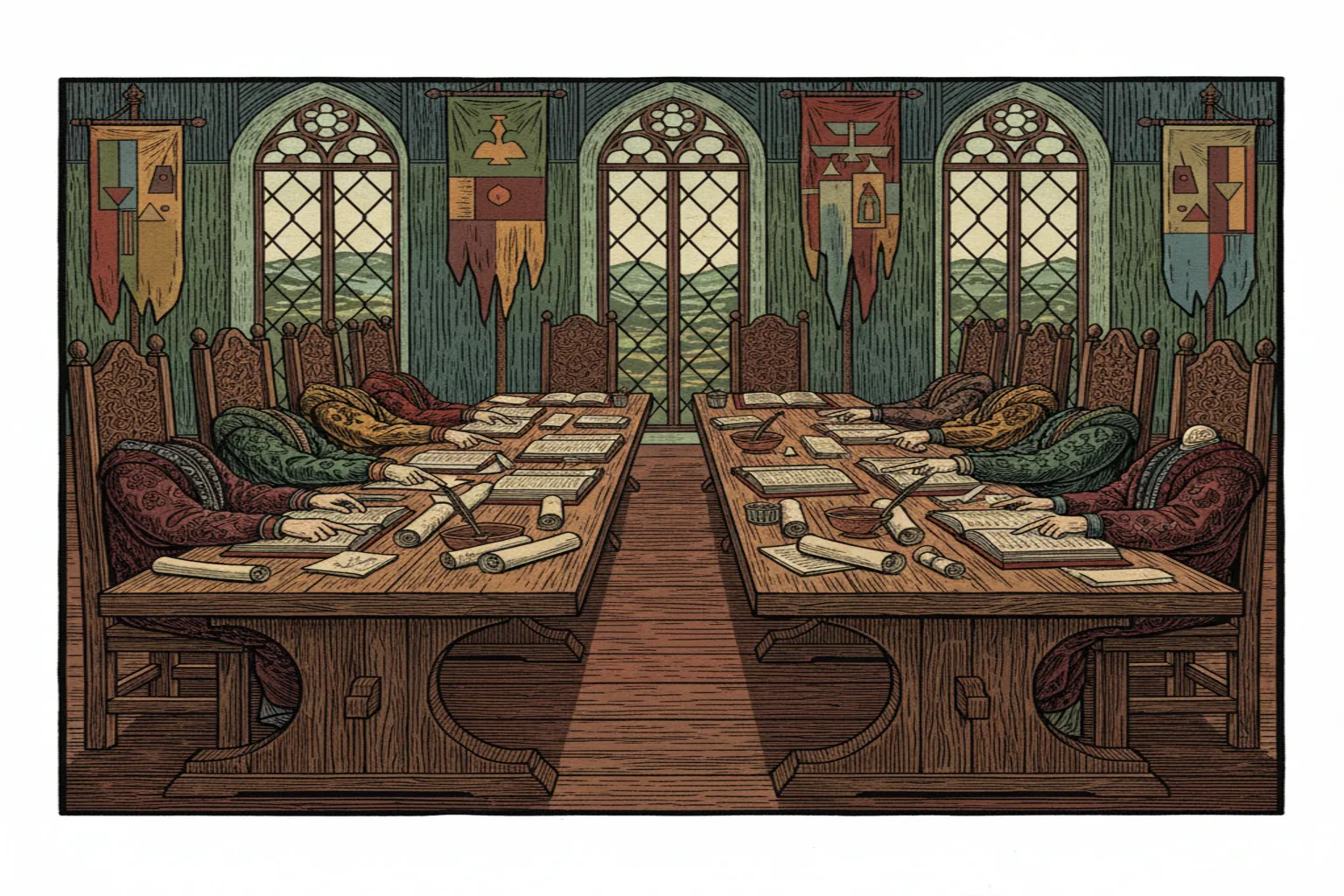
The United States and Iran are talking. In person, in the same room, in Islamabad. It is the first time American and Iranian officials have conducted direct, face-to-face negotiations since the 1979 Islamic Revolution. The talks began on April 11, mediated by Pakistan, and they are now entering their second week, NPR reported. The two-week ceasefire that made them possible expires April 22. Five days from now.
Vice President JD Vance leads the American delegation, joined by special envoy Steve Witkoff and presidential adviser Jared Kushner. The Iranian delegation of seventy-one members is led by parliamentary speaker Mohammad Bagher Ghalibaf and Foreign Minister Abbas Araghchi, according to Al Jazeera. Pakistani Prime Minister Shehbaz Sharif is mediating. A CBS News report from the talks said that no agreements had been made as of the opening session, CBS News reported.
The issues on the table are the ones you’d expect. Iran wants the United States to unfreeze $6 billion in assets, guarantee its nuclear program, and stop Israel’s offensive in Lebanon. The United States wants Iran to permanently reopen the Strait of Hormuz and abandon its nuclear weapons capability. President Trump said Friday that preventing Iran from obtaining nuclear weapons is the main objective, CNBC reported.
Forty-five years ago, the last time American and Iranian negotiators produced a binding agreement, they did it through intermediaries. The Algiers Accords of January 19, 1981, ended the 444-day hostage crisis. Algeria brokered the deal. The two governments never spoke directly. It took fourteen months. The Islamabad negotiators have five days before the ceasefire clock runs out and the option of a forty-five-day extension that mediators discussed before the talks began, according to Axios. In 1981, the agreement came together in the final hours. Whether 2026 follows that pattern or breaks it is the question the next five days will answer.
The ceasefire between the United States and Iran doesn’t cover Lebanon. Both President Trump and Israeli Prime Minister Benjamin Netanyahu have said so explicitly, according to CNN. The result is that while diplomats negotiate in Islamabad, the war in Lebanon continues.
Since March 2, when Israel began its current military operation against Hezbollah, more than 1.2 million people in Lebanon have been forced from their homes, the UNHCR reported. That is roughly one-fifth of the country’s population. More than 136,000 displaced people are sheltering in 660 collective sites, most of them schools filled far beyond capacity, according to UNHCR. The Lebanese Ministry of Public Health reported that attacks have killed more than 1,497 people and injured more than 4,639, Al Jazeera reported.
Israel occupied southern Lebanon from 1982 to 2000. Eighteen years. The stated objective then was to push the Palestine Liberation Organization away from the border. The stated objective now is to push Hezbollah north of the Litani River. The geography hasn’t changed. The river is in the same place. The question of what happens after the military operation, the question that defined those eighteen years, hasn’t been answered yet either.
The story that deserves a longer look this week: the American labor market is changing shape, and the change is structural.
Of the 369,000 jobs the Labor Department says were created since the start of President Trump’s second term, 348,000 of them went to women. Twenty-one thousand went to men. That is nearly seventeen times as many jobs filled by women as by men, NPR reported. The ratio isn’t a statistical quirk. It’s a reflection of which sectors are growing and who works in them.
Health care alone added 390,000 jobs over the past twelve months, more than the total net job creation in the economy, according to NPR. Women hold nearly eighty percent of health care jobs. Manufacturing, construction, and other sectors where men are the majority have been contracting or flat. The result is a labor market that is creating work, but creating it in one direction. Women now hold more nonfarm jobs than men. It isn’t the first time. The same thing happened briefly during the Great Recession and again just before COVID. But those were temporary crossings caused by male-dominated sectors collapsing. This one is different. It’s driven by one sector expanding faster than everything else.
In the mid-1970s, women held about forty percent of American jobs. By the early 2000s, they held just under half, and the number has hovered there for two decades. What changed isn’t the percentage. It’s the reason for it.
Twenty-three states are suing the federal government over the executive order President Trump signed on March 31 restricting mail-in voting. The coalition, led by Pennsylvania Governor Josh Shapiro and including the attorneys general of California, Massachusetts, Nevada, and Washington, filed suit on April 3 in federal court in Massachusetts, Votebeat reported.
The order, titled “Ensuring Citizenship Verification and Integrity in Federal Elections,” directs the Department of Homeland Security to create lists of eligible citizens in each state and instructs the U.S. Postal Service to deliver mail ballots only to voters on those lists, according to NPR. The states argue the order violates the Constitution by usurping state authority over election administration. Election law experts have said the timeline makes implementation before November’s midterms virtually impossible even without a court order blocking it, NPR reported.
Absentee voting by mail has existed in the United States since the Civil War. Union soldiers cast ballots from the field in 1864. The practice expanded steadily for 160 years. The legal question in 2026 isn’t whether mail-in voting works. It’s whether a president can direct the Postal Service not to deliver it.
Yellowstone National Park opened its North and West entrances at eight o’clock this morning, beginning the annual spring season. Visitors can access Mammoth Hot Springs, Lamar Valley, Norris Geyser Basin, the Grand Canyon of the Yellowstone, and Old Faithful from both entrances, weather permitting, according to the National Park Service. Additional roads will open throughout May. The park was established in 1872. It opens every spring.
And this. The world’s oceans passed a threshold this month.
The International Union for Conservation of Nature announced on April 1 that 10.01 percent of the global ocean is now officially designated within protected or conserved areas, according to the IUCN. It took six years longer than originally planned. The target was 2020.
The milestone was reached after Indonesia and Thailand added 284 new marine and coastal protected areas to the World Database on Protected and Conserved Areas. In the past two years alone, the world has protected about five million square kilometers of ocean, an area larger than the European Union, the IUCN reported. The next target is thirty percent by 2030. To get there, an area roughly the size of the Indian Ocean still needs protection. The UN High Seas Treaty, the first international agreement focused on protecting marine biodiversity in international waters, entered into force in January of this year.
Ten percent doesn’t sound like much. It’s the first ten percent. The treaty is new. The database is growing. Two countries added 284 protected areas, and the number crossed a line that six years ago seemed out of reach. That’s the day.