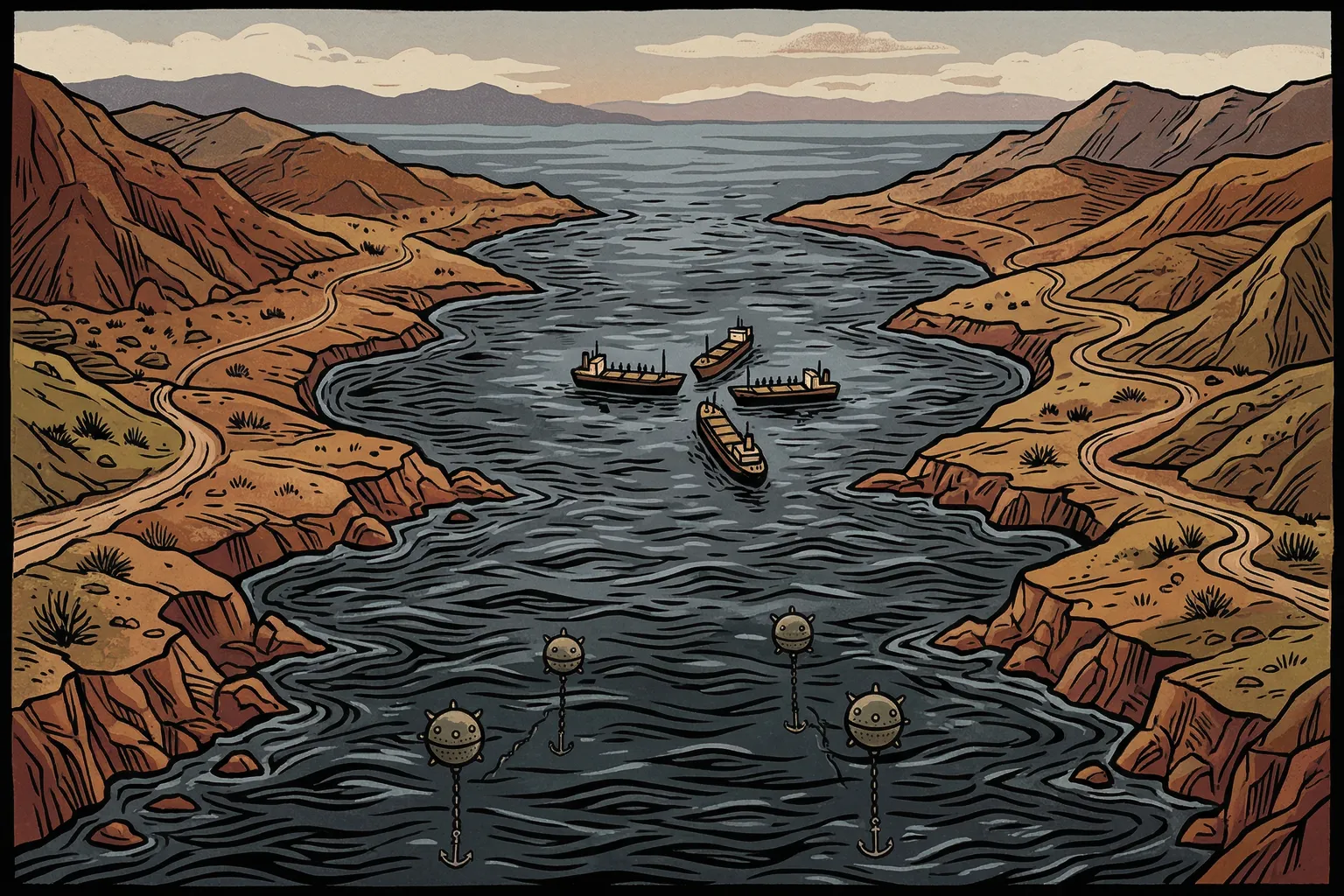
Iran mined the Strait of Hormuz in March. By April, according to U.S. officials cited by the New York Times, Iran had lost track of where it put them.
The ceasefire between the United States and Iran, now eight days old, requires the “complete, immediate and safe opening” of the strait, according to Al Jazeera. That was the condition President Trump set before negotiations could proceed. Iran agreed to it. The problem is that Iran may not be able to deliver. U.S. officials told the Times that Iran deployed the mines using small boats and decentralized forces, without a clear command chain and without systematic records of where the mines were placed, the Jerusalem Post reported. Some mines have drifted from their original positions. Neither the United States nor Iran currently has minesweeping equipment stationed in the strait to remove them.
The strait carries roughly twenty percent of the world’s oil and liquefied natural gas. Ship traffic through the waterway has dropped to a fraction of its normal volume, with as few as six or seven vessels passing through in a twenty-four-hour period compared with roughly one hundred forty under normal conditions, Al Jazeera reported. The ceasefire expires April 22. Six days from now.
Thirty-eight years ago this week, on April 14, 1988, the guided-missile frigate USS Samuel B. Roberts struck an Iranian mine in the central Persian Gulf. The blast blew a fifteen-foot hole in the hull and broke the ship’s keel. The crew fought fire and flooding for five hours and saved the vessel. When Navy divers recovered unexploded mines nearby, the serial numbers matched those seized from an Iranian minelayer the previous September. Four days later, the United States retaliated with Operation Praying Mantis, the largest American naval engagement since World War II. In 1988, Iran mined the Gulf deliberately, and the United States proved it with serial numbers. In 2026, Iran mined it again. This time, even Iran can’t find what it put there.
The war arrived at the cash register last week. The Bureau of Labor Statistics reported that consumer prices rose 0.9 percent in March and 3.3 percent from a year earlier, the highest annual rate since May 2024, CBS News reported. Gasoline prices jumped 21.2 percent in a single month, the largest monthly increase in the gasoline index since the Bureau began publishing it. The national average stood at $4.15 per gallon. Diesel averaged $5.68.
The headline number and the core number tell different stories. Excluding food and energy, prices rose just 0.2 percent for the month and 2.6 percent from a year ago, both below economists’ forecasts. The underlying economy isn’t overheating. The energy shock from the strait closure is doing the work. “This is only the beginning,” said Heather Long, chief economist at Navy Federal Credit Union. “Food prices, travel and shipping costs are all going up in April,” CBS News reported.
The Energy Information Administration projects gasoline will peak near $4.30 per gallon this month, according to the EIA. In 1973, the Arab oil embargo quadrupled crude prices in five months. In 1979, the Iranian Revolution doubled them again. The mechanism in 2026 isn’t an embargo or a revolution. It’s a waterway that nobody can safely navigate.
Department of Homeland Security employees began receiving back pay this week for work performed during the longest partial government shutdown in American history, Federal News Network reported. The shutdown began February 14. As of today, it is in its sixty-first day. The previous record was the thirty-five-day partial shutdown that ended January 25, 2019, when Congress and the White House disagreed over border wall funding. This one has lasted nearly twice as long. President Trump said he would sign an order directing payment for all DHS personnel despite the continuing lapse in appropriations, according to NBC News.
The House and Senate each passed their own DHS funding bills before the spring recess, but they haven’t agreed on the same one. The dispute centers on whether to fund Immigration and Customs Enforcement and Customs and Border Protection in the same bill or through a separate reconciliation process, NPR reported. Both chambers returned to Washington on Monday. The employees are getting paid. The department is still unfunded.
The story that deserves closer reading: the Board of Immigration Appeals issued a final order of removal against Mahmoud Khalil last week, NBC News reported. Khalil is a thirty-one-year-old legal permanent resident, a former Columbia University graduate student, and one of the most visible figures targeted by the Trump administration for deportation over pro-Palestinian campus protests.
Khalil was born in Syria to a Palestinian family and holds Algerian citizenship through a distant relative. He has said he could face danger if deported. “The only thing I am guilty of is speaking out against the genocide in Palestine,” Khalil said, according to NBC News. His attorneys called the ruling “largely expected” and said he can’t be lawfully detained or deported while a separate case continues in federal court. They’ve asked a full appeals panel to reconsider an earlier two-to-one decision and have requested one judge recuse himself, citing his prior role investigating campus protesters.
The ruling doesn’t end the case. It moves it to a different court. The legal questions underneath the headlines, whether the government can revoke a permanent resident’s status based on political speech and whether doing so violates due process, haven’t been answered yet. They’ve been escalated.
And this: a machine built by a Formula One racing team may help save the world’s coral reefs.
McLaren Racing and the Great Barrier Reef Foundation completed Machine One, a semi-automated coral-seeding system designed to do what human hands can’t do fast enough. The current restoration process is manual. It takes up to ninety seconds to assemble a single coral seeding device. Machine One does it in ten. Early modeling suggests it can produce up to one hundred thousand devices per week, according to the Great Barrier Reef Foundation. The team named it Oscar, short for Operating System for Coral Assembly and Restoration, and a nod to McLaren’s Australian Formula One driver, Oscar Piastri. It’s being shipped to the National Sea Simulator in Townsville, Australia, for field trials ahead of this year’s coral spawning season.
“We are in a race against time, working at a scale that can feel impossible,” said Anna Marsden, managing director of the foundation. “But this partnership is proving world class engineering can help close that gap,” McLaren Racing reported. The current global rate of coral planting is roughly one hundred thousand per year. Machine One is designed to push that to one million. A racing team and a reef foundation built a machine named Oscar, and they’re sending it to the sea. That’s the day.