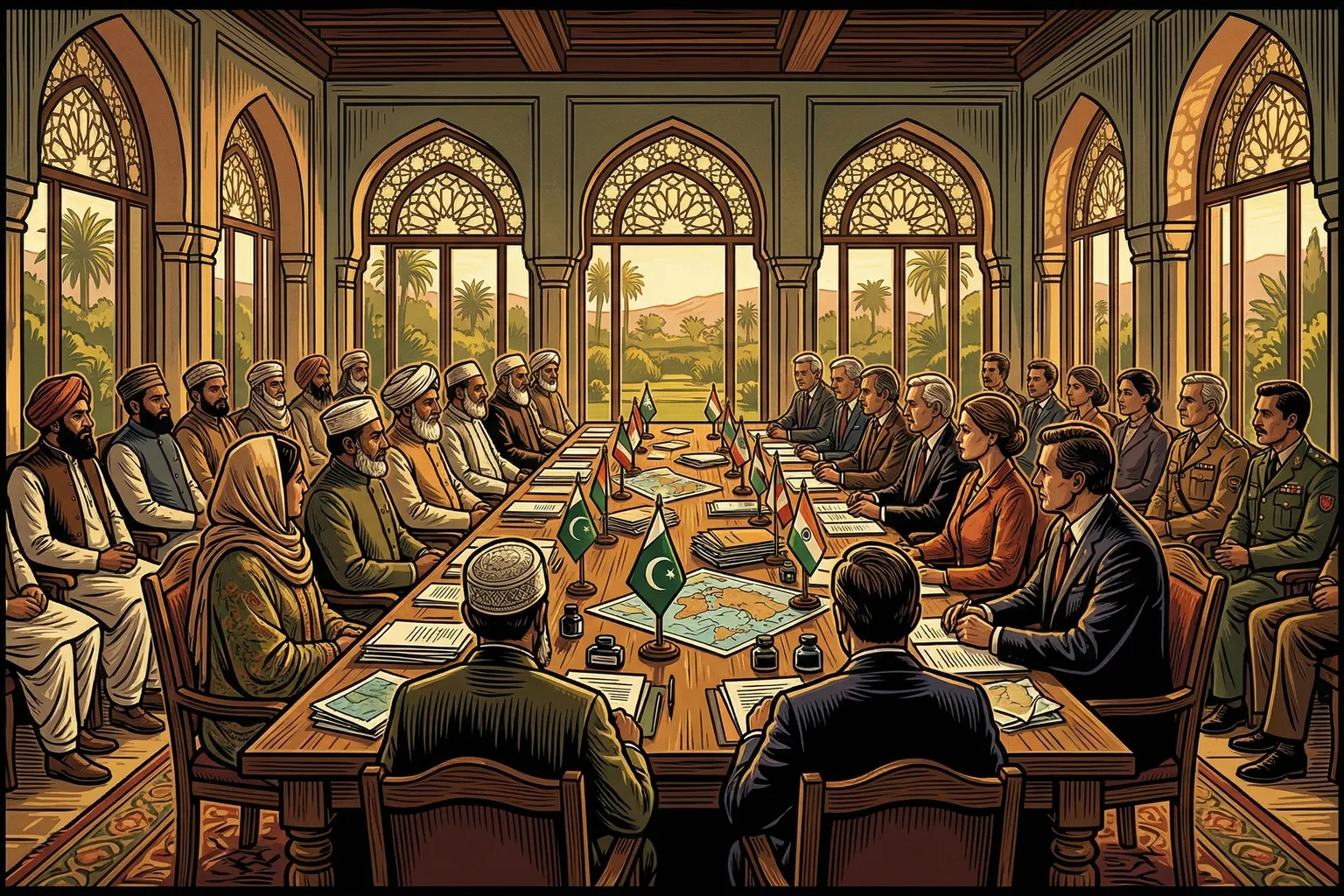
The first round of direct talks between the United States and Iran concluded Saturday in Islamabad, Pakistan, Al Jazeera reported. Vice President JD Vance led the American delegation, joined by special envoy Steve Witkoff and Jared Kushner. Iran sent seventy-one officials led by parliamentary speaker Mohammad Bagher Ghalibaf and Foreign Minister Abbas Araghchi, according to NPR.
Both sides exchanged written texts at the close of the first phase, confirming preliminary areas of agreement. Three issues dominated the table: the Strait of Hormuz, Iran’s stockpile of enriched uranium, and the Israeli offensive against Hezbollah in Lebanon, NPR reported. Iran’s state television said the country’s red lines include sovereignty over the Strait and a ceasefire in Lebanon, the Times of Israel reported.
These were the first direct, face-to-face negotiations between Washington and Tehran since the 1979 Islamic Revolution, according to Al Jazeera. The two-week ceasefire that brought both sides to Islamabad expires April 21. This is day forty-five of the conflict, which began with American and Israeli strikes on February 28. More than 5,600 people have been killed across the region since then, Al Jazeera reported.
In May 1968, the United States and North Vietnam sat down for peace talks in Paris. The Vietnam War had already been escalating for three years. Those talks took nearly five years to produce an agreement. The Paris Peace Accords were signed in January 1973. The war ended in April 1975, two years after that.
NASA’s Artemis II crew splashed down in the Pacific Ocean on Friday evening, ending a ten-day mission that sent four astronauts farther from Earth than any human beings have ever traveled, CBS News reported. The Orion capsule landed roughly forty miles off the coast of San Diego at 5:07 p.m. Pacific time. Mission Control called it “a perfect bullseye splashdown,” according to Space.com.
Commander Reid Wiseman radioed that all four crew members were doing well. The crew included pilot Victor Glover, the first Black astronaut to travel beyond low Earth orbit; mission specialist Christina Koch, the first woman to do so; and Canadian Space Agency astronaut Jeremy Hansen, the first non-American, CBS News reported. During the flyby, the crew set a new human distance record of 252,756 miles from Earth, surpassing Apollo 13’s mark of 248,655 miles, according to Space.com.
The last crewed mission beyond low Earth orbit was Apollo 17 in December 1972. Commander Gene Cernan climbed back into the lunar module and nobody followed for fifty-three years. Artemis II didn’t land on the moon’s surface. It was a flyby, a test of the capsule and the trajectory. But four people went to the moon and came home, and that hadn’t happened since Richard Nixon was president.
The story that deserves closer attention than it’s getting: on April 8, the day after the U.S.-Iran ceasefire was announced, Israel launched its most intensive bombing campaign against Lebanon since the conflict began. Lebanon’s Ministry of Public Health reported at least 254 people killed in a single day of strikes, Al Jazeera reported. The Israeli military called the operation Eternal Darkness and said it struck approximately 100 Hezbollah targets using fifty fighter jets and about 160 munitions, according to NBC News.
The strikes hit central Beirut, the port city of Sidon, the Beqaa Valley, and villages across southern Lebanon. Several struck busy commercial and residential areas during evening hours without prior warning, Al Jazeera reported. Lebanon declared a national day of mourning and called April 8 Black Wednesday. At least fourteen more people were killed in continued strikes the following day, Al Jazeera reported.
Pakistan, which brokered the ceasefire, says Lebanon is covered by the agreement. Israel’s prime minister says it isn’t, according to Al Jazeera. The United States has asked Israel to halt operations in Lebanon to avoid derailing the Islamabad talks, CNN reported. The disagreement over what the ceasefire covers remains unresolved.
The number that will be felt longest from last week: gasoline prices rose 21.2 percent in March, the largest single-month increase since 1967, CNBC reported.
The Bureau of Labor Statistics said Thursday that the consumer price index rose 3.3 percent from a year earlier and 0.9 percent for the month, according to CNBC. Gasoline accounted for nearly three-quarters of the headline increase. The national average at the pump reached $4.15 a gallon on Friday, up nearly 40 percent since the Iran conflict began, CNN reported.
Core inflation, which strips out food and energy, rose 2.6 percent from a year earlier, lower than economists expected, CNBC reported. The headline number and the core number tell different stories. One says prices are surging. The other says the underlying economy hasn’t changed much. The difference is a war that closed a strait, and oil that used to flow through it.
The last time gasoline prices spiked this sharply in a single month was 1967, the year the Six-Day War closed the Suez Canal. That canal stayed shut for eight years.
Peru went to the polls Sunday, with more than twenty-seven million voters choosing among thirty-five presidential candidates, Al Jazeera reported. No candidate was expected to clear 50 percent, meaning a runoff between the top two finishers is likely scheduled for June 7, according to CSIS. Keiko Fujimori, running for president for the fourth time, led pre-election polling with 14.5 percent support, Al Jazeera reported. Her father, Alberto Fujimori, served as president from 1990 to 2000 and was later convicted of human rights abuses.
The winner will be Peru’s ninth president in less than a decade, according to CSIS. The country has cycled through leaders at a pace that would suggest instability in most democracies. Twenty-seven million people voted anyway.
And in Geneva, researchers at the University of Geneva announced a test that detects 90 percent of colorectal cancers from a simple stool sample, ScienceDaily reported. The method uses machine learning to analyze gut bacteria at the subspecies level, a resolution fine enough to catch patterns that broader analyses miss. The study was published in Cell Host & Microbe.
Colonoscopies catch 94 percent of cases. This test comes within four percentage points, without the procedure, without the sedation, without the prep that keeps millions of people from getting screened in the first place. A clinical trial is being organized with Geneva University Hospitals to determine which cancer stages and lesions the test can identify, according to ScienceDaily.
Colorectal cancer is the second leading cause of cancer death in the United States. A test that catches it from a stool sample could change how millions of people are screened. That’s the day.