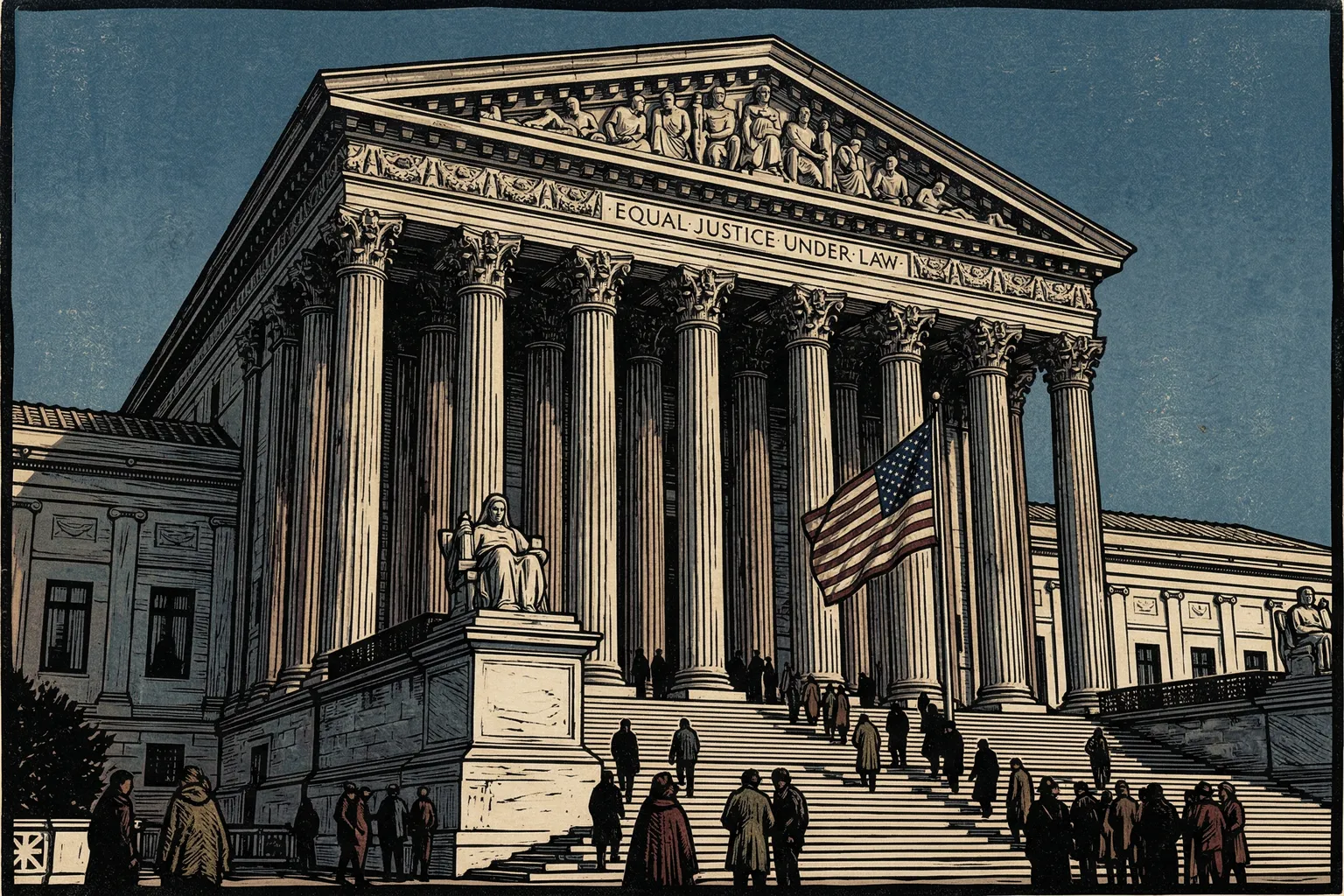
The Supreme Court heard oral arguments Wednesday on whether the 14th Amendment guarantees citizenship to every child born on American soil. It’s the most significant case on the meaning of citizenship since 1898, NPR reported.
President Trump signed an executive order on his first day in office seeking to end automatic citizenship for children born in the United States to parents who are in the country without legal status or on temporary visas. Federal courts in multiple states blocked the order. The administration appealed. The question before the justices is the phrase that begins the 14th Amendment, ratified in 1868 to protect the citizenship of formerly enslaved people: “All persons born or naturalized in the United States, and subject to the jurisdiction thereof, are citizens of the United States.” The Trump administration argues that “subject to the jurisdiction thereof” excludes the children of undocumented immigrants. Opponents, including the American Civil Liberties Union, argue the language means what it has meant for 158 years, the Washington Post reported.
The last time the court ruled directly was United States v. Wong Kim Ark, decided in 1898. Wong was born in San Francisco to Chinese parents who were barred from naturalizing under the Chinese Exclusion Act of 1882. The court ruled 6-2 that he was a citizen by birth. Congress codified birthright citizenship by statute in 1940, according to NPR. The executive order is the first attempt by a president to limit the practice since the amendment was ratified.
Before the executive order, challenges to birthright citizenship were widely regarded as a fringe legal theory. The case has split conservative legal scholars. Some argue the original public meaning of the 14th Amendment supports the president. Others say 128 years of precedent, a Supreme Court ruling, and a federal statute leave no room for reinterpretation, the New York Times reported. The 14th Amendment was written to overrule Dred Scott v. Sandford, the 1857 decision that declared Black people, enslaved or free, could never be citizens. The amendment’s authors chose broad language on purpose. Whether the current court reads it that way is the question that will shape the citizenship of every child born in this country going forward.
Four astronauts launched from Kennedy Space Center on Wednesday aboard NASA’s Artemis II mission, bound for the moon, NPR reported. No human being has traveled beyond low Earth orbit since Apollo 17 returned on December 19, 1972. That was 53 years ago.
The crew includes three Americans and one Canadian, Jeremy Hansen, who becomes the first non-American to fly on a lunar mission. The spacecraft will loop around the far side of the moon and return to Earth without landing, a flight plan that mirrors what Apollo 8 accomplished in December 1968. Artemis III, which would put astronauts on the lunar surface, is scheduled for 2028. “It’s starting to feel real,” one of the crew members said from prelaunch quarantine, the New York Times reported.
In December 1968, Apollo 8 launched during one of the most difficult years in American history. The astronauts orbited the moon on Christmas Eve and read from Genesis. The mission didn’t land. It didn’t need to. It proved the thing could be done. Artemis II is the same kind of proof, 58 years later, built on different hardware and the same premise: that going is worth the cost of going.
Iran’s leadership structure is fracturing under the pressure of five weeks of American and Israeli strikes, with commanders being killed and replaced faster than the government can coordinate its own negotiating positions, the New York Times reported. Officials familiar with the intelligence say Iranian negotiators involved in the Islamabad peace talks may not know what their government is willing to concede, because the people who would make those decisions keep changing.
President Trump told reporters Tuesday that regime change in Iran was “already complete” and that the country’s current leaders were “much more reasonable,” the Times reported. Iran’s power structure, including Supreme Leader Ali Khamenei, appears to remain in control, though communication between military and civilian leadership has been disrupted by the targeting of command infrastructure. Trump’s comments came as Brent crude held above $115 a barrel. The war is now in its fifth week with no ceasefire agreement.
The Department of Homeland Security shutdown entered its 47th day Wednesday with no resolution in sight. Senate Republicans held a brief session Tuesday and made no move to end the impasse, the New York Times reported. Congress is in recess.
Transportation Security Administration officers began receiving their first paychecks in weeks on Monday, after President Trump signed an executive order Friday directing DHS to pay them, the Times reported. Airport wait times, which had stretched to hours at major hubs, appeared to be easing by Tuesday, the Washington Post reported. The executive order didn’t specify whether TSA workers would be paid on a regular schedule going forward. If the shutdown continues without a funding agreement, the lines could return.
In the 1995-96 government shutdown, which lasted 21 days and was at the time the longest in history, federal workers went without pay for three weeks. This one has lasted more than twice that long, and most of DHS remains unfunded. The TSA fix is a workaround, not a solution.
Israel’s Knesset passed a law Tuesday authorizing the death penalty by hanging for Palestinians convicted of deadly attacks against Israelis, the New York Times reported.
Legal experts and rights organizations say the law was drafted so that it would apply almost exclusively to Palestinians and would be unlikely to cover Jewish extremists who commit similar acts of violence, according to the Times. Israel hasn’t executed a prisoner since Adolf Eichmann in 1962. That execution followed a trial that the Israeli government treated as a matter of historical reckoning, not criminal sentencing policy. The new law establishes a different precedent. It applies to a specific category of defendant based on the nature of the conflict, not the nature of the crime.
Thieves broke into the Magnani-Rocca Foundation outside Parma, Italy, early Tuesday and stole paintings by Renoir, Cezanne, and Matisse in approximately three minutes, the New York Times reported. The works are valued at several million euros. Italian police said the thieves broke through a wall, grabbed the paintings, and left before security could respond.
The Magnani-Rocca Foundation is a small museum in a 19th-century villa that houses one of northern Italy’s most significant private collections. Art theft in Italy isn’t rare. In 1969, thieves took a Caravaggio from the Oratory of San Lorenzo in Palermo. It hasn’t been recovered. The question after a theft like this is always the same: whether the paintings surface in a year through an insurance negotiation, or disappear into a private collection and don’t surface at all.
And in a story that isn’t a prank, though the timing might suggest otherwise: Woody Brown is publishing a novel.
Doctors told his parents he would never understand language. Brown has a rare neurological condition that was diagnosed in early childhood. Medical professionals believed he wouldn’t be able to process spoken or written words, the New York Times reported. He proved them wrong at every stage. He learned to read. He went to school. He earned a graduate degree. He wrote a book.
His debut novel is being published this spring. The details of the plot matter less than the fact of it. A man who was told he would never understand a sentence wrote a couple hundred pages of them, and a publisher read them and said yes. That’s the day. The ground is still under your feet.