In the winter of 1945, Roberto Rossellini was making a film about the Nazi occupation of Rome in a city that had only recently stopped being occupied. The bombed buildings in “Rome, Open City” are real bombed buildings. The neighborhood of Pigneto, where much of the film was shot, was a working-class district where people had actually lived under German control. Some of the people in the crowd scenes were not actors. They were the crowd. Rossellini had almost no money, almost no film stock, and no studio behind him. He shot on the streets because the streets were where the story was.
That is the material condition that produced Italian neorealism: not a manifesto, not an aesthetic theory, but a specific set of circumstances that forced filmmakers onto location and in front of real faces. The theory came later, in articles and essays by critics and screenwriters working out what they had been watching. The films came first.
Neorealism is the Italian cinema movement that ran from roughly the mid-1940s through the mid-1950s and changed what filmmakers understood a movie could look like. Its defining characteristics are location shooting instead of studio sets, the use of non-professional actors alongside or instead of professional ones, stories drawn from working-class and poor Italian life, a visual style that favored natural light and a certain documentary roughness, and a commitment to social reality that the Hollywood product of the same period mostly avoided. It emerged from Italy’s wartime and postwar conditions: a film industry that had lost most of its resources, a society that had lived through occupation, poverty, and defeat, and a group of filmmakers who decided that the existing modes of moviemaking could not tell the stories that needed telling.
The films they made from those decisions are worth your time separately and together.
“Rome, Open City” (1945) is the movement’s starting point in most accounts, and it earned that position. Rossellini shot it in pieces, with different film stocks that do not always match, with money he was raising as he went. The result does not look seamless. It looks true. The story follows a partisan priest, a Communist resistance leader, and a group of Romans resisting the Gestapo in the final months of the occupation. The priest is played by Aldo Fabrizi, a comedian Rossellini cast because he had seen him perform. The film’s most remarkable moments involve ordinary people caught in the mechanism of history, and they land the way they do partly because of the real street under their feet and the real neighborhood behind them. You can feel the weight of the place.
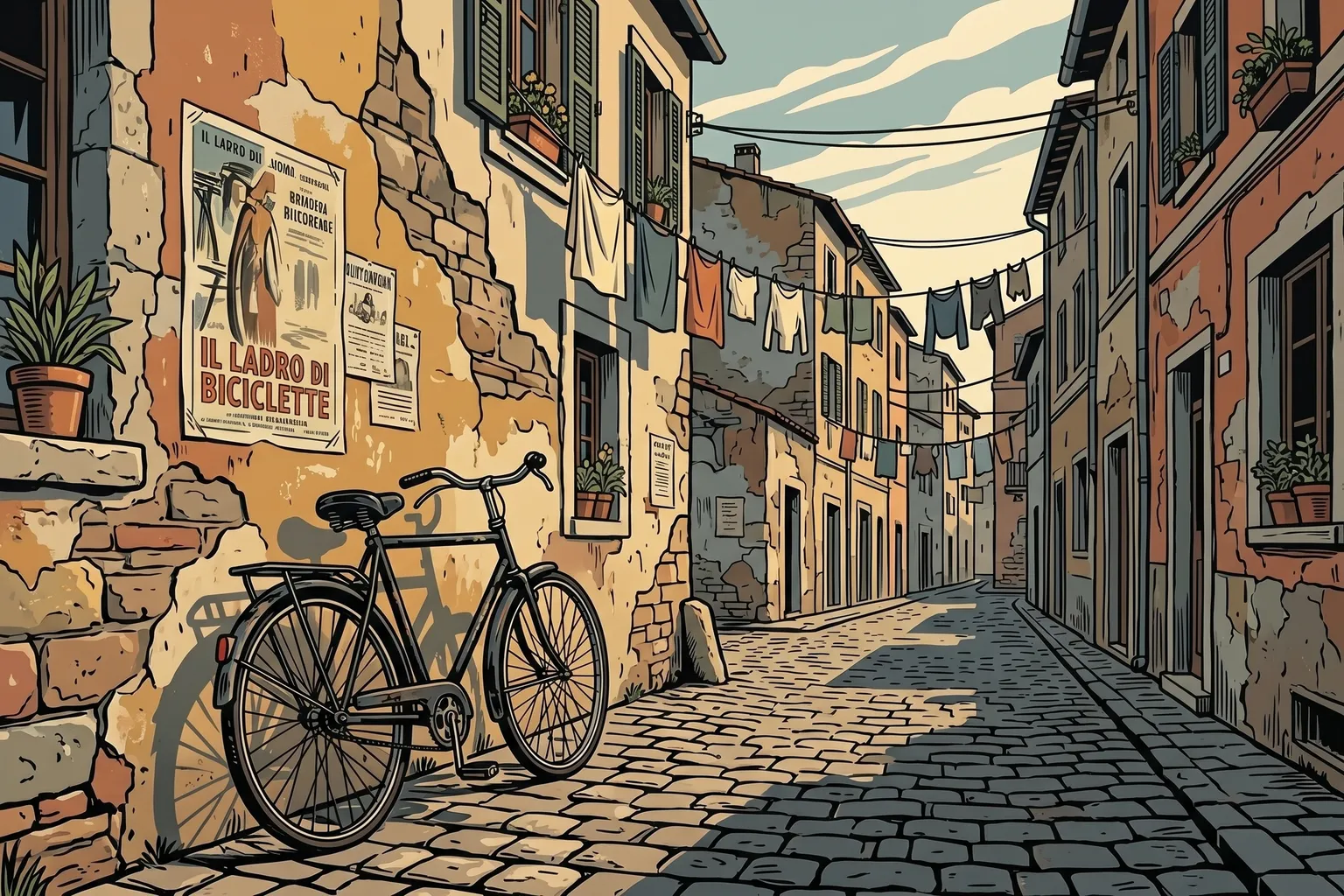
Vittorio De Sica took the movement further, and arguably deeper, with “Bicycle Thieves” in 1948. The story is simple: a man in postwar Rome gets a job putting up movie posters, which requires a bicycle; his bicycle is stolen on his first day; he and his young son spend the day searching for it. That is the whole film. What De Sica and his screenwriter Cesare Zavattini understood is that simplicity is not smallness. The bike is a job. The job is the family’s survival. The city they walk through is full of other people in the same position. The man searching for the bike is played by Lamberto Maggiorani, a metalworker whom Zavattini spotted and asked if he would like to be in a picture. Maggiorani had never acted before. His face carries the entire film. He is convincing in a way that requires almost no craft: he is simply a man who looks like he has too much riding on one day.
“Umberto D” (1952), also De Sica, is the movement’s most uncompromising film and probably its most painful. Umberto Domenico Ferrari is a retired civil servant, barely managing on his pension, about to be evicted from his room. That is the story. The man playing him, Carlo Battisti, was a linguistics professor whom De Sica cast because he needed a man who looked like he had once been more comfortable than he now was. The film refuses every available comfort. It does not resolve neatly. It asks you to sit with a specific human being in a specific condition and to look at him clearly. Italian audiences mostly did not want to. The government resented it. The neorealist filmmakers had not anticipated that making honest films about poor Italians would be received as an insult by people who preferred to believe things were getting better.
“La Strada” (1954) complicates the movement’s categories in ways that matter. Federico Fellini had trained in neorealism but he did not stay there. His film follows a brutish strongman, Zampano, and the simple young woman, Gelsomina, he buys from her family to be his assistant in a traveling circus act. It is shot on real roads in real Italian countryside, and Giulietta Masina’s performance as Gelsomina is one of the most fully inhabited characters in the cinema of any decade. But the film reaches for something that strict neorealism would not quite permit: fable, symbol, a kind of spiritual freight that the movement’s documentary impulse was designed to resist. Fellini won the first competitive Academy Award for Best Foreign Language Film for it. Then he spent the rest of his career going further in that direction and leaving the neorealist framework behind entirely. “La Strada” is the film where the movement first showed what it could become when it stopped being a program.
The Hollywood studio system I wrote about here last month was producing extraordinary work in the same years under entirely different conditions: controlled environments, contract players, the pressure of industrial efficiency applied to storytelling. What neorealism offered was the opposite. No controlled environment. No contract players. The pressure of actual poverty and actual streets. Both modes produced great films. The difference is what they were asking movies to do. The Hollywood model asked: how do we build the world we need for this story? The neorealist model asked: what world already exists, and what is it telling us? The second question is harder to answer honestly, because honest answers about the real world are often unwelcome.
The filmmakers who absorbed neorealism and carried it forward are scattered across four decades and two continents.
The French New Wave directors, Godard, Truffaut, Chabrol, Rohmer, Varda, were the most famous inheritors, though “inheritors” understates what they did with what they received. They brought location shooting and the commitment to contemporary life into French cinema in the late 1950s and early 1960s, then layered on a self-consciousness about cinema itself that neorealism mostly avoided. Godard’s “Breathless” (1960) owes its rhythm and its streets directly to the Italians, even as Godard is doing something to the audience’s experience of watching that Rossellini never attempted. The New Wave took neorealism’s freedom and made it a style. Sometimes that cost them neorealism’s urgency. The best of them knew it.
Satyajit Ray saw “Bicycle Thieves” in London in 1950 and felt it change something in his understanding of what a film could be. He returned to India and spent two years making “Pather Panchali” (1955), the first film of his Apu Trilogy, shot in the village of Boral with mostly non-professional actors on a budget that required him to stop and wait for money repeatedly. The film looks like nothing else in Indian cinema of its period, and it looks that way because Ray was trying to do what De Sica had done: to find the universal in the specific and the specific in the universal, to put a real child and a real family on real ground and let the camera pay attention.
The Dardenne brothers, Jean-Pierre and Luc, have been making Belgian films in the neorealist tradition for thirty years, and they are the strongest direct descendants the movement has. Their films, “Rosetta” (1999), “The Son” (2002), “Two Days, One Night” (2014), follow working-class Belgians through economic precarity with a handheld intimacy and a refusal of easy resolution that would have been recognizable to De Sica. They have won two Palme d’Or awards at Cannes. Their films are not comfortable. They are not supposed to be.
Sean Baker, whose “Anora” (2024) I have written about in this column, is the American filmmaker most actively working in this tradition. “Tangerine” (2015), shot on iPhone cameras in Los Angeles, follows transgender sex workers through a single Christmas Eve with the same commitment to real locations and lived-in faces that Rossellini brought to occupied Rome. Baker casts non-professionals alongside professionals. He shoots where people actually live. He is interested in economic precarity and survival and dignity, which is exactly what neorealism was interested in. He has said De Sica influenced him. You do not need him to say it.
What neorealism changed, ultimately, is the question a filmmaker can ask the camera. Both approaches produce great work. The neorealist approach is harder to sustain because it requires a filmmaker to be honest about the world outside the studio, and the world outside the studio is not always what governments or audiences or studios want to see documented. Rossellini’s neighbors did not always appreciate seeing themselves on screen. De Sica’s government did not appreciate “Umberto D.” The Dardennes’ Belgian industrial towns do not look like promotional material for anyone.
That is what the movement was. A decision to look at the world without blinking, with whatever camera and film stock and faces you could find, and to make what the looking showed you. The films are still there. They have not gotten easier, and they have not gotten less true. Start with “Bicycle Thieves.” Ninety minutes. A man and his son walking through Rome. Nothing else, and nothing else needed.