The term “film noir” was coined by French critics in the summer of 1946, when American films blocked from European distribution during the war finally arrived in Paris simultaneously. Critics who watched “Double Indemnity,” “Laura,” and “The Maltese Falcon” in quick succession noticed something they hadn’t seen before: a consistent darkness, not just in subject matter but in the way the images themselves were built. They borrowed a phrase from literature. “Serie noire” was already the name for French translations of American hard-boiled crime fiction. The films needed a name too.
The people making those films didn’t call them anything. They called them crime pictures, thrillers, melodramas. Genre labels are almost always retrospective, applied after someone outside the system notices a pattern that those inside it were too busy working to see. Film noir was never a studio category or a box on a production memo. It was a way of seeing that spread through Hollywood in the 1940s and early 1950s, then went underground for twenty years, then came back, and never really went away.
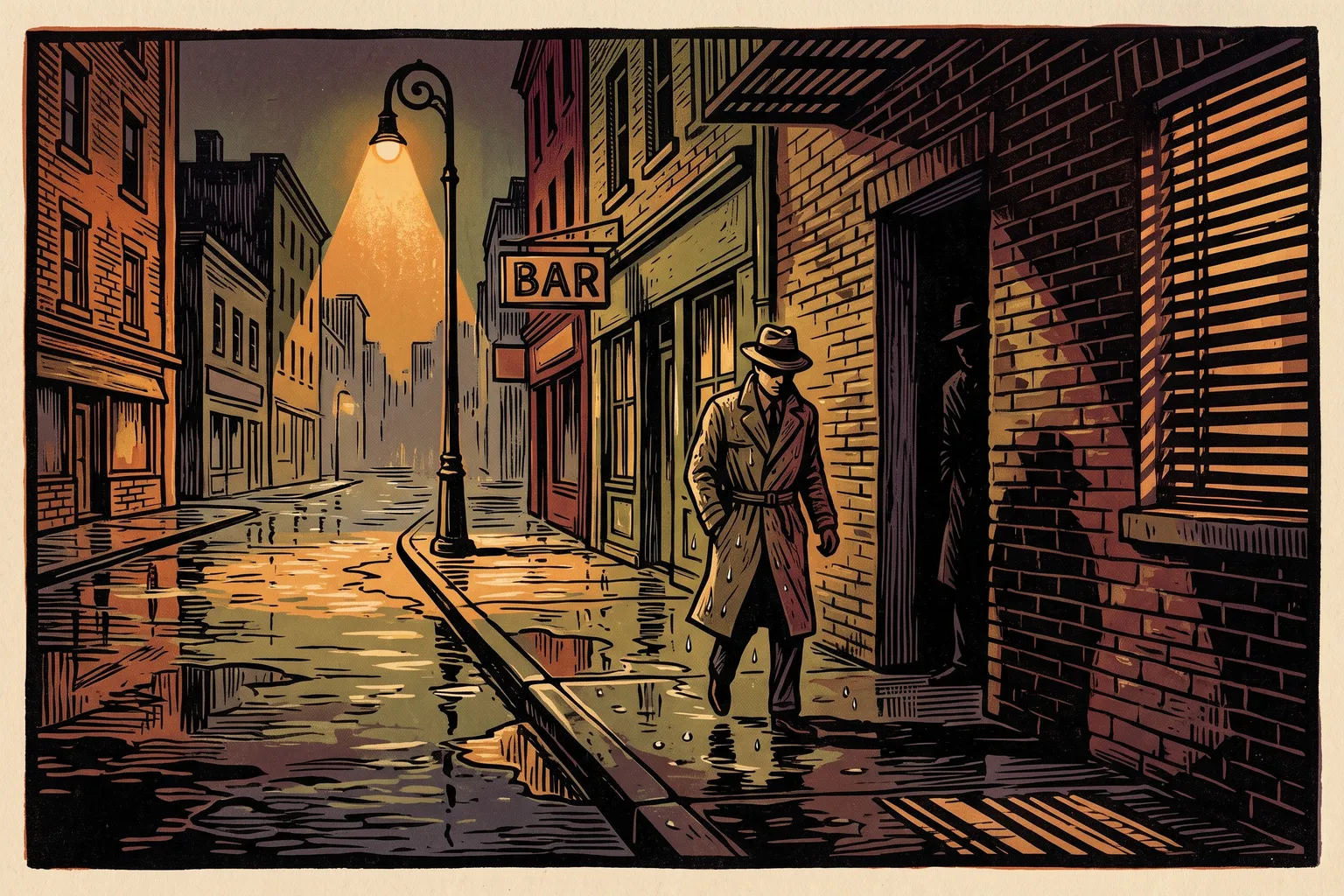
The visual grammar came first. Film noir looks the way it looks because of German Expressionism and the directors who carried it out of Europe. Fritz Lang, Otto Preminger, Robert Siodmak, Billy Wilder: these were filmmakers who had trained in or absorbed the German cinema of the 1920s and 1930s, where shadow and distortion were deliberate instruments. When they arrived in Hollywood, mostly as refugees, they brought that grammar with them and applied it to American stories. The result was a style built on high contrast and low light: deep shadows cut by single-source illumination, the silhouettes of venetian blinds striping men’s faces, rain-slicked streets that turned every location into a threat. The world in noir is beautiful and dangerous, and the beauty makes it more dangerous.
The cinematographer John Alton was the visual architect who formalized what noir actually looked like. His book “Painting with Light,” published in 1949, explained the method, but the films are the better explanation. His work on “He Walked by Night” (1948) and “The Big Combo” (1955) remains the clearest demonstration of how light, withheld strategically, becomes the primary storytelling instrument. In a well-lit room you see everything and the images are neutral. In a noir frame, what the light falls on is significant and what it doesn’t fall on is threatening. Every choice about where to put the lamp is a choice about what to trust.
The narrative grammar follows from the visual. Noir stories are built on compromised protagonists, which is different from flawed protagonists. The heroes of conventional genre pictures have weaknesses but they keep their moral bearings. Noir protagonists lose theirs.
Fred MacMurray in “Double Indemnity” (1944) is an insurance salesman who commits murder for a woman he has known for a few weeks. He knows what he is doing. He does it anyway. The film, directed by Billy Wilder from a screenplay Wilder wrote with Raymond Chandler, based on James M. Cain’s novella, opens with MacMurray’s Walter Neff already caught, dictating a confession. The entire movie is told in flashback. You know from the first frame that he doesn’t get away. What you’re watching isn’t a mystery but an autopsy: how does a reasonable man destroy himself?
That structure, the flashback narration, the retrospective confession, is as much a noir signature as the shadows. Robert Mitchum’s Jeff Bailey in “Out of the Past” (1947) is another man who knows he’s trapped before the film tells you why. Jacques Tourneur’s direction makes every sunny scene ominous. The past in noir is never past. It returns with what it is owed.
The femme fatale, which critics have been arguing about for seventy years, is both the most recognized element and the most misunderstood. The women in noir are agents of danger, yes. But the danger exists because the men in these films choose to be endangered. Barbara Stanwyck’s Phyllis Dietrichson in “Double Indemnity” doesn’t trick Walter Neff into murder. She provides the occasion for it. He provides the willingness. Jane Greer’s Kathie Moffat in “Out of the Past” is as ruthless as any character in 1940s Hollywood, but Jeff Bailey knows exactly who she is and goes back anyway. Noir’s femme fatale is a measure of the protagonist’s capacity for self-destruction, not an external cause of it.
World War II produced a specific kind of returning soldier: a man who had seen violence institutionalized, who had been asked to do things that civilian life offered no framework for integrating. The postwar domestic ideal that American culture was promoting simultaneously, the ranch house, the nuclear family, the smooth recovery from historical trauma, had nothing to do with what veterans actually carried back. Noir emerged in this gap. Its crime pictures are populated by men who can’t fit back into ordinary life, women who took economic and social agency during the war and were now being told to give it back, and cities that are beautiful and corrupt and permanent. The crime isn’t really about the crime. It’s about the pressure building before the camera ever turns on.
The hard-boiled fiction that noir drew from understood this pressure. Raymond Chandler’s Philip Marlowe, who appears in “The Big Sleep” (1946) in the person of Humphrey Bogart under Howard Hawks’s direction, is already a man who knows the world isn’t clean and isn’t pretending otherwise. Dashiell Hammett’s Sam Spade, who appears in John Huston’s “The Maltese Falcon” (1941), also as Bogart, operates by a code that is entirely his own because the institutional codes have been compromised beyond use. These aren’t cynics. They’re realists who were made cynical by careful attention.
The Bogart pictures are the most famous noirs because Bogart is the most famous noir actor. That fame is accurate in terms of cultural reach but not a complete guide to the genre’s range. Joan Crawford’s Mildred Pierce in “Mildred Pierce” (1945), directed by Michael Curtiz, is a woman driven to crime by the specific conditions of what a mother is expected to sacrifice, which is a noir subject if there is one. Gloria Swanson in “Sunset Boulevard” (1950) is possibly the most fully realized creation in Wilder’s catalogue: a woman constructed by the industry and then discarded by it, returned as an image of what the industry does to people. William Holden’s Joe Gillis narrates the film from a position you understand in the first two minutes. The whole picture is already over when it starts.
The Hollywood studio system I wrote about here last month was producing extraordinary work under entirely different conditions: controlled environments, contract players, the pressure of industrial efficiency applied to storytelling. Italian neorealism was asking the opposite question: what world already exists, and what is it telling us? Noir sat between these impulses. It was shot mostly on studio sets and backlots, with contract players and controlled lighting. But its stories were about the world outside the studio, the corrupt city, the moral compromise that survival requires, the institutions that promise protection and deliver betrayal. It used the tools of the factory to question what the factory was built for.
Noir didn’t have a manifesto. The French New Wave had a manifesto. Neorealism had theorists articulating its principles as the films were being made. Noir just happened. Directors working under similar conditions, budget pressure, censorship navigation, studio efficiency demands, independently arrived at similar solutions. Low-key lighting costs less to set up than high-key. Night exteriors on real streets cost less than built sets. A flashback structure lets you drop backstory efficiently. The style that looks like aesthetic intention was partly the result of working fast and cheap. This is one of Hollywood’s recurring gifts: conditions meant to constrain production sometimes produce a distinctive way of seeing.
Noir didn’t end. It went underground. By the late 1950s the formal cycle was winding down, and “Touch of Evil” (1958), with Orson Welles directing himself in a baroque self-satire of the genre, was already an ending. But the grammar never disappeared. It resurfaced in the 1970s as neo-noir, which is what you call noir after the filmmakers know they’re working in a tradition. Roman Polanski’s “Chinatown” (1974), from Robert Towne’s screenplay, with Jack Nicholson as a private detective in the exact Bogart tradition, is the best neo-noir film and the most rigorous argument for why the genre survived. The subject, corruption so deep it has become the structure rather than the exception, isn’t historical. The corrupt city isn’t the 1940s city.
Lawrence Kasdan’s “Body Heat” (1981) is an explicit reworking of “Double Indemnity,” almost scene for scene in some stretches, starring William Hurt and Kathleen Turner, set in sweltering Florida instead of Los Angeles, and it works because the template holds. The situation Cain invented in 1936 wasn’t period-specific. A man who wants something enough to destroy himself for it isn’t a postwar phenomenon.
The Coen Brothers understood this and built a significant portion of their career on it. “Blood Simple” (1984), their debut, is noir as formal exercise and genuinely unsettling mystery. “Fargo” (1996) is noir in the upper Midwest, in the daylight, in the snow, which sounds like a contradiction and works as a revelation. “No Country for Old Men” (2007) is the purest extraction of what noir was always about: a protagonist who discovers he isn’t equipped for the world he’s living in, and can’t become so.
David Fincher has been working in the noir tradition his entire career. “Se7en” (1995), “Zodiac” (2007), “Gone Girl” (2014), “The Killer” (2023): different surfaces, the same underlying question, which is what happens when the institutions we depend on to protect us from violence are inadequate or corrupt or simply absent. Fincher’s visual grammar is noir grammar translated into contemporary digital production. The source of illumination has changed. The relationship between light and threat hasn’t.
Denis Villeneuve’s “Prisoners” (2013) and “Sicario” (2015) are both working in this tradition. “Nightcrawler” (2014), directed by Dan Gilroy and starring Jake Gyllenhaal as a local news videographer who discovers there are no ethical constraints on how far you can go if you don’t have any, is the cleanest noir made in the last decade. It’s also about media, which is what makes it contemporary. The city in these films isn’t Los Angeles 1947. The structure underneath the city is the same structure.
Noir isn’t a style. It’s a way of thinking about the relationship between individual desire and structural corruption. The things it concerns itself with, compromised institutions, the seduction of self-destruction, the gap between what a society advertises about itself and what it actually does, aren’t period subjects. They’re permanent subjects dressed in different clothes.
The visual grammar it invented is permanent in the same way. Low-key lighting, shadow architecture, the frame that withholds as much as it shows: these are now so thoroughly part of cinema, television, advertising, and music video that they’ve become invisible. You don’t notice them because you grew up inside them. But you are inside a visual language constructed by European refugees and American cinematographers working fast and cheap in the 1940s, and when you see a face half in shadow, you feel exactly what they wanted you to feel. They built it that way on purpose, because the budget demanded it, and because they understood that what you can’t quite see is more frightening than what you can.
Start with “Double Indemnity.” Just under two hours. A man tells you at the beginning that he did it and got away with it and didn’t really get away with it. Then you watch why.