Three and a half hours is a lot to ask. I want to be honest about that upfront, because if you are the kind of person who checks the running time before you commit to a movie, “The Brutalist” is going to give you pause. It gave me pause. I have been watching movies for more than fifty years, and I still feel a small knot in my stomach when the lights go down and I know I won’t see daylight again for the length of a cross-country flight.
But here is what I want to tell you: this film earns it. Every minute. I don’t say that often. I have sat through too many two-hour movies that contained ninety minutes of story and fifty minutes of someone’s ego. Brady Corbet’s film is not that. It is dense and deliberate and alive in every frame, and when it ended I sat in my chair for a long time, not because I was tired, but because I wasn’t ready to leave the world it had built.
Adrien Brody plays Laszlo Toth, a Hungarian-Jewish architect who arrives in America after the Second World War with his training, his talent, and almost nothing else. He ends up in Pennsylvania, working for his cousin, doing labor that has nothing to do with the buildings he once designed in Europe. The film follows what happens when a wealthy industrialist, played by Guy Pearce, discovers Toth’s talent and decides to put it to use. That sounds simple. It is not.
What Corbet has made is a film about the cost of patronage. About what it means to owe your art to someone who owns you. About the distance between what America promises and what it delivers, and about how that distance looks different depending on which side of it you’re standing on. These are not small subjects, and the film does not shrink them to fit a comfortable running time. It lets them breathe. It lets scenes run long enough for you to feel the weight of what is happening, and then it lets the silence after those scenes do its own work.
I want to talk about Brody’s performance, because it is the best work he has done since “The Pianist,” and I think it might be better. He played Wladyslaw Szpilman more than twenty years ago now, and he won the Oscar for it, and he deserved it. But that was a performance built on suffering, on the reduction of a man to his most essential self. What he does here is harder. Toth is not reduced. He is complicated. He is proud and desperate and brilliant and sometimes cruel, and Brody plays all of it without asking you to love him. He trusts that you will find him interesting, which is a braver choice than asking for sympathy.
Felicity Jones plays Erzsebet, Toth’s wife, and she is extraordinary. She arrives in the film’s second act, and her presence changes everything. Jones gives Erzsebet a sharpness that the film needs. She sees what her husband cannot see about the bargain he has made, and she says it plainly, and Jones delivers those moments with the kind of quiet precision that makes you understand exactly what this marriage is and what it costs both of them.
Guy Pearce is the other essential piece. He plays Harrison Lee Van Buren with the easy confidence of a man who has never been told no by anyone who mattered. It would be easy to make Van Buren a villain. Pearce doesn’t do that. He makes him something more unsettling: a man who genuinely believes he is doing good, who cannot see the difference between generosity and ownership because no one in his life has ever needed to explain it to him. When he commissions Toth to build a community center, he means it. When the project becomes something else entirely, he means that too. Pearce makes you understand both impulses without forgiving either one.
The film has an intermission. I loved this. We don’t do intermissions anymore, and we should, especially for movies this long. It gives you a moment to sit with what you’ve seen, to talk to the person next to you, to get a cup of coffee and think about where the story might go. David Lean used to build intermissions into his epics, and the comparison to Lean is not one I make casually. “The Brutalist” has the scope and patience of “Lawrence of Arabia” or “Doctor Zhivago,” though its concerns are more intimate. Lean filmed deserts and ice palaces. Corbet films concrete and steel and the faces of people who are trying to build something permanent in a country that has not yet decided whether it wants them.
That comparison tells you something about what this film is doing. The great American epics of the mid-twentieth century told stories about who we were. “Giant,” “East of Eden,” the Coppola films. They took big canvases and used them to say something true about the country. We stopped making those movies for a while. We got smaller, or we got louder, and somewhere in the middle we lost the ability to be both ambitious and quiet at the same time. “The Brutalist” gets that balance right. It is ambitious in the way that a cathedral is ambitious: not because it is showing off, but because the thing it is trying to hold requires the space.
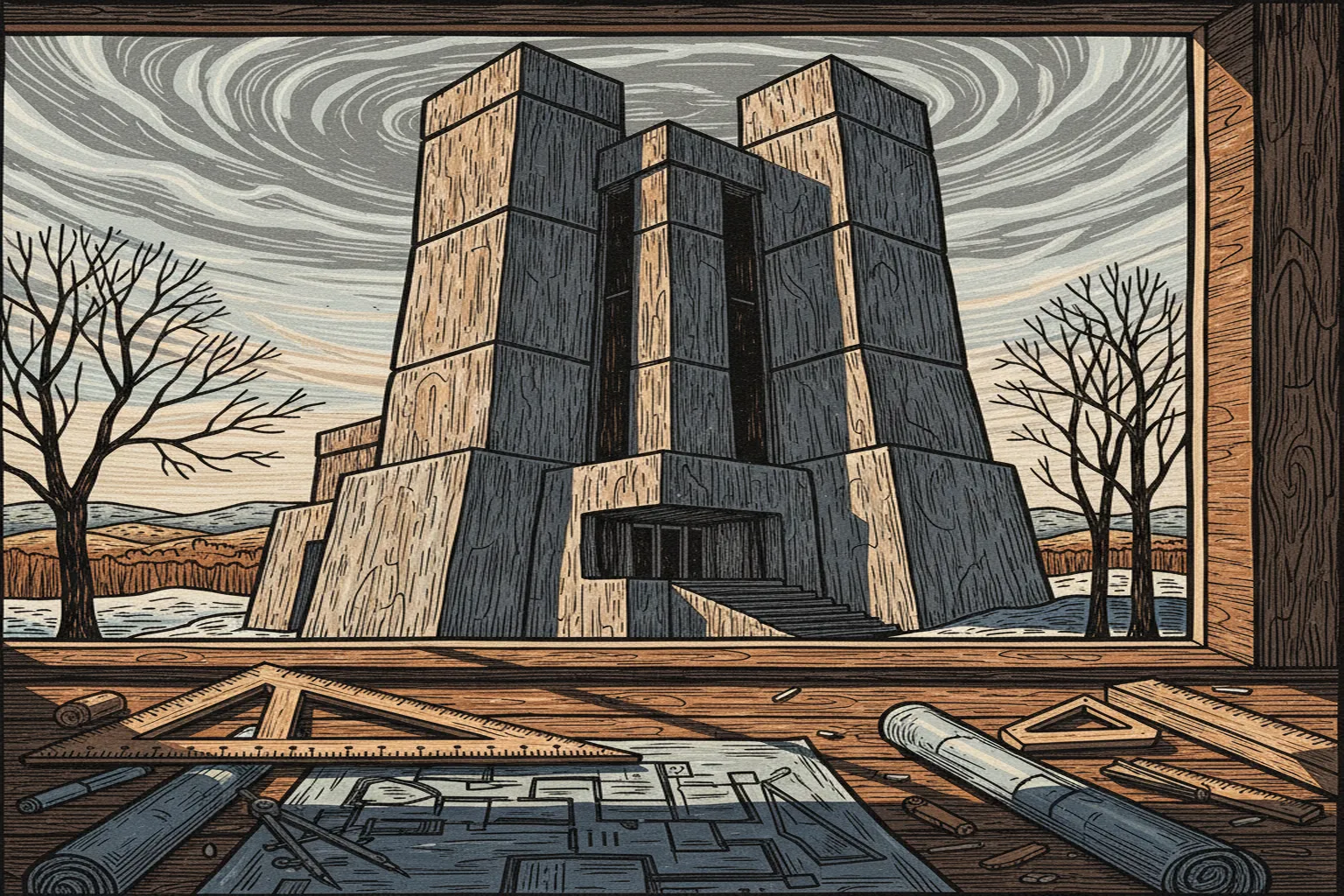
The cinematography, by Lol Crawley, deserves mention. Corbet shot the film in VistaVision, a format that hasn’t been widely used since the 1950s, and the images have a clarity and grain that feel deliberately out of step with the digital slickness we’ve gotten used to. The buildings in this film look like buildings. The concrete looks heavy. The Pennsylvania landscapes have a muted beauty that makes you understand why someone would want to build something here and why the land might resist it.
I should tell you who this movie is for and who should skip it. If you need your movies to move fast, this one will try your patience. There are long stretches where not much happens in the conventional sense. People talk. People wait. Decisions get made in rooms and their consequences arrive slowly. If that sounds like a chore, go watch something else and don’t feel bad about it. Not every movie is for every person, and that is fine.
But if you have ever cared about what it means to make something, if you’ve ever done work you were proud of for someone who didn’t fully understand it, if you’ve ever been an outsider in a place that welcomed you with one hand and held you at arm’s length with the other, this movie will find you. It will sit with you. You will think about it for days.
I have seen more than four thousand movies. I have reviewed most of them. I can count on two hands the number that made me feel the way this one did: that I had been inside something true, something built with the same care and stubbornness that Laszlo Toth brings to his buildings. “The Brutalist” is not a movie that happens to you. It is a movie that you live inside for three and a half hours, and when you come out, the world looks a little different.
It is worth your time. That is the highest thing I know how to say about a movie.