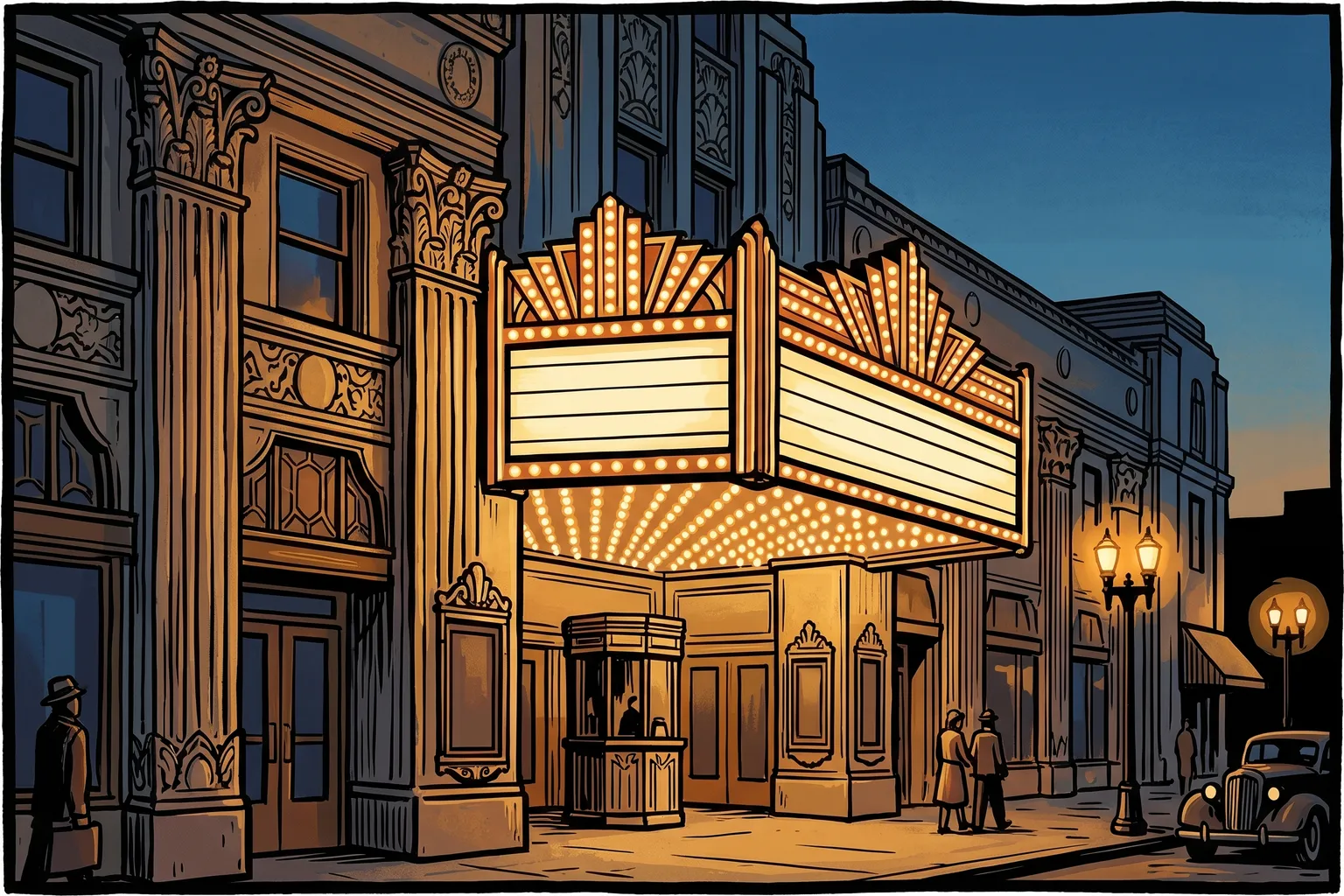
Somewhere around 1939, if you were a working filmmaker in Hollywood, you could look around at what the American movie industry was producing and feel justified in calling it a golden age. In a single calendar year, audiences got “Gone with the Wind,” “The Wizard of Oz,” “Stagecoach,” “Mr. Smith Goes to Washington,” “Ninotchka,” and “Only Angels Have Wings.” That’s not a fluke. That’s a system working at full capacity.
That system was also, by the standards of any reasonable labor law, a machine for controlling human beings. Both of those things are true, and you can’t understand what the golden age of Hollywood was without holding them together.
The era runs roughly from 1927, when Warner Bros. released “The Jazz Singer” and the sound film changed everything, to somewhere around the late 1950s, when television finished what the Supreme Court started and the studio factory model began its long collapse. About thirty years. Enough time to build an industry, perfect it, and watch the foundations crack.
The Big Five studios in their prime, MGM, Paramount, Warner Bros., RKO, and 20th Century Fox, operated through vertical integration. They made films, distributed films, and owned the theaters where those films played. Control the whole pipeline and you control everything. They also controlled the talent. Actors, directors, writers, costume designers, cinematographers, many of them worked under multi-year contracts that told them when to work, what to work on, and how much they’d be paid. The studio system was a factory floor. The product just happened to be movies.
What came out of that factory is extraordinary craft. When you have a stable of directors making pictures continuously, year after year, they get very good at it. Howard Hawks made picture after picture across four decades. John Ford was the same. Billy Wilder, who came from Vienna via Berlin and learned the trade in the American system, made “Double Indemnity” in 1944, “Sunset Boulevard” in 1950, “Stalag 17” in 1953, “Witness for the Prosecution” in 1957, and “Some Like It Hot” in 1959. Five films in fifteen years that you can still teach from. The system created the conditions for that kind of accumulated skill. Wilder knew his cinematographer. His crew had done this before. They did it again.
That efficiency produced films that hold up because they couldn’t afford to waste time. “Casablanca,” Michael Curtiz’s 1942 masterpiece, was shot in under two months on a budget of just over one million dollars. The screenplay was being rewritten daily. Ingrid Bergman reportedly didn’t know which man Ilsa would choose until late in the shoot, which affected how she played certain scenes, which means the film’s most famous ambiguity was partly accidental, a product of the pressure the system ran on. What you see onscreen looks inevitable, as if the film couldn’t have been made any other way. That’s studio craftsmanship under pressure. There’s an argument that constraint produces the best work, and the golden age makes it without needing to say so.
Between 1934 and roughly 1966, Hollywood operated under the Motion Picture Production Code, administered by Joseph Breen and known today as the Hays Code, after Will Hays, who ran the industry association that created it. The Code told filmmakers what they couldn’t show: crime that pays, sexuality that isn’t punished, interracial romance treated approvingly. The list ran long.
Here’s what’s interesting about the Code: some of the best films of the era exist because of it, not despite it. When you can’t show something directly, you find ways to suggest it. Film noir, that gorgeous, shadow-drenched genre of moral corruption and doomed protagonists, is partly a Code film. Directors and writers found ways to make the darkness palpable without making it explicit. “Double Indemnity” again: the murder plot, the charged tension between Fred MacMurray and Barbara Stanwyck, the rot at the center of the story, all of it conveyed through dialogue and framing and Stanwyck’s walk down a staircase in a blonde wig. You can’t show it, so you imply it so effectively that the implication is worse than the thing itself. Smart directors used the Code’s constraints as tools. The restrictions didn’t flatten the work. They sharpened it.
But the Code also kept genuine stories off the screen. The full scope of the Black experience in America was largely absent from golden age Hollywood, or present only in ways that accommodated white audiences’ comfort. When Hattie McDaniel won the Best Supporting Actress Oscar for “Gone with the Wind” in 1940, becoming the first Black person to win an Academy Award, she wasn’t permitted to attend the film’s premiere in Atlanta because of Jim Crow. She had to sit at a segregated table at the awards ceremony in Los Angeles. The machine that made those films wasn’t neutral. It reflected the specific social arrangements of its time, and the Code was part of that arrangement.
On the surface, the contract system looked like security. The studios paid for training, image, publicity, and housing. In return, the actor worked when told and played the roles assigned. Refuse the role, go on suspension. Accept the role, collect the paycheck.
Bette Davis decided it didn’t have to work that way. In 1936, she sued Warner Bros. in England, claiming a restrictive and unfair contract. She lost the case, returned to the studio, and proceeded to make “Jezebel,” “Dark Victory,” and “All About Eve” in the years that followed. The lawsuit didn’t free her. It established that she was someone who would fight.
Olivia de Havilland succeeded where Davis hadn’t. In 1944, she challenged a Warner Bros. contract that extended her seven-year deal through the use of suspensions. The California Court of Appeal ruled in her favor, and what became known as the de Havilland decision set the limits on what studios could do with contracted talent. It took a lawsuit to get there. It always took a lawsuit, or a breakdown, or both.
I wrote about the question of what it costs an artist to make work for someone who owns the conditions of that work in my review of “The Brutalist.” The studio system is that question played out at industrial scale. The factory produced masterpieces. It also produced the specific suffering of Judy Garland, who was under contract to MGM from childhood and whose studio put her on stimulants to manage her weight and sedatives to manage her sleep, both calibrated to production schedules rather than to her. She spent decades dealing with the consequences. “The Wizard of Oz” exists because of that system. So does what happened to Garland inside it. You can hold both facts at the same time. You should.
It ended when it had to. The Supreme Court’s 1948 decision in United States v. Paramount Pictures forced studios to divest their theater chains, breaking the vertical integration that made the whole structure work. Television pulled audiences away throughout the 1950s. By 1960, the factory model was shutting down. What replaced it was less certain and, at its best, freer. Italian neorealism had been working since the mid-1940s. The French New Wave was already underway. American filmmakers spent the 1960s absorbing those lessons and remaking the cinema in their image. Directors like Sean Baker, whose work I’ve written about here, are direct descendants of that freedom, making films of a personal specificity that the contract system actively discouraged and the Code would have shut down entirely.
If you’ve never watched a film from this era and want to understand what the argument is about, start with three.
“Casablanca” first. Michael Curtiz, 1942, Bogart and Bergman. It’s about love and sacrifice and what you owe to the historical moment you’re living through. Ninety-nine minutes. Nothing wasted. It’s the most accessible great film the golden age produced, and it earns every bit of that description.
Then “Sunset Boulevard.” Billy Wilder, 1950. William Holden plays a broke screenwriter who takes shelter in the decaying mansion of a silent film star played by Gloria Swanson. It’s the golden age’s most honest film about itself: about the people the system used and discarded, about the gap between the glamour the industry sold and the reality it produced. Swanson’s performance is one of the great ones. The film opens with a dead man narrating from a swimming pool. That shouldn’t work. It works perfectly.
Third, and the most purely pleasurable of the three: “Rear Window.” Alfred Hitchcock, 1954. James Stewart, Grace Kelly, a man with a broken leg watching his neighbors through a courtyard window. Hitchcock made it almost as a technical dare, to see whether he could build a compelling thriller without ever leaving a single apartment. He could. He did. It has more to say about the act of watching itself than most films that set out to make that argument explicitly. Start with the pleasure. The ideas follow.
That’s what the golden age was. Extraordinary craft built on a system that extracted a real price from the people inside it. You watch those films and you know you’re watching something good. The job is to know why it was possible and what it cost. The best films from that era survived because they were made by people who cared more about the work than the machine they were working inside.
The work is still there. It hasn’t gotten worse. Watch it.