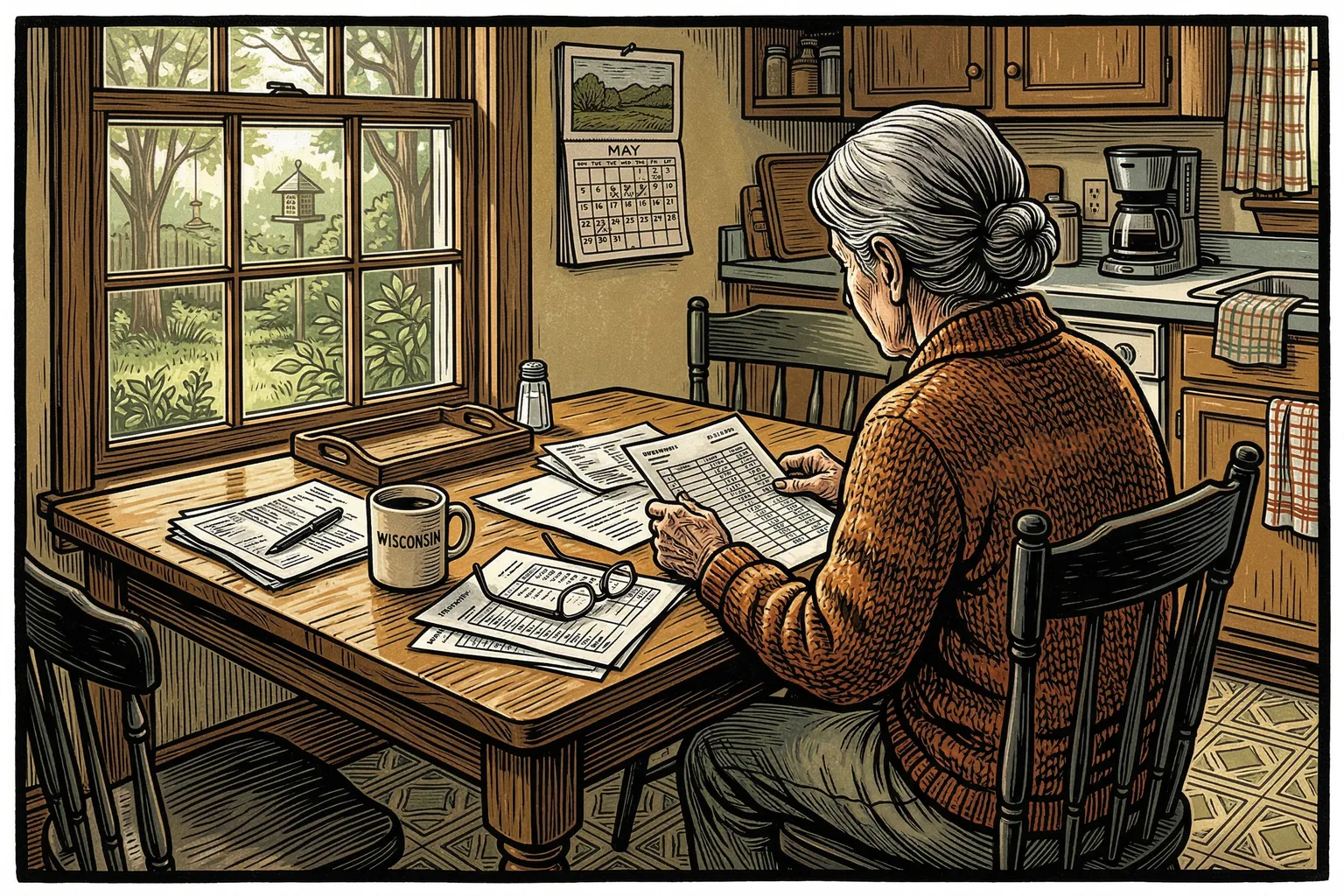
A man named Mike sat across from me last spring, sixty-two years old, wearing a flannel shirt with a small Wisconsin Badgers logo on the breast pocket. He’d worked thirty-one years at a packaging plant in Oshkosh, done everything right, and had $340,000 in a 401(k), no pension, and a house that was mostly paid off. He wanted to claim Social Security at sixty-two and wanted me to tell him it was a good idea.
His father had died at sixty-eight. That was the whole argument.
I hear some version of this conversation about four times a year. The details change. The logic doesn’t. You’re afraid that you’ll spend your whole working life paying into Social Security, then die before you collect enough to matter. It’s a reasonable fear. It is, at its core, a fear of dying too soon.
I want to address that fear directly, then take it apart with actual numbers.
What You Lose by Claiming at 62
For anyone born in 1960 or later, full retirement age is 67. That is when Social Security pays you 100 percent of your primary insurance amount, which is the benefit the Social Security Administration calculated based on your lifetime earnings history.
If you claim at 62, you do not get 100 percent. You get 70 percent.
That 30-percent reduction is permanent. It does not go away when you turn 67. It is not recalculated. You took the early benefit and that is what you get, adjusted for inflation, for the rest of your life.
If you wait until 70, you get 124 percent. That is the maximum. For every year you delay past full retirement age, your benefit grows by 8 percent per year. Three years from 67 to 70, times 8 percent, equals 24 percent more than your full benefit. The delayed retirement credits stop accumulating at 70, so there is no advantage to waiting past that.
Here is what this looks like in dollars. Say your full retirement benefit is $2,000 per month. That is not far off the average for a career worker retiring in 2026.
- Claim at 62: $1,400 per month
- Claim at 70: $2,480 per month
- Difference: $1,080 per month
One thousand and eighty dollars a month is $12,960 a year. Over a ten-year period in retirement, that’s $129,600. And unlike most of your retirement assets, this amount is guaranteed, inflation-adjusted, and backed by the federal government. You cannot outlive it. You cannot lose it in a market correction. There is no fund manager collecting 1 percent of it annually for the privilege of managing it.
The Break-Even Calculation
Here is the math Mike needed to see.
By waiting from 62 to 70, you give up eight years of $1,400 checks. That is $134,400 in total benefits you do not receive during those years.
But starting at 70, you receive $1,080 more per month than you would have at 62. At that rate, you recover the $134,400 in approximately 124 months, which is ten years and four months. Add that to age 70 and you get your break-even age: roughly 80.
If you live past 80 and four months, waiting to 70 pays more in cumulative lifetime benefits. The longer you live past that, the further ahead you come out.
Now here is what the actuaries know that most people making this decision don’t: the average life expectancy for a healthy sixty-two-year-old man in the United States is approximately 83. For a healthy sixty-two-year-old woman, it is closer to 86. These are averages, which means half of healthy people in those categories live longer.
The break-even is 80. The average healthy person in this room lives to 83 or 86.
You do not need to be a financial planner to see where this is going.
What Longevity Insurance Actually Means
Let me use the phrase “longevity insurance” and immediately explain what I mean by it, because I have no patience for jargon used without explanation.
Longevity insurance means you are protecting yourself against the financial risk of living a very long time. A lot of people die younger than average, and those people don’t need longevity insurance. They needed their money early and they should have had it. But if you are healthy at 62, the actuarial reality is that you have a meaningful probability of living into your late eighties or early nineties. Social Security, once you’ve claimed, pays you until you die. There is no cap, no depletion of principal, no sequence-of-returns risk.
Here is why that matters: every dollar you pull from your 401(k) at 75 or 80 to supplement a reduced Social Security benefit is a dollar that was sitting in a market-exposed account, subject to required minimum distributions, vulnerable to a down market at the wrong moment. The $1,080 extra per month you get by waiting to claim is not subject to any of that. It just arrives. Every month. Indexed to inflation.
For a married couple, this becomes even more pronounced. If at least one of you lives to 90, which a healthy couple in their early sixties has roughly a one-in-two chance of experiencing, the cumulative benefit of having claimed at 70 rather than 62 is substantial. We are talking about a difference that compounds over two decades.
One more thing the inflation adjustment does that people consistently underestimate: it does not just hold your purchasing power steady. It widens the dollar gap between the early-claimer and the late-claimer over time. At a 3 percent annual inflation rate, that $1,080 monthly difference becomes approximately $1,940 per month in inflation-adjusted terms after twenty years. Claiming early is a decision that gets more expensive as time passes.
The Widow Trap
There is one scenario that never shows up in the Social Security Administration’s pamphlets.
When one spouse in a married couple dies, the surviving spouse keeps the higher of the two Social Security benefits. The lower benefit disappears.
If you are the higher earner in your marriage and you claimed at 62, your surviving spouse, if you die first, inherits your reduced benefit. That is $1,400 a month instead of $2,480 a month, for the rest of their life. You made a decision about your own retirement income and inadvertently made it for your spouse’s widowhood as well.
I have watched this happen. The surviving spouse is spending down assets faster than projected because the Social Security floor is lower than it should have been. There is no correcting it at that point.
The higher earner in a marriage has an argument for waiting to 70 that has nothing to do with their own life expectancy. It is about what they are leaving their spouse if they die first.
When Claiming Early Is the Right Call
I do not tell everyone to wait. There are situations where claiming at 62 or at full retirement age is the correct decision. I want to name them specifically, because the last thing anyone needs is one-size-fits-all advice from someone who hasn’t heard their situation.
Poor health with a realistic expectation of shortened life. If you have a serious condition diagnosed in your late fifties or early sixties that genuinely changes your prognosis, the break-even math changes with it. If your doctor has given you reason to believe you will not see 80, claiming early recovers benefits you would otherwise miss. This is not about general anxiety or the fact that your father died young. It is about documented, realistic medical prognosis. Know your actual numbers.
No other income and genuine financial need. If you have minimal savings and no other way to cover living expenses while you wait, you may not have the luxury of holding out until 70. Eight years is a long time to draw down a small retirement account. In that case, claiming early is not a mistake. It is a financial necessity. Being right about the long-term math does not help you if you run out of money at 67. If you need the income, take it.
Some complicated survivor benefit situations. Claiming strategy for a married couple, particularly when one spouse has a significantly higher earnings record, can get intricate. There are cases where the lower-earning spouse claims early while the higher-earner waits, for reasons specific to their benefit amounts and age difference. The mechanics here require running your actual numbers rather than applying a general rule. A fee-only planner can model this in about an hour and it is worth the cost.
These exceptions are real. They apply to a minority of the people who use them to justify claiming early.
What I Told Mike
I told Mike that his father’s death at sixty-eight was a real loss and a reasonable thing to carry into a financial decision. I also told him that his father’s early death was, statistically, an outlier relative to his own likely lifespan. Mike was in good health. He had $340,000 in savings. His wife Linda was sixty-one and healthy.
If Mike claimed at 62 and died at 73, Linda would spend the rest of her life on $1,400 a month instead of the $2,480 she would have received if he had waited.
If Mike waited until 70 and died at 73, he would leave Linda with the higher benefit, and she would have only collected three years before he died. That is a real cost: roughly $100,800 in foregone early benefits. But Linda would have $2,480 a month for the rest of her life instead of $1,400.
I asked Mike how old Linda’s mother was.
Eighty-seven. Still sharp, still living alone.
Mike’s father’s story was not Mike’s story. He needed to plan for the life he was actually likely to have, not the one he was afraid of.
He waited. He turns 70 this August.
The Social Security claiming decision is probably the single largest one-time financial decision most people make in retirement, and most people make it without running any numbers at all. They make it the way you make a bet at a card table: on a feeling, a family story, and a vague sense that something is better than nothing.
The Social Security Administration’s actuaries have been running the numbers on human lifespans longer than any of us have been alive. They built the break-even into the formula. The system is designed to be roughly actuarially fair across the range of reasonable claiming ages, assuming you die at an average age. The person who lives past average consistently comes out ahead by waiting.
If you are in average health at 62, the break-even is 80. The average healthy person makes it to 83 or 86. The math is not close.
For most healthy people reading this: wait. Work longer if you can. Draw from other savings if you can’t. Claim at 70 if at all possible.
The money is better when you wait for it.
Glenn Suttner is a CFP and the Money & Retirement columnist for the Sunday Evening Review. He has worked in fee-only financial planning for thirty years and holds no financial interest in any fund company, brokerage, or advisory firm. Questions can be sent to the Sunday Evening Review editorial desk.