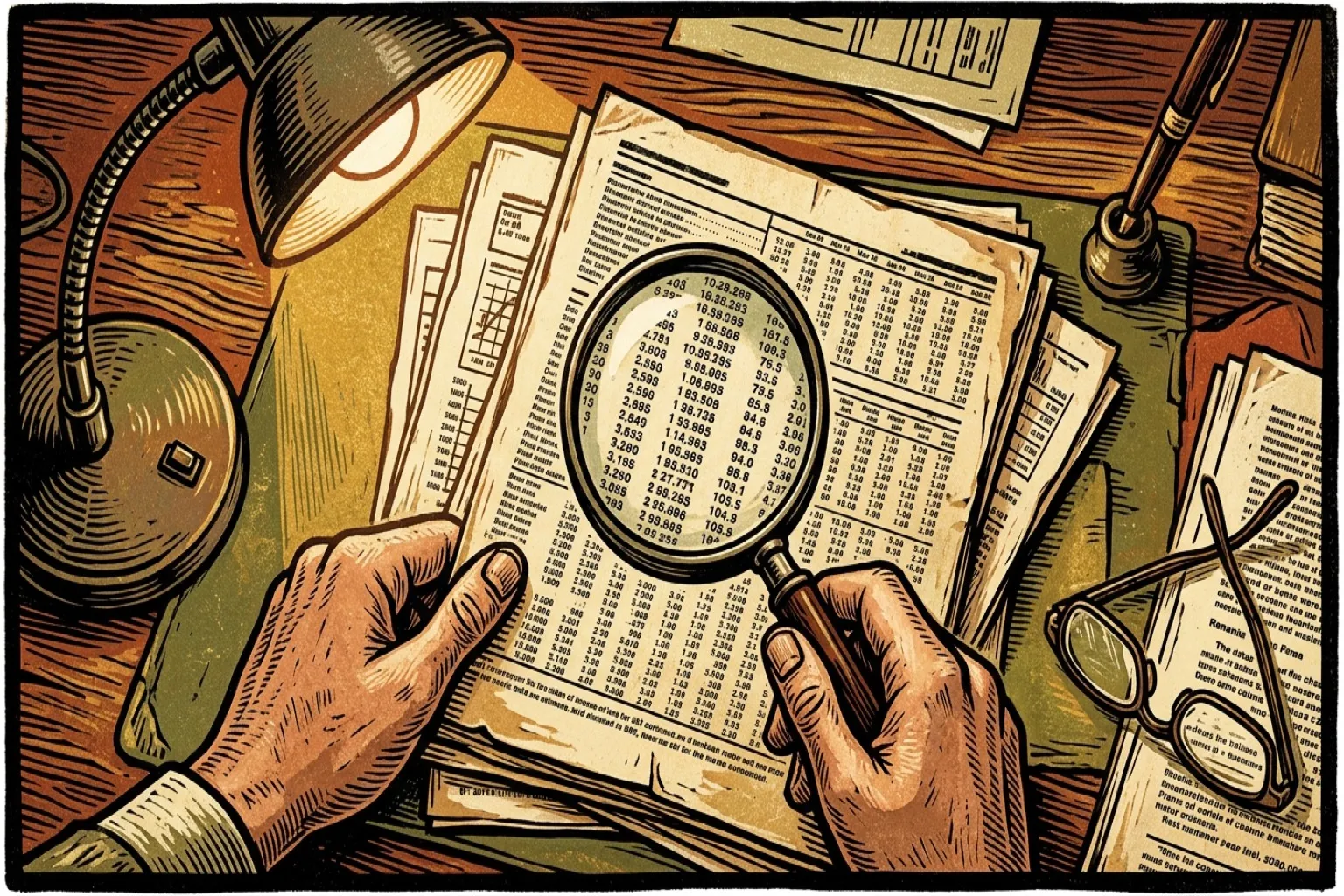
Let me tell you about a bill you’ve been paying every single year for the last decade or two that has never once shown up in your mail.
It didn’t arrive in a statement. It wasn’t labeled as a fee. Nobody called to explain it. It was simply taken — lifted quietly from your balance every day in tiny increments, totaled annually, and reflected nowhere except as a slightly smaller number than you would have had otherwise. You would have to know to look for it to even see where it went.
It’s called an expense ratio. It is how mutual funds and ETFs pay for their operations — fund managers, marketing, trading costs, administration, and in many cases a distribution fee that goes to the broker or platform that sold you the fund in the first place. That last piece is called a 12b-1 fee. I’ll come back to it.
Here’s the short version: if you are holding actively managed mutual funds in your 401(k) or IRA and you have never looked up the expense ratios on those funds, there is a reasonable chance you are paying somewhere between 0.50% and 1.25% per year in fund fees. Some loaded funds sold through brokerages are running 1.50% or higher.
That sounds like nothing. Fractions of a percent. What’s the difference?
I’ll tell you exactly what the difference is.
The Arithmetic of Small Numbers
Say you have $300,000 in a mix of actively managed mutual funds with a blended expense ratio of 1.00%. You’re paying $3,000 per year in fund expenses. You don’t write that check. It just disappears from your return.
Now say the market earns 7% that year. You don’t earn 7%. You earn 6%. The fund company earned the other 1%.
Over twenty years, assuming you’re drawing the account down slowly in retirement, that 1% gap costs you somewhere between $80,000 and $120,000 in compounded value, depending on your withdrawal rate and sequence. Those are real numbers I’ve run for clients. Not hypothetical. Not worst case. That’s what the math does when you let 1% run for two decades.
Now here’s the part that should make you genuinely angry: a simple S&P 500 index fund — one that holds the 500 largest American companies in proportion to their size, requiring essentially no active management — costs somewhere between 0.03% and 0.10% per year. Vanguard’s Admiral Shares version of its 500 Index Fund charges 0.04%. That is $40 per year on every $100,000 you have invested.
The actively managed fund charging 1.00% charges $1,000 per year on that same $100,000. Every year. In good markets, bad markets, flat markets. The expense ratio doesn’t drop when the fund loses money. The meter runs regardless.
And here is what most people find unpleasant to accept: the weight of evidence — across decades of academic research and real-world fund performance — shows that the average actively managed fund does not outperform the index over long periods, net of fees. Some do. Most don’t. You are not likely to be in the ones that do. If you’re picking funds from a 401(k) menu, you are almost certainly not in the ones that do.
You are paying 10 to 25 times more in fees for a product that historically delivers less.
The 12b-1 Fee: The Most Cleverly Named Rip-Off in Finance
Now let’s talk about the 12b-1 fee, which gets its name from the Securities and Exchange Commission rule that permits it. The rule dates to 1980 and was originally intended to allow funds to use shareholder assets to pay for distribution costs — marketing, basically — on the theory that growing the fund would lower per-investor costs over time.
What it became in practice is a built-in kickback mechanism.
A 12b-1 fee is paid by the fund to the broker or financial advisor who put you in the fund. It’s buried inside the expense ratio. The legal maximum is 1.00% per year, though most run between 0.25% and 0.75%. Your financial advisor — or the platform where your account sits — receives this payment every year you remain in the fund. It is an ongoing financial incentive for them to keep you in that fund rather than moving you to something better.
You don’t see it as a line item. You don’t authorize it annually. It just runs.
This is not illegal. This is not a secret in any technical sense — it’s disclosed in the fund’s prospectus, usually on page 9 in type sized for people with better eyes than mine and time sized for people with less to do. But it is, in the most straightforward reading of the situation, a payment from your money to your advisor’s pocket for not moving you out of an expensive fund.
I have been in this business for thirty years. I ran a fee-only planning practice for two decades. I never took a 12b-1 fee. I never held a client in a fund that paid one when a functionally identical fund without one was available. I am not writing this to congratulate myself. I am writing it because the advisor at the bank branch where you opened your rollover IRA in 2015 is probably not operating on those same terms, and you should know that.
How to Find Your Expense Ratios Right Now
This takes about four minutes. Do it today.
Pull up your 401(k) or IRA account. Write down the name of every fund you hold. Then go to the fund company’s website — Vanguard, Fidelity, Schwab, American Funds, Franklin Templeton, wherever — and search for each fund by name. The expense ratio will be listed in the fund summary, usually under Fees or Fund Details.
Anything above 0.50% deserves scrutiny. Anything above 0.75% deserves a hard conversation with yourself or your advisor. Anything above 1.00% deserves a straight answer: what is this fund doing that justifies charging me ten times more than Vanguard charges for an index fund?
The answer is almost never satisfying.
If you see a 12b-1 fee listed — and it will be itemized in the fee table in the prospectus, which you can get from the fund company website or the SEC’s EDGAR database at no cost — you now know that a portion of what you’re paying is going to whoever sold you the fund or whoever is holding your account, as an ongoing retention incentive.
What to Do About It
If you’re in a 401(k), your fund choices are limited to whatever your employer has put on the menu. Many 401(k) menus are poorly constructed and full of expensive options. But most menus have at least one or two index funds. If yours does, and you’re not in them, consider a conversation with HR about why the plan menu is structured the way it is. Employers have a fiduciary duty to their plan participants. Many don’t exercise it particularly well. Asking the question on the record sometimes produces results.
If you’re in an IRA or taxable brokerage account, you have complete freedom of fund selection. Fidelity, Vanguard, and Schwab all offer zero-commission index funds at fees so low they are essentially rounding errors. You can hold a diversified portfolio — U.S. stocks, international stocks, bonds — in three funds for a blended expense ratio under 0.10%.
If you have a financial advisor who is holding you in funds with 12b-1 fees, I’m not telling you to fire them today. I am telling you to ask them, directly, what the total expense ratio is on each fund you hold and whether any of those funds pay the advisor or their firm a distribution fee. A good advisor will answer this without getting defensive. The answer to a fee question should never require a lawyer.
One more thing. If you’ve been in high-fee funds for a long time and you’re considering moving to lower-cost alternatives, be aware of the tax situation. In a tax-advantaged account — a 401(k), traditional IRA, Roth IRA — you can exchange funds without triggering a taxable event. In a taxable brokerage account, selling means realizing gains, which means a tax bill. That’s not a reason to never move, but it’s a number worth calculating before you act. Run the numbers, or ask someone who will run them honestly.
The Summary, in Plain Terms
You are almost certainly paying more in fund fees than you need to. The difference between 1.00% and 0.05% is not a rounding error. Over a twenty-year retirement, compounded, it can be the difference between leaving your kids something and leaving them a lesson.
The fund companies are not going to send you a reminder. The broker who put you in the expensive fund is being paid annually not to move you. The disclosure is legal and technically accessible and written in a way designed to be unread.
The information exists. It is on the fund company’s website. It is in the prospectus. It is not hidden — it is just inconvenient to find, and the people who benefit from you not finding it are counting on inconvenience being enough.
It usually is.
Don’t let it be.
Glenn Suttner is a CFP and the Money & Retirement columnist for the Sunday Evening Review. He has worked in fee-only financial planning for thirty years and holds no financial interest in any fund company, brokerage, or advisory firm. Questions can be sent to the Sunday Evening Review editorial desk.