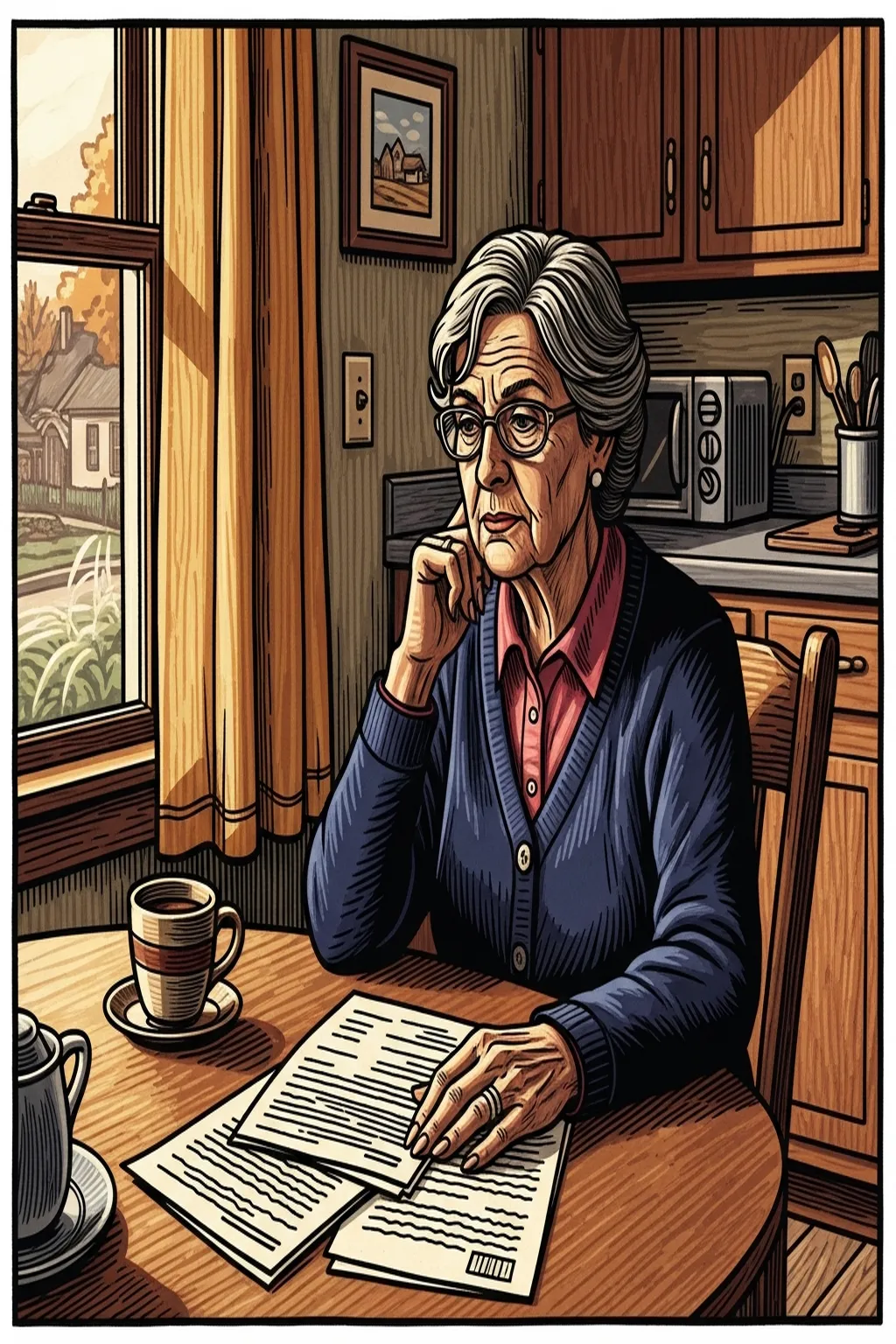
Beverly Hartmann came to see me eight months after her husband Dennis died. She was sixty-four years old, still working three days a week as a dental hygienist in Fond du Lac, and she was two months away from filing for Social Security. She’d done her homework, she thought. She knew her benefit was going to be around $1,100 a month at sixty-four, reduced from what she’d get at sixty-seven, but she needed the income and the logic seemed sound.
Dennis had claimed Social Security at sixty-two. He’d been pushed out of a supervisory job at a printing company in a round of layoffs, found himself with a thin bank account and no immediate prospects, and filed the month after his last paycheck. He got $1,680 a month. He died eleven months later, a heart attack at sixty-three.
Beverly assumed his benefit had died with him.
She was wrong. She was also about to file for the wrong benefit at the wrong time, and the difference between the path she was on and the one actually available to her came out, depending on how long she lives, to somewhere between $35,000 and $60,000 in total payments.
This isn’t unusual. I’ve had some version of this conversation at least a dozen times. Survivor benefits are a separate layer of the Social Security system with their own rules, their own ages, their own strategic logic. They don’t advertise themselves. The Social Security Administration doesn’t send a letter to a widow saying, “By the way, here is what you can now claim.” You have to know to ask.
Who qualifies and what they get
A surviving spouse qualifies for survivor benefits starting at age sixty, or fifty if they’re disabled. Children under eighteen are eligible, as are dependent parents sixty-two and older in limited circumstances. And divorced spouses qualify under specific conditions I’ll get to.
The core math: if you wait until your full retirement age, which is sixty-seven for anyone born in 1960 or later, you can collect one hundred percent of what your deceased spouse was receiving or was entitled to receive. If you claim at sixty, you get seventy-one and a half percent. The benefit scales upward between sixty and sixty-seven, but it doesn’t grow past sixty-seven. There are no delayed retirement credits for survivor benefits. Waiting past your full retirement age earns you nothing extra on this particular benefit.
That last point matters strategically, and I’ll come back to it.
How the deceased’s claiming age affects your benefit
Here’s the part that surprised Beverly.
When a worker dies before claiming Social Security, the surviving spouse can collect one hundred percent of that worker’s full benefit at their own full retirement age. Straightforward.
When a worker dies after claiming reduced benefits early, the survivor benefit is governed by what’s called the widow’s limit. The surviving spouse receives whichever is higher: what the deceased was actually receiving, or eighty-two and a half percent of the deceased’s full retirement benefit.
Dennis claimed at sixty-two and received $1,680 a month. His full retirement benefit at sixty-seven would have been $2,400. Eighty-two and a half percent of $2,400 is $1,980. Beverly’s survivor benefit at her full retirement age of sixty-seven was based on that $1,980 floor, not on the lower $1,680 Dennis was collecting. She didn’t lose the full penalty Dennis took for claiming early, but she did lose something. If he had waited until sixty-five, or sixty-six, she’d have had a higher number to work from.
This is one of the least-discussed reasons why delaying your own Social Security claim matters even after you’re gone. It shapes what your surviving spouse can collect.
The two-claim strategy
Here is what nobody told Beverly before she walked into my office.
She didn’t have to choose between claiming her own benefit and claiming the survivor benefit. She could claim one now and switch to the other later. This isn’t a trick. It’s the designed structure of the system.
Your own retirement benefit grows if you delay claiming past your full retirement age. Eight percent per year, every year you wait from sixty-seven to seventy. A benefit of $1,571 a month at sixty-seven becomes $1,948 a month at seventy. The survivor benefit doesn’t grow that way. It maxes out at full retirement age.
So the strategic question becomes: which one do you claim first, and when do you switch?
If the survivor benefit is larger than your own benefit at full retirement age, the usual play is to claim your own retirement benefit first at whatever age makes sense for your cash flow, then switch to the higher survivor benefit at sixty-seven. You’re using the smaller benefit as income while letting the larger one stay at its maximum.
If your own benefit at seventy would exceed the survivor benefit, the logic flips. You claim the survivor benefit now at a reduced rate, take that income, and let your own retirement benefit grow at eight percent a year until you switch to it at seventy.
Beverly’s own benefit at sixty-seven would have been around $1,571 a month. With delayed credits, at seventy it would reach roughly $1,948. Her survivor benefit at sixty-seven was $1,980. The two numbers were almost identical.
That made her situation a genuine modeling question rather than an obvious call. I ran two scenarios for her.
Path one: She claims her own benefit now at the reduced rate of about $1,100 a month, continues working for two more years, and at sixty-seven switches to the full survivor benefit of $1,980. She collects the smaller benefit for three years, then the larger one for the rest of her life.
Path two: She files for the survivor benefit now at the reduced rate for age sixty-four, collects roughly $1,740 a month, and at seventy switches to her own benefit at $1,948. She takes the larger of the two starting now, then slides sideways to her own benefit later when the delayed credits make them comparable.
Running those two paths out to age eighty-five, the difference was about $38,000 depending on the exact sequence. Both options beat what Beverly was originally planning, which was simply filing for her own reduced benefit at sixty-four and never touching the survivor benefit at all.
The earnings test trap
Beverly was still working. That changes the math.
If you claim any Social Security benefit before your full retirement age and you’re still earning wages, your benefits get reduced if your earnings exceed the annual threshold. In 2025 that limit was $23,400, and it adjusts each year for wage growth. For every two dollars you earn above that line, Social Security withholds one dollar in benefits.
Beverly was earning around $32,000 from her part-time work. About $8,600 over the threshold. Half of that, $4,300 a year, would have been withheld from whatever benefit she claimed. That’s roughly $358 a month she wouldn’t see.
This isn’t money that disappears. Social Security recalculates your benefit when you reach full retirement age and credits you for the months that were withheld. Your benefit going forward gets a modest bump to account for the withheld time. But you don’t have that money now, and for someone managing month-to-month expenses after losing a spouse’s income, the timing gap is real.
The earnings test is a strong practical argument for waiting until sixty-seven to file if you’re still working at a decent wage. After sixty-seven, there is no earnings limit. You can earn $300,000 a year and collect your full Social Security benefit. The test only bites during the years before your full retirement age.
For Beverly, this tilted the decision toward path one: file for her own reduced benefit at sixty-four, which was small enough that some withholding was manageable, continue working two more years, and move to the full survivor benefit at sixty-seven when the earnings test no longer applied.
Divorced spouses
The survivor benefit rules for divorced spouses catch a lot of people off guard, usually pleasantly.
If you were married to someone for ten or more years and that person has since died, you may be eligible for survivor benefits on their record even if you’ve been divorced for twenty years and haven’t spoken since. The requirements: you’re sixty or older, and you’re currently unmarried, or you remarried at age sixty or later.
That last point is worth underlining. If you remarried before sixty, you can’t collect on the ex-spouse’s record unless you’re later widowed or divorced again. If you remarried at sixty or after, you can still collect. The age threshold is sixty, not fifty-nine.
Your claim has no effect on anyone else. The deceased’s current widow doesn’t lose anything. There’s no notification to the family. Your eligibility is based purely on your own work record relative to the ex-spouse’s, and the Social Security Administration will look at every record you might be eligible for and pay you the highest one.
I’ve seen cases where someone eligible on both a current spouse’s record and a former spouse’s record discovered the former spouse had been a higher earner. The benefits from the second marriage, the one that stuck, were actually smaller. Nobody in that situation had thought to ask the question.
The ten-year marriage requirement is firm. Nine years and eleven months doesn’t qualify. The SSA uses the actual dates from the marriage certificate to the divorce decree. If you’re unsure whether you’re close to that threshold, it’s worth looking up the actual dates before assuming the answer.
For standard surviving spouses (not divorced), the marriage only needs to have lasted nine months, with limited exceptions for accidents and military service. The bar is lower than most people assume.
What Beverly did, and what you should do before you file
Beverly filed for her own reduced retirement benefit at sixty-four. She continued working. At sixty-seven she will switch to the full survivor benefit of $1,980 a month, at which point the earnings test no longer applies and she can work as much as she wants. The expected difference over her planning horizon is meaningful enough that she called me two days later to say she’d told her sister about it.
The mechanics: to claim survivor benefits, you generally need to contact the Social Security Administration directly, either at an SSA office or by calling them. You can’t file for survivor benefits online the same way you can for your own retirement benefit. Bring the marriage certificate and the death certificate. They’ll tell you exactly what you’re eligible for.
I want to make one more point, which connects survivor benefits to something I’ve written about in different contexts.
The survivor benefit flows automatically through Social Security based on your marital record. There’s no beneficiary designation form to fill out, no document to update. But everything else your spouse had: the IRA, the 401(k), the life insurance policy, those require beneficiary designations, and those designations are entirely independent of any will you wrote. A beneficiary form overrides a will. Always. It doesn’t matter what the will says. If the 401(k) still lists an ex-spouse from a first marriage as beneficiary, that’s where the money goes. The will doesn’t save you.
I’ve covered this in Living Trust vs. Will: The Question Most People Get Wrong. The short version here is that reviewing beneficiary designations is a thirty-minute task that roughly half my clients haven’t done in the past decade.
If you want to go deeper on your own Social Security retirement benefit strategy, the delay math, and the break-even calculations for early versus late claiming, The Social Security Math They Don’t Show You covers that ground in detail. The survivor benefit is a separate layer on top of that. Once you understand both, you can see the actual decision in front of you.
Beverly didn’t know she had that decision to make until she sat down across from me. She’d been eight weeks from filing, which would have locked her into a path that left real money behind. That’s the part that gets me. The information exists. The SSA will answer your questions if you call. A fee-only financial planner can model both scenarios in an hour.
The problem isn’t that the rules are hidden. It’s that nobody thinks to ask until they need to, and by then they’ve sometimes already filed.