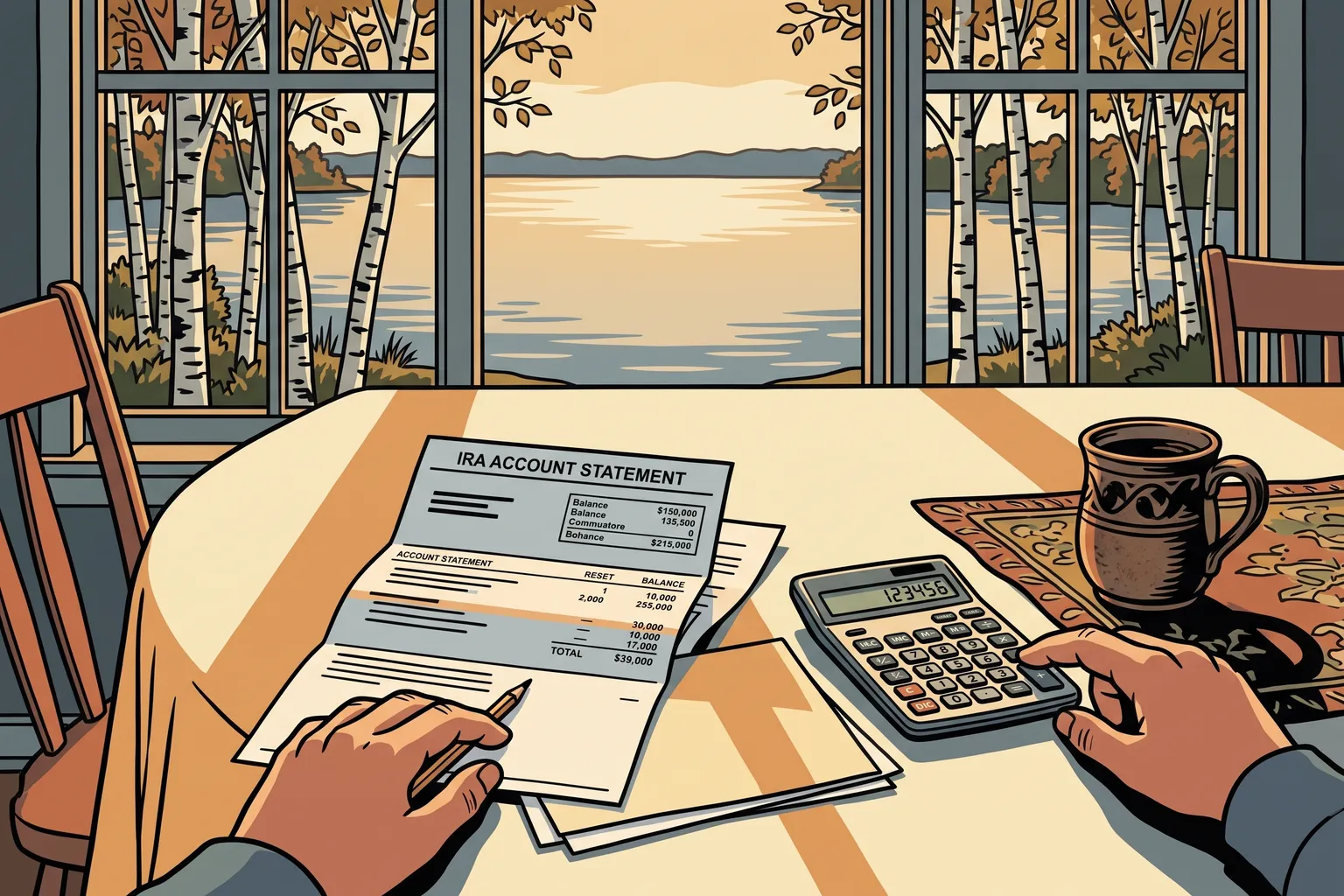
Think about a couple I’ll call the Halvorsons. Both 64. Both retired six months ago after a combined fifty-some years of putting money into 401(k)s and traditional IRAs. They have $800,000 in those accounts. They are living on $80,000 a year, drawn from taxable savings and a modest pension, and they haven’t touched the IRAs yet. Social Security can wait. They are healthy and cautious and doing everything right.
They are also, right now, in the middle of the most important tax planning window of their financial lives. And they don’t know it.
The window is the gap between retirement and the day your required minimum distributions and Social Security together push your taxable income back up into territory you haven’t seen since you were working. Under the SECURE 2.0 Act, the age when required minimum distributions begin is 73 if you were born between 1951 and 1959, and 75 if you were born in 1960 or later. The Halvorsons, born in the early 1960s, have until 75. That gives them roughly eleven years of this low-income stretch if they retire at 64. Most people with this kind of IRA balance have no idea the window is that long.
Here is what the window actually looks like. When the Halvorsons were working, their combined income might have been $140,000 or $160,000 a year, putting them firmly in the 22% or even 24% federal bracket. Now their taxable income, with the pension and investment returns from the taxable account, runs around $60,000 a year. After the standard deduction for a married couple, taxable income is closer to $30,000. They are sitting in the 12% bracket for the first time since their thirties. That rate, for 2026, runs to roughly $97,000 of taxable income for married filers.
This is where the Roth conversion strategy comes in.
A Roth conversion means you take money from your traditional IRA, pay income tax on it this year, and move it into a Roth IRA where it grows tax-free and stays tax-free forever. No tax on qualified withdrawals. No required minimum distributions. Ever. The question isn’t whether Roth money is better than traditional IRA money. It almost always is. The question is at what rate you pay the tax to get it there. The window is when the rate is lowest.
The Halvorsons convert $40,000 this year. Their taxable income rises from roughly $30,000 to $70,000. They are still comfortably inside the 12% bracket. The federal tax on that $40,000 conversion is approximately $4,800. They pay it from their taxable savings account, which is the right move: paying conversion taxes from the IRA itself defeats part of the purpose. They repeat this for eight years. They move $320,000 out of the traditional IRA and into Roth. They pay around 12% on each dollar along the way.
Now fast-forward to 75. Social Security has kicked in. A couple receiving $45,000 per year in combined benefits will have 85% of those benefits subject to income tax once combined income crosses the relevant thresholds, and the Halvorsons’ other income easily clears those thresholds. Their required minimum distribution, calculated on whatever remains in the traditional IRA, might generate another $20,000 or $25,000 in mandatory ordinary income, whether they need it or not. The 22% bracket stops being hypothetical. Every dollar they converted during the window at 12% is now sitting in Roth, outside of that calculation entirely.
That’s the trade. It isn’t complicated. It’s just invisible until someone points at it.
Three things that can go wrong
The first is IRMAA, which stands for Income-Related Monthly Adjustment Amount. This is the surcharge Medicare adds to your Part B and Part D premiums when your income crosses certain thresholds. In 2026, the first tier for married couples filing jointly starts at roughly $212,000 in income. The Halvorsons, converting $40,000 a year on top of $80,000 in other income, are nowhere near that number. But a retiree who tries to convert $150,000 in a single year to “get ahead of it” can spike their income and trigger IRMAA two years later, because Medicare looks at your tax return from two years prior. You make a conversion decision in 2026, and the premium bill arrives in 2028. Most people don’t connect the two. A CPA who runs the numbers before December 31 every year will catch it.
The second is the 5-year rule. Roth IRA earnings have to sit for five years from the date you first funded a Roth account before they can be withdrawn completely tax-free. If you’re 64 and you’ve never had a Roth IRA before, the earnings on money you convert today won’t be tax-free until you’re 69. The converted principal, your $40,000 itself, can come out penalty-free any time because you’re over 59 and a half. But the growth on it is a different matter until the clock runs. The fix is simple: open a Roth IRA now, even with a small contribution if you’re still working or a small initial conversion, and start the clock before you begin converting in meaningful amounts.
The third, and really the one that matters most, is doing this without modeling it first. A Roth conversion doesn’t happen in isolation. It interacts with how much of your Social Security becomes taxable, whether you hit the IRMAA threshold, what your state income tax situation looks like, and where you are in relation to the 0% long-term capital gains bracket, which is a separate benefit that aggressive Roth conversions can eat into. The right conversion amount in any given year is specific. I’ve seen CPAs who review this annually with retired clients every October or November, before the year-end deadline, and adjust the conversion figure to maximize the benefit without crossing any of the tripwires. That annual review is not exotic financial planning. It’s basic due diligence. If your accountant isn’t doing it, ask whether they’ve looked at your situation in those terms. If they don’t know what you’re talking about, that’s useful information.
What the window closing actually looks like
The math changes faster than most people expect once RMDs begin. A couple with two Social Security checks, a traditional IRA generating mandatory distributions, and some investment income can find themselves with $80,000 or $90,000 in taxable income before they’ve spent a voluntary dollar. The 22% bracket isn’t a distant abstraction; it’s the rate on every dollar you convert after that point, and conversions once RMDs begin are limited anyway by the fact that you must take the distribution first. You can’t use RMD dollars for a Roth conversion. They come out as ordinary income regardless of what you want to do with them.
There’s also the inheritance angle, which is worth a sentence. Traditional IRA money that passes to your children or other non-spouse beneficiaries is ordinary income to them on the way out. They’ll pay taxes on those dollars at their own marginal rate, on the IRS’s mandatory timetable. Roth money they inherit passes tax-free. If you have one account that’s going to outlast you, Roth is almost always the better one to leave.
The Halvorsons aren’t a complicated case. They are the median retiree: disciplined savers, no pension windfall, no trust fund, two Social Security checks waiting at the end of the runway. What they have, right now at 64, is something they’ve never had before and won’t have again: eleven years of predictably low taxable income, a traditional IRA full of money that hasn’t been taxed yet, and a Roth conversion window wide open.
It won’t stay open.
If you’re in retirement or close to it, not yet drawing Social Security, and sitting on a traditional IRA, this is the piece of your financial situation most worth examining this year. The information isn’t hard to find. The modeling, done correctly by a CPA or fee-only financial planner, isn’t expensive relative to what it’s worth. This doesn’t require a sophisticated investor. It requires a calendar and a tax return and someone willing to run the numbers before December 31.
Get the numbers run.