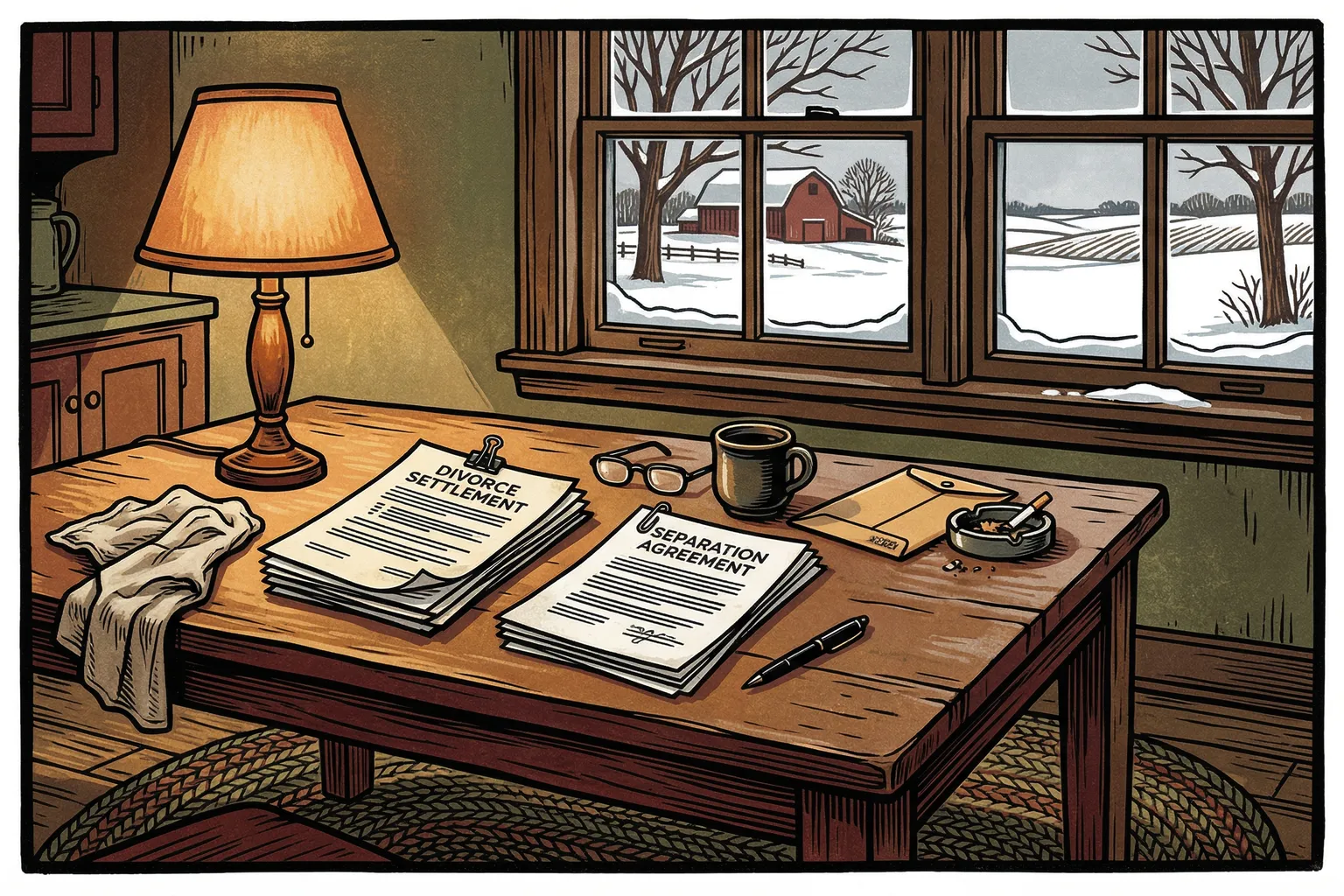
A woman called me last October. Her name was Karen, and she lived outside of Green Bay. Her father had died in July. He had a will. It was a perfectly good will, drafted by an attorney, signed, witnessed, notarized. Everything in order.
And none of it mattered, because the will still had to go through probate.
Nine months later, when I talked to Karen, the estate wasn’t settled. The attorney fees had reached $18,000. The house, which her father wanted sold and split between Karen and her brother, sat empty with the furnace running and the property taxes coming due. She couldn’t sell it. She couldn’t rent it. She couldn’t touch the bank accounts. Everything was frozen in a court process that her father never knew existed and that a $1,200 trust document would have avoided entirely.
“Nobody told him,” Karen said. “Nobody told us.”
That sentence is why I’m writing this piece.
The question people actually have
Most people who search for “living trust vs. will” are asking the wrong question. They think they’re choosing between two documents, like picking between two insurance policies. Option A or Option B. Which one is better?
Neither one is better. They do different things. And the real question, the one that actually matters for your family, is this: which problems are you trying to solve, and in what order?
If you get that question right, the documents follow. If you get it wrong, you end up like Karen’s father. A perfectly drafted will, a perfectly avoidable disaster.
What probate actually is
Probate is the court process that validates your will after you die. A judge reviews the document, confirms it’s legitimate, appoints an executor, and supervises the distribution of your assets. It sounds orderly. It is orderly, in the way that standing in line at the DMV is orderly. It works. It just takes forever and costs more than it should.
In most states, probate takes six to eighteen months. In states with complicated probate codes, like California, it can take longer. The costs vary, but attorney fees typically run 2% to 5% of the estate’s value. On a $400,000 estate, that’s $8,000 to $20,000. On a $300,000 estate, you’re looking at $6,000 to $15,000. These are real dollars coming out of your family’s inheritance to pay for a court process that exists primarily because you used a will instead of a trust.
There are also court filing fees, executor fees, and appraiser fees. And everything is public record. Your will, your assets, your beneficiaries, the value of every account and piece of property you owned. Anyone can look it up. If you’ve never thought about that, think about it now.
Probate isn’t a punishment. It’s a system designed for an era when wills were the only game in town. The problem is that better tools exist now, and most people don’t know about them until it’s too late.
What a will does (and what it can’t do)
A will does three important things. It names who gets your stuff. It names who manages the process of distributing your stuff (your executor). And if you have minor children, it names who raises them.
That last one is critical. If you have children under eighteen, you need a will. A trust cannot name a guardian for your children. Only a will can do that.
But here’s what a will cannot do: it cannot avoid probate. Every will, no matter how well drafted, must pass through the probate court before your executor can act on it. That’s the fundamental limitation. A will is an instruction set that only activates after a judge says it can.
A will also cannot help you if you become incapacitated. If you have a stroke tomorrow and can’t manage your finances, your will is useless. It only works after death. For incapacity, you need a different set of documents, which I’ll get to.
What a revocable living trust actually is
A revocable living trust is a legal container you create while you’re alive. You transfer your assets into it. Your house, your bank accounts, your investment accounts. The trust owns them, but you control the trust. You’re the trustee. You can buy, sell, spend, change beneficiaries, or dissolve the whole thing tomorrow morning. Nothing changes in your daily life.
The difference shows up when you die. Assets inside the trust don’t go through probate. They pass directly to your beneficiaries according to the trust’s instructions, managed by the successor trustee you named. No court, no judge, no attorney fees beyond what you already paid to set it up. The timeline drops from months to weeks. Karen’s father’s house could have been listed by September.
The cost of setting up a revocable living trust with an attorney ranges from $1,000 to $3,000 for a married couple, depending on complexity and where you live. Online services run $300 to $600, though I’d recommend an attorney for anything beyond the simplest situations. Compare that to the $18,000 Karen’s family paid in probate fees and you can see the arithmetic.
A trust also provides privacy. Unlike a will, which becomes public record, a trust is a private document. Your assets, your beneficiaries, and your wishes stay between you and your family.
And a trust works during your lifetime. If you become incapacitated, your successor trustee steps in and manages the trust assets without court involvement. No conservatorship hearing. No judge deciding who controls your money. The person you chose, chosen while you were competent to choose, handles it.
When a will is enough
Not everyone needs a trust. I want to be honest about that because the estate planning industry has a financial incentive to sell trusts to everyone, and I don’t have that incentive.
If your estate is small and simple, say under $100,000 in probatable assets, the cost of probate may be low enough that a trust isn’t worth the setup fee. Many states have simplified probate procedures for small estates. Wisconsin, where I live, allows a simplified process for estates under $50,000.
If you’re young with few assets and minor children, a will is the priority. You need that guardian designation. You can add a trust later when your assets grow.
If nearly all your assets pass outside of probate already, through beneficiary designations on retirement accounts and life insurance, through joint ownership on your house, through payable-on-death designations on bank accounts, then probate may have very little to process. In that case, a will serves as a safety net for anything you missed.
The key question is: what assets would actually go through probate? If the answer is “not much,” a will may be sufficient. If the answer includes a house, significant bank accounts, or investment accounts without beneficiary designations, a trust starts making financial sense very quickly.
When a trust is worth every dollar
A trust is worth the cost when you own real estate, especially in more than one state. If you own a home in Wisconsin and a condo in Arizona, without a trust your family faces probate in both states. That’s two sets of attorneys, two court processes, two timelines. A trust eliminates both.
A trust is worth it when you want to control the timing of distributions. If you have an adult child with poor money habits or an addiction, a trust lets you structure how and when they receive their inheritance. A will gives them a lump sum. A trust can give them $2,000 a month.
A trust is worth it when privacy matters. Wealthy families, families with complicated dynamics, families with a member who might contest the estate. All of these benefit from the privacy a trust provides.
A trust is worth it when you’re over sixty and your assets are substantial enough that probate costs would exceed the cost of the trust. For most people with $200,000 or more in probatable assets, the math favors the trust. It’s not close.
And if you’re choosing where to retire, you should know that probate costs and timelines vary dramatically by state. That’s a factor most retirement guides never mention.
What neither document can do alone
Here’s where people get into trouble. They set up a trust or draft a will and believe they’re done. They’re not.
A trust isn’t a substitute for a power of attorney. If you become incapacitated, your successor trustee can manage the assets inside the trust, but they can’t file your tax return, manage your Social Security benefits, deal with your Medicare, or handle any asset you forgot to put in the trust. For that, you need a durable power of attorney, a separate legal document that gives someone you trust the authority to act on your behalf in financial matters.
A trust isn’t a substitute for a healthcare directive. If you can’t make medical decisions, your trustee has no authority over your medical care. You need an advance healthcare directive (sometimes called a living will, which is confusingly different from a regular will) and a healthcare power of attorney.
I wrote about this in my piece on the long-term care conversation. The families who get hurt worst are the ones who had some documents but not all of them. They thought they were covered. They weren’t.
A complete estate plan is four documents: a will, a trust (if appropriate), a durable financial power of attorney, and an advance healthcare directive with healthcare power of attorney. Most attorneys will prepare all four together for $1,500 to $3,500. If you only get one, you’ve left a gap that will cost your family more in time, money, and anguish than the missing document would have cost to draft.
If you have an elderly parent and you haven’t had this conversation yet, the document to ask about first is the power of attorney for an elderly parent. Not because it’s the most important. Because it’s the one that matters while they’re still alive, and it becomes impossible to create once they’ve lost capacity. I’ve sat across the table from families who waited one month too long. There is no fix for that. None.
The mistakes I see every year
The unfunded trust. This is the most common and most expensive mistake. Someone pays $2,000 to have a beautiful trust drafted. It sits in a drawer. They never transfer their assets into it. When they die, the trust is an empty container. Every asset goes through probate anyway, because the assets were never retitled in the trust’s name. I see this at least three or four times a year, and every time it breaks my heart a little, because someone paid good money for the solution and then didn’t finish the job. Your attorney should help you fund the trust. If they don’t offer, ask. If they won’t help, find a different attorney.
The outdated beneficiary designations. Your 401(k), your IRA, your life insurance, all of these pass to whoever is listed as the beneficiary on the account, regardless of what your will or trust says. I’ve seen cases where an ex-spouse inherited a $300,000 IRA because the account holder forgot to update the beneficiary form after the divorce. The will said “everything to my current wife.” The beneficiary form said the ex-spouse’s name. The beneficiary form won. It always wins.
Check your beneficiary designations today. Every retirement account, every insurance policy, every payable-on-death account. If the names are wrong, fix them this week. This costs nothing and takes thirty minutes.
The handshake estate plan. I worked with a couple, two men who had been together for twenty-two years. They owned a home together, had combined savings of roughly $450,000, and had no legal documents of any kind. No will, no trust, no power of attorney. They trusted each other completely and assumed that trust was enough.
It wasn’t. When one of them was hospitalized, the other had no legal authority to make medical decisions, access bank accounts, or even visit during restricted hours in the ICU. They had to go through an emergency guardianship proceeding while one of them was in critical care. It cost $7,500 in legal fees, took three weeks, and was entirely preventable with documents that would have cost $2,000 and an afternoon.
If you’re in a relationship, married or not, the documents matter more, not less. Marriage provides some legal protections automatically. Unmarried partners have almost none. If your partner is the person you want making decisions for you, you need it in writing.
The one thing I tell every client
I spent thirty years in financial planning, and I’ve written about Social Security timing, the psychology of spending in retirement, and the fee structures that cost people thousands. But if I could only give one piece of financial advice to every person reading this, it wouldn’t be about investments or tax strategies. It would be this:
Get your estate documents in order before you think you need them. Because by the time you need them, it’s too late to get them.
You don’t need to be wealthy. You don’t need to be old. You don’t need to be sick. You need to be a person who has assets, relationships, and opinions about what should happen to both. If that describes you, and it describes nearly everyone reading this, then you need a plan.
Start with the power of attorney and healthcare directive. Those protect you while you’re alive. Then decide whether a will alone is sufficient or whether a trust makes sense for your situation. If you own a home and have more than $200,000 in assets, the trust probably makes sense. If your situation is simpler, a will with proper beneficiary designations may be enough.
Don’t use your brother-in-law who “does some legal work.” Don’t download a form from the internet and assume it’s valid in your state. Estate law varies by state, and the consequences of getting it wrong land on the people you love most.
Find an estate planning attorney. Pay the $1,500 to $3,500 it costs to do this properly. It will be the best money you ever spend for your family, and you won’t be around to hear them say thank you for it. That’s all right. They’ll know.
Karen’s father was a good man who loved his children and had a will that said so. But the will couldn’t do the one thing his family needed most: keep them out of a courtroom for nine months while they were still grieving.
A trust could have. For $1,200, it could have.
The information exists. You have it now. Go use it.