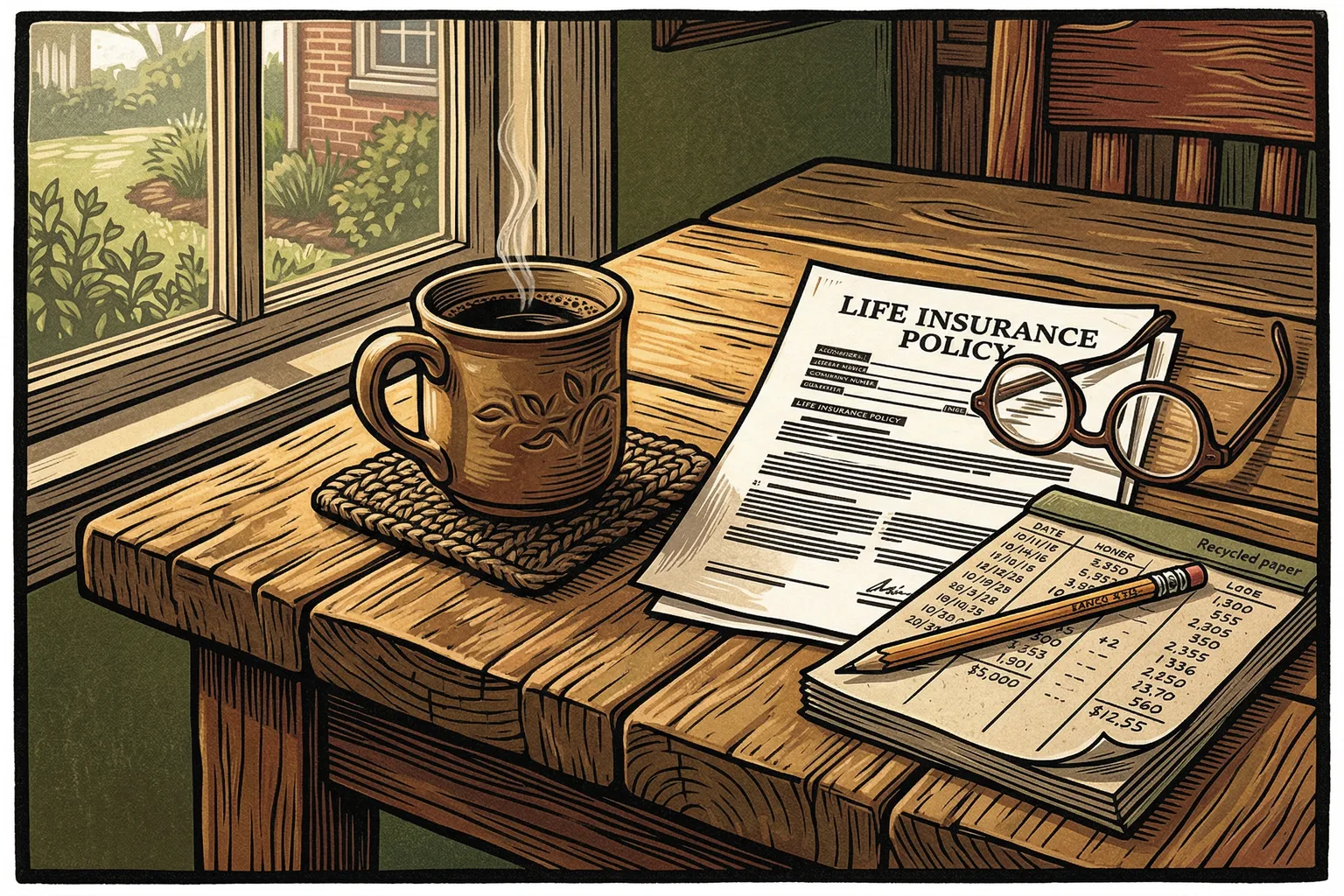
A man I worked with years ago, a retired machinist from Oshkosh named Ray, came to see me when he was sixty-four. His wife, Patty, had found an ad in the back of a magazine for a guaranteed acceptance life insurance policy. No medical exam. No health questions. $25,000 in coverage for $85 a month. She’d already called the number. She was ready to sign up.
Ray wanted to know if it was a good deal.
It wasn’t. I’ll explain why in a moment. But the reason Patty wanted that policy is the reason I’m writing this piece, and it’s a reason worth respecting. She wanted to know that if something happened to Ray, she wouldn’t be stuck. She wouldn’t be calling her kids asking for money to cover the funeral, the last round of medical bills, the three months of mortgage payments while she figured out what came next. She wanted to take care of it. Both of them did.
That impulse, the impulse to protect the people you love from a financial mess you could have prevented, is exactly right. It’s one of the most generous things a person can do. The problem is that the life insurance industry knows this about you, and it has built an entire sales apparatus around that generosity. Some of what it sells is worth buying. A lot of it isn’t. And the difference can cost you tens of thousands of dollars over the last decades of your life.
So let’s walk through this the way I’d walk through it if you were sitting across from me with a cup of coffee, which is how I’ve done this roughly four hundred times.
Why the math changes after 60
When you’re thirty-five with a mortgage, two kids, and a spouse who’d be financially devastated if you died tomorrow, the life insurance calculation is straightforward. You need a lot of coverage. You need it cheap. You buy a twenty-year term policy for $500,000 or $750,000 and you pay $40 a month and you don’t think about it again until the term expires.
That calculation doesn’t apply anymore.
By sixty, most people have paid off or significantly reduced their mortgage. The kids are grown. The spouse, if there is one, likely has their own Social Security benefit, their own retirement savings, maybe a pension. The financial crater that your death would have caused at thirty-five is smaller now. Sometimes much smaller. Sometimes it’s barely a dent.
This is good news, and I want you to hear it as good news. It means you may not need as much life insurance as you think. It might mean you don’t need any at all. And understanding that is the first step to making a smart decision, because the industry will never tell you that you don’t need their product. That’s not how the economics work.
But for some people over sixty, life insurance still makes real sense. The question is whether you’re one of them.
Who still needs coverage (and who probably doesn’t)
You probably still need some form of life insurance if any of the following is true:
Your spouse depends on your income or your Social Security benefit to maintain their standard of living. This is the big one. If you’re the higher earner and your spouse would lose a significant portion of household income when you die (your Social Security benefit drops to the survivor benefit, your pension stops or reduces), that gap is real. Life insurance can fill it.
You have outstanding debts that would burden your surviving family. A mortgage balance, a home equity loan, medical debt that would pass to a surviving spouse in your state.
You have a dependent, an adult child with a disability, a grandchild you’re raising, an aging parent you support financially.
You want to leave a specific financial legacy. Maybe you want to make sure each grandchild has $10,000 for college. Maybe you want to ensure your spouse can stay in the house without touching retirement savings. Maybe you want to cover your final expenses so your kids don’t have to.
You own a small business and need to fund a buy-sell agreement or cover business debts.
Now here’s the honest part. You probably don’t need life insurance if your spouse would be financially secure without it. If both of you have adequate retirement savings, Social Security, and no significant debt, then a life insurance premium is money leaving your pocket every month for a benefit your family may not need. That $200 a month over fifteen years is $36,000. I’d rather see that money in an index fund or spent on something that improves your actual life.
I’ve told clients this. Some of them were relieved. Some of them were surprised, because no insurance agent had ever suggested they might not need the product.
The types that matter at this age
There are really three categories worth understanding.
Term life insurance is temporary coverage. You buy it for a set period, ten, fifteen, or twenty years, and if you die during that period your beneficiaries receive the death benefit. If you outlive the term, the policy expires and you get nothing back. This isn’t a flaw. This is how insurance is supposed to work. You’re paying for protection during a specific window of financial vulnerability.
At sixty, term life is still available and still the cheapest option per dollar of coverage. A healthy sixty-year-old man can get a twenty-year, $250,000 term policy for roughly $250 to $350 a month, depending on health classification. A healthy sixty-year-old woman will pay less, typically $175 to $275 for the same coverage. At sixty-five, those numbers jump. At seventy, they jump again. And at seventy-five, most term policies are either unavailable or so expensive they no longer make economic sense.
The window for term life narrows as you age. If you need it, buy it early in your sixties while your health still qualifies you for the best rates.
Permanent life insurance (whole life or universal life) covers you for your entire life as long as premiums are paid. It also builds a cash value component. The premiums are dramatically higher than term. A $100,000 whole life policy for a sixty-year-old might cost $500 to $800 a month.
I have written before about my skepticism toward whole life as an investment vehicle. The cash value grows slowly, the fees are steep, and the returns typically lag what you’d earn in a simple index fund. But there is a narrow set of people for whom permanent insurance makes sense: those with a taxable estate large enough to face federal estate tax (the exemption is currently around $13.99 million per individual, though this may change), those funding an irrevocable life insurance trust for estate liquidity, or those with a lifelong dependent who will need support after the policyholder dies. If none of those describe you, permanent life insurance is probably not the right tool.
Final expense or burial insurance is a small whole life policy, typically $5,000 to $25,000, designed to cover funeral costs, outstanding medical bills, and other end-of-life expenses. Premiums are lower because the coverage amounts are lower. A $15,000 final expense policy for a sixty-five-year-old might run $50 to $100 a month.
This is the category where I see the most people over sixty getting sold something, and where the traps are most common.
The traps you need to know about
The life insurance market for people over sixty is full of products that sound good in a thirty-second television ad and look different when you read the contract. Here are the ones I see most often.
Guaranteed acceptance policies with waiting periods. This is what Patty almost bought for Ray. These policies require no medical exam and no health questions. Anyone can get one. That should immediately tell you something about the pricing, because the insurer is accepting everyone, including people in poor health, and they’re pricing that risk into the product.
The catch is the waiting period, usually two to three years. If you die during the waiting period, your beneficiaries don’t receive the full death benefit. They get a return of premiums paid, plus maybe 10% interest. So if Ray had signed up, paid $85 a month for eighteen months ($1,530 total), and died, Patty wouldn’t have received $25,000. She’d have received roughly $1,680.
Read that again. The policy that was supposed to protect Patty would have paid her back almost exactly what they’d put in. The insurer kept the risk-free float for a year and a half and called it coverage.
Guaranteed acceptance policies have their place. If you have serious health conditions that make you uninsurable through any other channel, they may be the only option. But they should be the last resort, not the first call. Always apply for a simplified issue policy first (one that asks a limited set of health questions but doesn’t require a full medical exam). The premiums are significantly lower, the coverage starts immediately, and most people over sixty can qualify if they don’t have a terminal diagnosis or certain serious conditions.
Riders that eat the policy value. Some policies come loaded with riders, add-on features like accelerated death benefits, accidental death benefits, or chronic illness riders. Some of these are genuinely useful. Some of them sound useful but carry costs that quietly erode your death benefit over time. The accidental death rider, for instance, pays an extra benefit if you die in an accident. Statistically, most people over sixty don’t die in accidents. You’re paying for a coverage trigger that is very unlikely to fire. Read the rider costs. Ask what each one adds to your monthly premium. If you can’t explain why you need it, you probably don’t.
The funeral home upsell. Some funeral homes have arrangements with insurance companies to offer policies at the time of pre-planning. The setting, a conversation about your funeral, creates an emotional urgency that benefits the seller. You’re already thinking about your family. You’re already thinking about the burden. The policy is presented as part of the planning package.
This isn’t the right time or place to buy insurance. The policies offered through funeral home partnerships tend to be more expensive than what you’d find by shopping independently, and the comparison shopping that every insurance purchase requires is impossible when you’re sitting in a funeral director’s office. Pre-plan your funeral if you want to. Buy your insurance separately.
How to calculate what you actually need
This is simpler than the industry wants you to believe.
Start with the gap. If you died tomorrow, what financial obligations would your family face that they couldn’t cover with existing resources? Be specific. I’ve walked clients through this with a pencil and a piece of paper, and it usually comes down to four categories.
Final expenses: funeral, burial or cremation, outstanding medical bills. The median funeral cost in America is roughly $8,000 to $12,000. Cremation is less, often $2,500 to $7,000 depending on whether there’s a viewing and memorial service.
Debt: remaining mortgage balance, car loans, credit card debt, anything that would fall to a surviving spouse or estate.
Income replacement: if your spouse depends on your income or Social Security, estimate how many years of support they’d need and at what annual amount. A sixty-five-year-old surviving spouse who needs $20,000 a year in additional income for ten years needs $200,000 in coverage (simplified; actual planning should account for inflation and investment returns, but this gets you in the right neighborhood).
Specific goals: college funding for grandchildren, charitable gifts, equalization among heirs if one child is receiving a house and others aren’t.
Now subtract what’s already covered. Your existing savings, retirement accounts, other life insurance policies still in force, Social Security survivor benefits, pension survivor benefits. If the number after subtraction is zero or negative, you likely don’t need additional life insurance. If there’s a gap, that gap is your coverage target.
I’ve done this calculation with people who were convinced they needed $200,000 in coverage and discovered they needed $30,000. I’ve done it with people who thought they needed nothing and discovered a $150,000 gap because they hadn’t accounted for the Social Security income their spouse would lose.
Do the math. Don’t guess.
When it makes sense and when it doesn’t
If you’re sixty-two, in good health, with a spouse who depends on your income, and you have a specific, calculable gap, a ten or fifteen-year term policy is likely the smartest and cheapest solution. Buy it now while you can still qualify at reasonable rates.
If you’re sixty-eight, healthy, with no debts, adequate savings, and a spouse who is financially independent, you probably don’t need life insurance. Put the premium money into your retirement accounts or spend it on something that makes your life better. I wrote about the psychology of spending in retirement and this is a case where giving yourself permission to spend rather than insure is the right financial move.
If you’re seventy-three and you want to make sure your funeral costs don’t land on your children, a small final expense policy of $10,000 to $15,000 may be worth it, especially if your liquid savings are tied up in retirement accounts your spouse will need. Shop for a simplified issue policy first. Only go guaranteed acceptance if you can’t qualify for anything else.
If you’re being told you need a $100,000 whole life policy at sixty-seven and you don’t have a taxable estate or a lifelong dependent, someone is selling you something you don’t need. The commission on that policy is making someone else’s boat payment. I’ve written about how to spot the fees they never show you and the same skepticism applies here.
And if you haven’t done your estate planning yet, do that first. A $15,000 life insurance policy means nothing if your beneficiary designations are wrong, your power of attorney is missing, and your family ends up in probate court for nine months anyway. The documents come before the products. Always.
What I told Ray and Patty
I told them the guaranteed acceptance policy was a bad deal. I told them why. I showed them the waiting period clause and the math on what Patty would actually receive if Ray died in the first two years.
Then I told them what Patty really wanted, which was security, and I showed them they mostly had it already. Ray’s Social Security was $2,400 a month. Patty’s was $1,100. They had $180,000 in retirement savings and a paid-off house. When Ray died, Patty would step up to his Social Security benefit, keeping the higher of the two. She’d lose his $2,400 but gain a survivor benefit of the same amount. Her total income would drop, but not catastrophically. The retirement savings were there for the gap.
What they actually needed was a $10,000 final expense policy to cover funeral costs so Patty wouldn’t have to pull from savings during a hard time. We found a simplified issue policy from a well-rated insurer for $48 a month. Full coverage from day one. No waiting period.
Patty signed the paperwork and then she said something I’ve never forgotten. She said, “I just didn’t want him to leave me with a mess.”
He didn’t. They took care of it together, on a Tuesday afternoon, for $48 a month. That’s what this is, when you do it right. Not planning for death. Just taking care of the people who matter while you still can.
The information exists. You have it now.