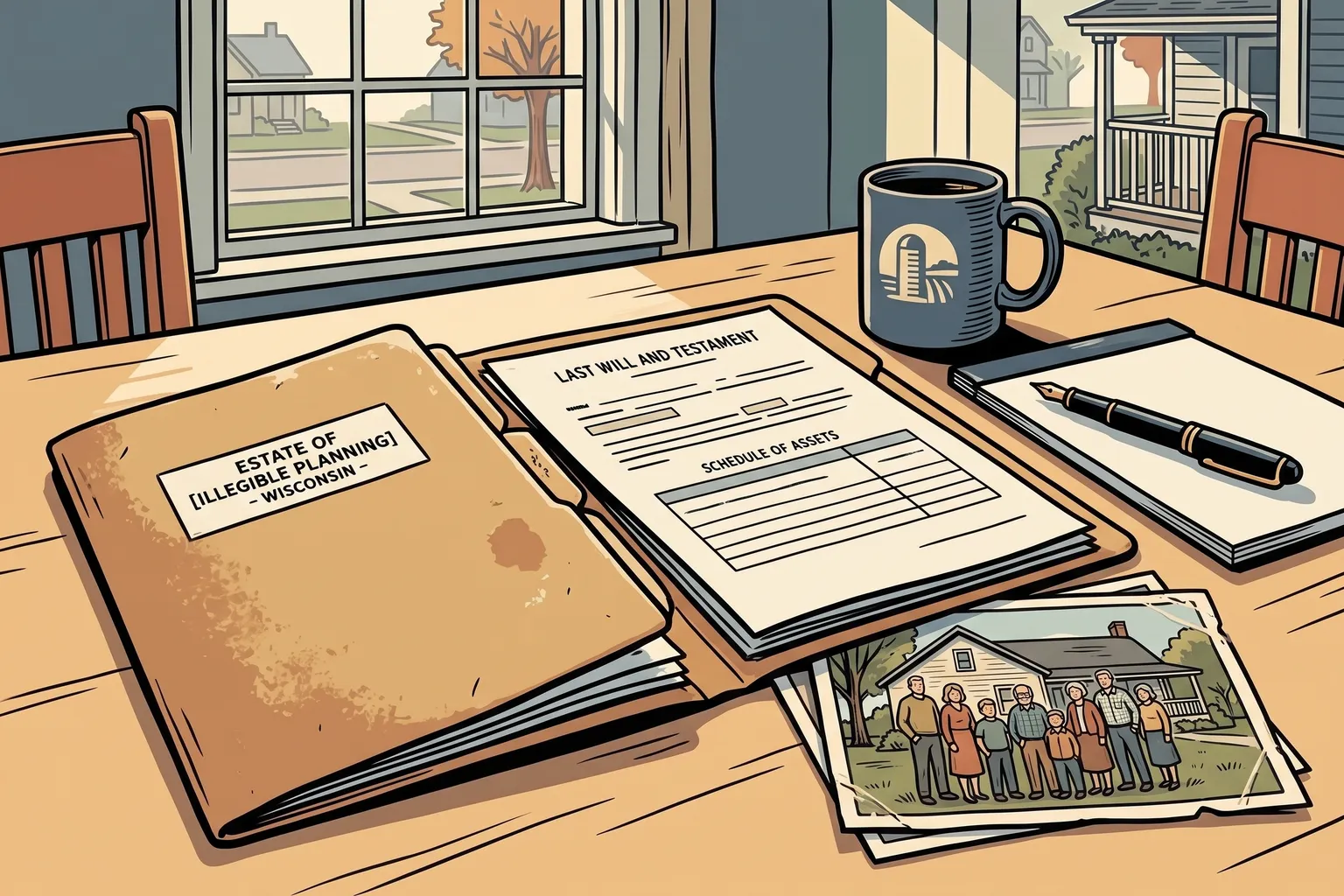
The Halverson family of Green Bay had done everything right. Both parents were in their early seventies. They had a fully funded revocable living trust that had been updated two years before the father died. Durable powers of attorney, healthcare directives, a clean will that named the trust as the primary beneficiary. They’d spent $4,200 on a good estate attorney and followed every instruction.
Their gross estate came to $1.2 million. Their three children received $910,000.
That $290,000 gap wasn’t the result of bad planning. It was the result of something nobody had addressed: what happens after the estate plan is signed. The legal work was excellent. The inheritance planning was nonexistent.
That’s the distinction I want to be precise about. Estate planning is the legal architecture: the will, the trust, the powers of attorney, the beneficiary designations, the retitling of assets. Inheritance planning is everything that determines what your heirs actually walk away with. The two aren’t the same thing, and conflating them is one of the most expensive mistakes in personal finance.
The Three Triggers (and Why Most Plans Only Cover One)
When financial planners talk about estate planning, they almost always mean death. Your documents assume you’ll be alive until you’re not, and then the machinery kicks in.
But estates can be disrupted by two other triggers: disability and incapacity. If you spend eighteen months in memory care before you die, and your power of attorney was drafted narrowly, or your agent doesn’t know where the accounts are or what authority they actually have, assets can sit frozen or mismanaged during a period when your family can least afford the friction. That’s not a hypothetical. I’ve watched it happen. It’s how estates quietly lose $40,000 to $80,000 in mismanaged investments, unpaid bills that turn into liens, and legal fees that a properly drafted durable power of attorney and a single conversation would have prevented.
The fix isn’t a different document. It’s making sure your agent knows they have authority, knows where everything is, and knows what you want. That’s inheritance planning territory. The power of attorney is the document. The conversation is what makes it work.
The Gap Between What You Owned and What Your Heirs Receive
Here’s the number that tends to leave families stunned at the lawyer’s office: the difference between gross estate value and net inheritance. Let me walk through the main contributors.
Federal estate taxes don’t touch most households. The exemption is generous enough that only estates well into the millions trigger federal liability. But there’s a layer below the federal threshold that catches people who’ve stopped paying attention.
Five states currently impose a separate state inheritance tax on top of federal rules: Kentucky, Maryland, Nebraska, New Jersey, and Pennsylvania. Rates vary by state and by the beneficiary’s relationship to the deceased, ranging roughly from 1 to 16 percent (Tax Foundation). If you live in one of these states, or if your heirs live there (state rules differ on who pays), that’s not an abstraction. On a $900,000 estate with assets passing to adult children, the spread between states is wide: Nebraska exempts the first $100,000 per heir and taxes the rest at 1 percent, so three children would owe roughly $6,000 in total, while Pennsylvania taxes lineal descendants at a flat 4.5 percent, or about $40,500. Check your state before assuming you’re clear.
Probate costs are the quieter drain, and the one most families don’t see coming. Even with a trust, assets that weren’t properly transferred into the trust go through probate. The brokerage account opened after the trust was established. The piece of investment property with a deed that was never retitled. The car. These assets get probated separately, and in most states, probate costs run 3 to 8 percent of the gross value of the probated assets. On $200,000 in assets that fell outside a trust, that’s $6,000 to $16,000 in fees that were preventable. I’ve written about the four tools for avoiding probate entirely if you want the mechanics of how to close that exposure.
Executor fees are charged on top of probate costs. Most states allow executors to charge 2 to 4 percent of the probate estate. Family members often waive these. Professional executors and attorneys serving as executors generally don’t, and shouldn’t be expected to.
Then there’s time. A contested estate, or even an uncontested one with complex or out-of-trust assets, can take two to three years to fully distribute. During that time, your heirs are potentially maintaining real estate, paying property taxes, managing investments they may not understand, and waiting. The opportunity cost of $300,000 sitting idle for twenty-four months at even a conservative rate of return is real money.
The Beneficiary Designation That Overrides Your Will
This is the most expensive common mistake in estate planning, and it’s made regularly by people who otherwise have excellent documents.
Your IRA doesn’t pass through your will. Neither does your 401(k), your 403(b), or your life insurance. These are contractual instruments. Whoever is named on the beneficiary form receives the asset, full stop, regardless of what your will says. This is settled federal law. Courts don’t rewrite beneficiary designations because a will says something different. The will and the beneficiary form are two separate legal universes, and the beneficiary form wins.
The practical problem is that beneficiary designations get set once, often decades ago, and then forgotten. A man updates his will to leave everything equally to his four children after a second marriage but forgets that his $380,000 IRA still names only his two children from the first marriage, because that’s how the form was filled out in 1998. The will is irrelevant. The two older children split $380,000. The two younger children inherit only what passed through the trust. That’s not what he intended. That’s what he documented.
The fix is simple and costs nothing: review every beneficiary designation on every account and every policy, and do it every two to three years and after any significant family change. A divorce, a death, a remarriage, a grandchild you want to include. Name contingent beneficiaries too, because if your primary beneficiary predeceases you and there’s no contingent named, the asset may default to your estate and go through probate after all.
If you have a trust, you may want the trust itself named as beneficiary on some accounts, depending on how your estate is structured. Talk to your attorney about this, because on IRAs it’s more complicated than it sounds and getting it wrong can cost your heirs significantly.
The Inherited IRA Tax Bomb
The SECURE Act of 2019 changed the inheritance rules for IRAs in a way that most people with adult children don’t know about and haven’t planned for.
Before 2020, a non-spouse beneficiary who inherited an IRA could “stretch” required distributions over their own life expectancy (IRS Pub. 590-B). A 48-year-old who inherited a $500,000 IRA from a parent could take small annual distributions over forty-plus years, keeping the annual tax hit modest and allowing the rest to keep growing tax-deferred.
That option is gone for most non-spouse beneficiaries. The SECURE Act requires most non-spouse heirs to empty an inherited IRA within ten years of the original owner’s death. IRS final regulations issued in July 2024, effective for 2025, added further complexity around required annual distributions within that window: whether you must take distributions annually during the ten years depends on whether the original owner had already started their required minimum distributions at the time of death. But the core reality is this: the ten-year clock is ticking, and the account has to be zeroed out.
The tax implication is significant. Your son, who’s earning $130,000 a year in logistics management, inherits your $450,000 traditional IRA. He takes nothing for years one through nine and then must take the full remaining balance in year ten, adding roughly $450,000 plus growth to his taxable income in that single year. Or he spreads distributions across ten years, which is smarter, but each distribution still piles onto his ordinary income during what may be his peak earning years. Either way, he’s paying 24 to 35 percent federal income tax on money that might have grown tax-deferred for another decade under the old rules (2026 Tax Brackets, Tax Foundation).
The most effective response to this, if it applies to your situation, is a Roth conversion strategy during the years between retirement and age 73 (or 75, if you were born in 1960 or later), when required minimum distributions kick in. You pay income taxes on conversions now, at your current rate. Your heirs inherit a Roth IRA, which has its own ten-year window but no income tax on qualified distributions. Converting $50,000 to $100,000 per year in those gap years, depending on your tax bracket, can dramatically reduce the inherited IRA balance and the corresponding tax burden your children face. I covered this in detail in the Roth conversion window piece if you want the math.
This isn’t planning your attorney can do. It requires coordination between your estate attorney and a tax advisor, and it requires telling your heirs what you’re doing and why.
Two Families, Same Gross Estate, Different Outcomes
Let me put a number on the difference between estate planning and inheritance planning.
Two Wisconsin families. Each has a gross estate of $900,000: a $400,000 house, a $350,000 investment account, and a $150,000 IRA. Each has three adult children. Each has a valid will and a signed revocable living trust.
Family A did the legal work but not the follow-through. The trust was created but the house deed was never retitled into the trust’s name, an oversight nobody caught. The IRA beneficiary form, filled out in 2004, named only the eldest child. Nobody reviewed it since. The family never talked about any of it.
When the surviving parent died, the house went through probate because it was still titled in the parents’ names. Probate costs and executor fees: $21,000. The eldest child received the full IRA. The two younger children received equal shares of the investment account through the trust, but not the IRA. One of the younger children hired an attorney to contest the IRA distribution, arguing it was an oversight. The other sibling did the same. The estate paid $26,000 in legal fees before the contest was abandoned, because the beneficiary designation was unambiguous. Total friction costs: $47,000. Total distributed to heirs: $853,000, allocated in a way nobody intended, with family damage that will cost more than money.
Family B spent $1,400 to have their estate attorney run a post-signing review eighteen months after the trust was created. The attorney caught that the house deed hadn’t been retitled and handled the correction. They updated every beneficiary designation, splitting the IRA equally among all three children. They sat at the kitchen table one Sunday and told their children where the documents were, who the executor was, and what they were thinking. Nobody disclosed exact dollar amounts. They explained the logic.
When the surviving parent died, the trust administered cleanly. The IRA split three ways. Nothing went through probate. Total estate costs: $3,100 including the original planning and the follow-up review. Net distributed to heirs: $896,900, allocated correctly, in eight months.
Same gross estate. $43,900 difference in net outcome. And Family B spent $1,400 more in planning than Family A, not less.
The Conversation Nobody Has
I’ve sat across from hundreds of families going through estate administration. The ones who handle it without destroying their relationships almost always have something in common: the parents talked to them. Not necessarily about the dollar amounts. About the logic. About who the executor is and why that person was chosen. About whether there’s a piece of real estate that one child is supposed to buy out at fair value or whether it’s meant to be sold. About the specific bequest someone mentioned once at Thanksgiving that everybody has a different memory of.
The families who discover the estate plan at the lawyer’s office are the ones who write to me about what went wrong.
Having that conversation doesn’t require disclosing your net worth. It doesn’t require legal formality. It requires deciding what your heirs need to know to administer the estate you’ve built, and then telling them. That’s inheritance planning. It costs nothing except the willingness to have a conversation that most families keep putting off.
The living trust versus will question, which I’ve covered in detail, is about how to structure the legal architecture. The question I’m raising here is different: how do you make sure the architecture serves its actual purpose? Legal documents don’t inherit themselves. Someone has to know what they’re supposed to do with them.
What Actually Needs to Happen
The estate plan is the foundation. What turns it into an inheritance plan is the work that comes after.
Review every beneficiary designation. Every IRA, every 401(k), every 403(b), every life insurance policy. Name contingent beneficiaries. Do this every two to three years. Set a calendar reminder if that’s what it takes.
Confirm every major asset is actually inside the trust. An unfunded trust does approximately nothing. Your attorney can run a pour-over check in an hour.
Understand the inherited IRA rules as they apply to your situation. If you have a meaningful IRA balance and non-spouse heirs, talk to a tax advisor about whether Roth conversions in your gap years change the math for your family.
Know whether your state imposes an inheritance tax, and if it does, know the rates that apply to your beneficiaries.
Talk to your heirs. Not a legal briefing. A conversation. Where the documents are, who the executor is, what you intended.
The difference between what you leave and what your children actually receive is inheritance planning. Most people skip it. The families who don’t are the ones who close the gap.
Glenn Suttner writes about money, retirement, and estate planning for the Sunday Evening Review. He is a CFP with three decades of experience working with the second-tier affluent: the people between the advisors who ignore them and the products sold to fill that gap.