The hardware store I’m talking about is the one on Division Street in Traverse City, which I’ve been walking into for twenty years without much purpose. You go in for a box of deck screws and walk out forty minutes later with things you didn’t know you needed and nothing you went in for.
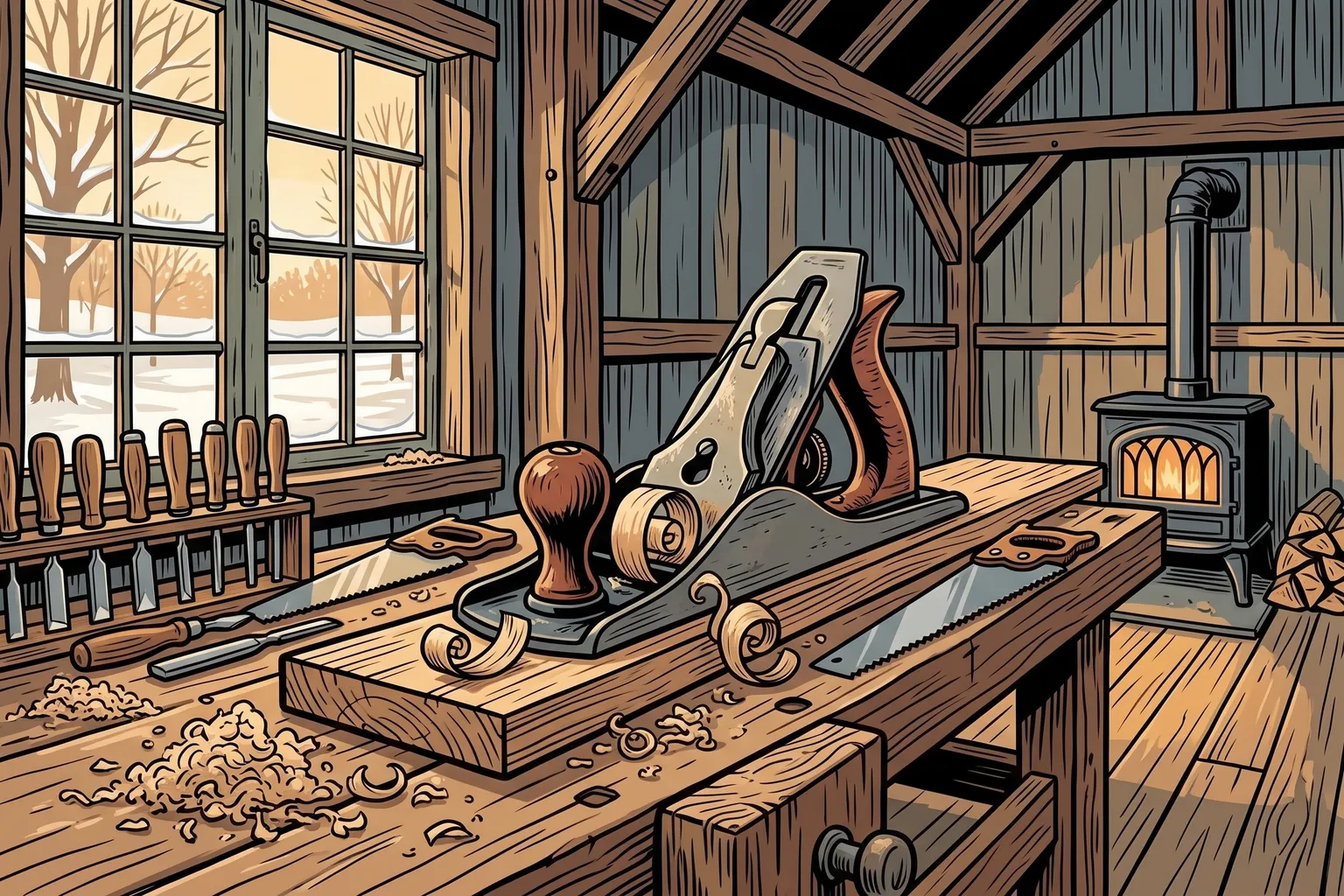
I was there in late February, looking at nothing in particular, and I picked up a block plane off the display hook. A Lie-Nielsen No. 60-1/2, which I’d seen used plenty of times but had never held. It was heavier than I expected, the iron body cool in my hand, the adjustment wheel turning with a fine and deliberate click.
I stood there holding it for about three minutes. Longer than a person should stand in a hardware store holding a tool he has no immediate use for.
What came to me, standing there, was my father’s workbench in the basement of the house on Blueberry Lane in Marquette.
Thomas Kowalski worked his whole life with his hands. Foreman at the Cleveland-Cliffs pellet plant for thirty-one years. His workbench in the corner of the basement was the most organized surface I’ve ever seen: a wooden mallet, a leather chisel roll with six chisels arranged oldest to newest, two hand planes polished until you could see yourself in the flat. He never said a word about any of it. He worked, and if you were down there, you watched.
I put the plane back and drove home. I didn’t buy anything. But I think something was decided in that hardware store that I didn’t register until a few weeks later.
I’ve been coming to things late. At sixty-three I came to fly fishing on the Davidson River in North Carolina, stumbling through what my son-in-law made look effortless. A year after that I finally stopped watching Patty’s garden from a respectful distance and started getting my hands into it. Neither of those was planned. Both arrived the same way: as a slow accumulation of proximity until the gap between watching and doing became hard to justify.
Woodworking is the same kind of thing. I’d been watching it for fifty years without ever picking up a tool. My father, uncles I hunted with, the man who built the timber-frame barn on our Traverse City property in 2005 and moved with the patient competence of someone who understood every piece of wood he touched. I watched all of them. I thought that was enough.
It wasn’t, obviously. Watching isn’t knowing.
Here is the thing I’d tell someone thinking about starting, and what I wish someone had told me: don’t start with tools. Start with the material.
Wood has grain. I knew this the way you know things you’ve never needed to act on. What I didn’t understand was that grain isn’t just a fact about how a board looks. It’s the terms of your relationship with it. A hand plane or a chisel moving with the grain cuts clean and quiet. Against it, the wood tears and you fight it, and the fight shows in the finished piece in ways that no amount of sanding corrects. The grain isn’t a suggestion. It’s what the material requires.
Reading grain takes attention. You look at the surface of a board and read the angle of the figure, then confirm by feel, running your fingers lightly across the face until you sense the direction the fibers want to go. When you get it right, the plane moves like a hand through water. When you get it wrong, you know it immediately. Wood isn’t subtle about this.
This is what people mean when they say wood is an honest material. It doesn’t cooperate with impatience or inattention. It tells you exactly what you’re doing wrong, every time, without apology. I find this useful. A material that lies to you about your mistakes is a material that doesn’t help you get better.
The other thing about wood: it’s specific in a way that I wasn’t prepared for. Two boards from the same tree can behave differently. A piece of white oak that planed beautifully yesterday will give you trouble tomorrow if you’re working a different section of the log. You don’t develop a relationship with a species in the abstract. You develop it board by board.
My uncle Walt, who taught me to still-hunt deer in the Hiawatha National Forest when I was sixteen, told me the secret was to move at half the speed I thought was slow. Then half that. I’ve carried that sentence into fishing, into golf, into more situations than I can count.
It applies here, too.
Woodworking punishes speed in a particular way. Rushing a cut means re-cutting, or worse, scrapping a board you can’t get back. A joint cut carefully and laid up square takes longer than a bad joint, but it also takes less time than a bad joint plus everything you do afterward trying to fix it. There’s a version of this in every craft, but wood makes it physical. You feel the moment you moved too fast. You feel it in the surface under the plane, in the gap between pieces that won’t close, in the corner of the box that won’t sit true.
The patience this asks for isn’t really patience in the waiting sense. It’s attention. You slow down because the work asks for it, not because you’re trying to develop a virtue. The work knows what it needs. Your job, especially at the beginning, is to stop long enough to listen.
On tools: I’ll say what I think is true, and you can take it or leave it.
You need a solid work surface before anything else. Something level and stable that doesn’t move when you push against it. A real workbench is worth building eventually. My father’s had four-inch maple legs and two lag screws sunk into studs. Mine is a converted potting table Patty declared surplus after reorganizing the garden shed. It vibrates on hard work. I’ve learned to work around it. Don’t let the absence of the right bench stop you from starting.
Then a saw. A good Japanese-style pull saw, a Gyokucho or a Suizan, runs forty to fifty dollars. The pull stroke keeps the blade in tension rather than compression, and for someone who hasn’t yet developed the body mechanics for a Western-style push saw, it’s more forgiving. You can cut a straight line with one before you know what you’re doing. That matters at the beginning.
Then a block plane. The Lie-Nielsen No. 60-1/2, which I eventually went back and bought, costs two hundred dollars. The Veritas low-angle block plane is comparable in price and quality. Either will outlast you. A cheap block plane can be made to work, but the adjustment on a quality plane is the difference between a tool that teaches you something and a tool that teaches you nothing except frustration. Buy the good one once.
That’s three things: a surface, a saw, a plane. Add a set of bench chisels when you’re ready and a marking gauge for laying out cuts, and you’ll have what you need to make most of what a beginning woodworker wants to make. Power tools can come later, if they come at all. The hand tools are slower and quieter and they don’t let you outrun your understanding of what the wood is telling you. That’s worth something.
The first thing I made was a step stool for the barn studio. Two steps, rough-cut white oak from a sawmill outside Williamsburg, Michigan, nothing elaborate. It took most of a Saturday, which I estimate was about twice as long as it should have taken. The proportions are slightly off. The joinery is tighter on one side than the other.
It holds weight. It doesn’t wobble. It sits next to the woodstove and I step up on it every morning to reach the top shelf of the bookcase.
I’m working on a small shelf for the writing desk now. Something to hold a lamp and four books. I expect it’ll take longer than it should and look exactly like what it is, which is work done by someone still learning to read the grain.
That’s where I am at sixty-six. In a converted barn five hours south of where my father used to run a shift, trying to understand what he was doing at that bench all those years. He was doing the thing I’m now doing: paying close attention to a material that won’t forgive anything less.
There are worse reasons to pick up a new skill. There are probably better ones, too. But standing in a hardware store holding a hand plane and thinking about your father is as honest a reason as I know of for starting something.
The wood doesn’t care why you’re here. It only asks whether you’re paying attention now.