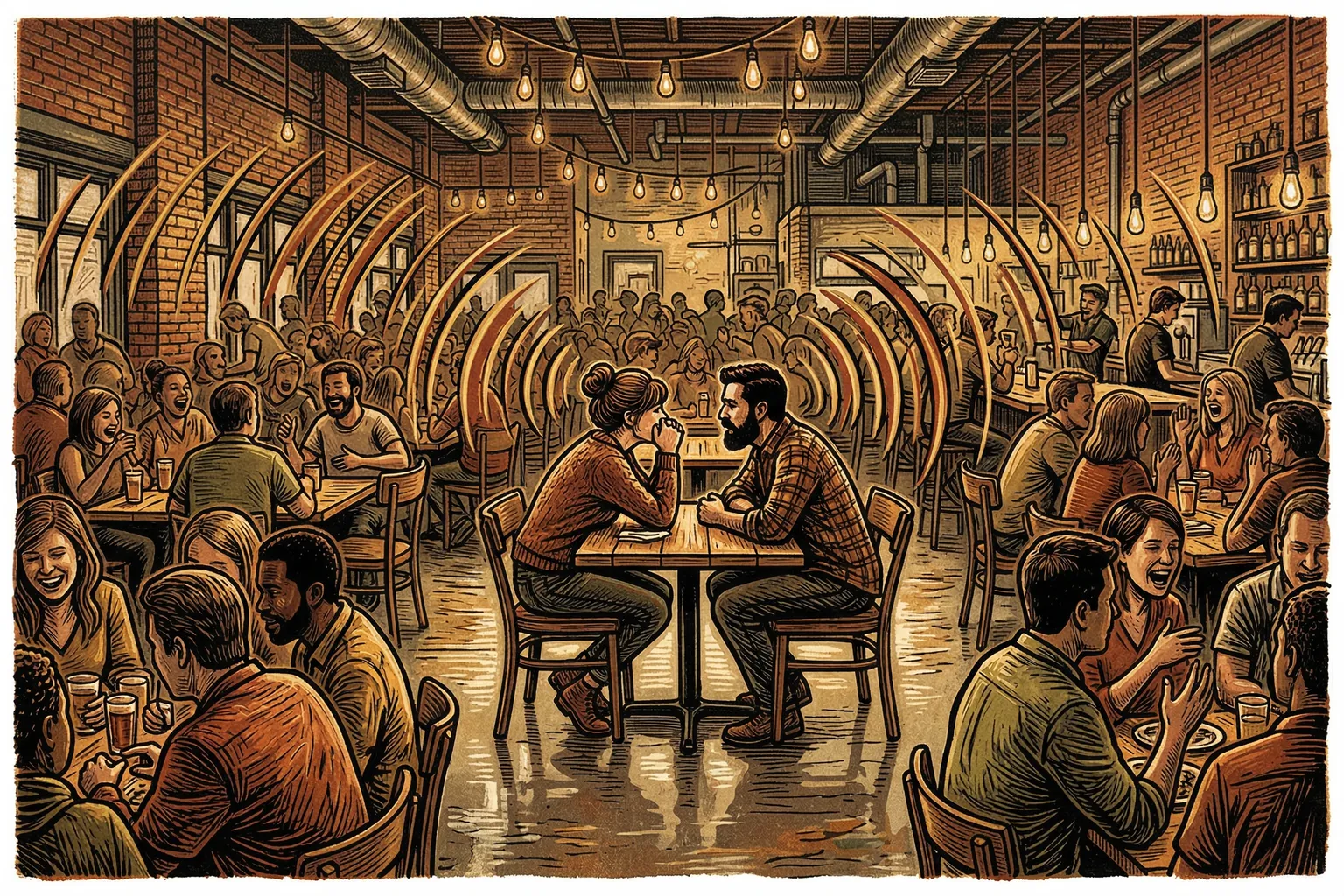
The restaurant was beautiful. I want to be clear about that. It was a new place on the north side of San Antonio, opened maybe three months earlier, and the room was stunning. Polished concrete floors. Exposed ductwork. Edison bulbs hanging from the ceiling at irregular heights, which is a look I have seen enough times now to wonder if there is a single Edison bulb distributor supplying every restaurant in America. The tables were reclaimed wood. The chairs were metal. Every surface in the room was hard.
Elena and I sat down at seven-thirty on a Friday night. The host seated us at a two-top near the open kitchen. The menu was interesting. The cocktail list was short and serious. I ordered an Old Fashioned. Elena ordered a glass of Tempranillo. The drinks came quickly and they were good. Then I tried to say something to my wife.
I couldn’t hear her. She couldn’t hear me. We were sitting two and a half feet apart and we were, functionally, in separate rooms. The noise level in that restaurant was somewhere between a high school gymnasium and an airport runway. I’m not exaggerating by much.
I know what you’re thinking. He’s sixty-eight. His hearing is going. And you’re not entirely wrong. I’ve been to an audiologist. The news wasn’t wonderful. But I’ve been eating in restaurants for forty years, and I’m telling you something changed, and it wasn’t just my ears.
Here’s what happened.
Sometime around 2008, American restaurant design shifted. The old model, the one I grew up with, featured carpet, tablecloths, acoustic ceiling tiles, padded booths, curtains. All of those materials absorb sound. They make a room quieter. They also look, to a certain generation of designers and restaurant owners, old. Dated. Like your grandmother’s dining room.
The new model is what I call the Warehouse. Concrete floors. Metal chairs. Open ceilings. Glass walls. Communal tables. Open kitchens. Subway tile. Every surface reflects sound instead of absorbing it. The Warehouse looks modern and clean and photogenic, and it turns every restaurant into an echo chamber.
This isn’t speculation. Acousticians have measured it. A typical restaurant with carpet and tablecloths and a dropped ceiling produces ambient noise levels around 70 decibels, roughly the volume of a normal conversation from three feet away. A modern restaurant with hard surfaces routinely hits 85 to 90 decibels. That’s the noise level of a lawnmower. At 85 decibels, you have to shout to be heard from two feet away. At 90, you can sustain hearing damage with prolonged exposure.
Ninety decibels. In a room where you’re supposed to be having dinner.
I’ve measured it myself. I carry a sound meter app on my phone because I am the kind of person who carries a sound meter app on his phone, which tells you everything you need to know about me. Over the last year, I’ve measured noise levels at thirty-one restaurants in Texas, Louisiana, and Oklahoma. The quietest was 68 decibels, a Cajun place in Lake Charles with carpet and cloth napkins and a owner who told me she keeps the music low because her customers are there to eat, not to dance. God bless that woman. The loudest was 94 decibels, a new taco restaurant in Dallas where the music was so loud I could feel the bass in the table. The tacos were excellent. I ate them and left in twenty-two minutes because I couldn’t stand to be in the room any longer.
The median across all thirty-one restaurants was 82 decibels. That’s loud. That’s “lean across the table and raise your voice” loud. That’s “give up on the conversation and just eat” loud.
Who benefits from this?
The restaurants do. This is the part that surprised me. Loud restaurants turn tables faster. When you can’t have a conversation, you don’t linger. You eat, you pay, you leave. A quiet restaurant where couples talk for two hours after dessert is a restaurant that seats that table twice on a Friday night. A loud restaurant seats it three times. Maybe four. In a business where margins run between three and five percent, that extra turn is the difference between staying open and closing.
There’s also the energy question. A loud room feels busy. A busy room feels popular. A popular room feels like the place to be. Restaurant consultants actually advise owners to keep the noise up because silence feels like failure. An empty-sounding restaurant scares people. A roaring one attracts them. We are, apparently, pack animals who want to eat where other pack animals are eating, even if we can’t hear ourselves chew.
And the music. The music has gotten louder everywhere. I remember when restaurant music was background. Something you noticed only when it stopped. Now it’s foreground. It’s curated playlists at volumes designed for retail stores, not dining rooms. I was at a breakfast place in Austin last month where they were playing Khruangbin at a volume that would have been appropriate for a pool party. It was eight-fifteen in the morning. I was eating eggs.
The price of loudness falls disproportionately on certain people. People with hearing loss, which is roughly one in eight Americans over twelve and one in three over sixty-five. People with hearing aids, which amplify everything, including the roar. People on first dates who actually want to learn something about the person across the table. Families with small children who can’t hear the kid say she needs to use the bathroom. Older couples who have been married for decades and who still have things to say to each other but who need to be able to hear the words.
Elena has started reading my lips across the table. She’s gotten good at it. That shouldn’t be a skill you need to develop to eat a thirty-two-dollar plate of pasta.
I don’t want to sound like I’m yelling at clouds. I’m not. I love restaurants. I love the energy of a full dining room on a Saturday night. I love the clatter of a busy kitchen. I love the sound of people enjoying themselves. What I don’t love is the industrial-grade volume that makes conversation impossible and turns dinner into an endurance test.
Some restaurants are fighting back, and I want to give them credit. I’ve noticed acoustic panels showing up in newer restaurants, sometimes disguised as art installations or decorative wall hangings. A few places in Houston have started offering “quiet hours,” early seatings with the music turned down, which is both a wonderful idea and a mildly depressing concession that the normal volume is too loud for a significant portion of the population. One restaurant in Fort Worth put a sign on every table that said “We keep it quiet so you can keep talking,” and I nearly wept with gratitude.
There are things you can do. Ask for a booth. Booths have high backs that block some noise. Ask for a table away from the kitchen and the bar, which are always the loudest zones. Go early. Six o’clock on a Friday is a different acoustic planet than eight o’clock. And if a restaurant is too loud, say so. Tell the manager. Write it in the review. Noise is a design choice, and design choices can be changed.
I was at a diner outside Fredericksburg, Texas, two weeks ago. Old place. Been there since the seventies. Vinyl booths, dropped ceiling, carpet that has seen better decades. Elena and I sat in a corner booth and ordered chicken-fried steak, which was $14.95 with two sides and a drink. The steak was good. Not remarkable, not Instagram-worthy, just a solid honest piece of meat pounded flat and fried with care. The gravy was peppery and real. The mashed potatoes were from actual potatoes.
But here’s what I remember most. I could hear my wife. She told me about a book she was reading. I told her about a barbecue place someone had recommended outside Llano. We talked about Daniel’s new apartment in Houston. We talked about whether Marisol’s restaurant was going to make it through the summer, which is the kind of conversation you can only have quietly and honestly and with someone who loves the same person you love.
The meal cost us thirty-four dollars for two, including tip. The room was maybe 70 decibels. We stayed for an hour and fifteen minutes. Nobody rushed us. Nobody needed to, because the room was built for staying.
I don’t need every restaurant to be that diner. I don’t need the world to go back to carpet and tablecloths and waiters in bow ties. But I need to be able to hear the person I came to dinner with. That’s not a lot to ask. That’s actually the whole point of sitting down together in the first place.
This column is called The Table. It’s about the experience of eating out in America, which is something I’ve been doing and writing about for more than thirty years. I’ll write about the fourteen-dollar sandwich and the ninety-dollar tasting menu and the gas station taco that changed my understanding of what a tortilla can be. I’ll write about diners and food trucks and chain restaurants and places with waitlists and places with no sign on the door. I’ll write about all of it, because all of it matters. Every restaurant is somebody’s favorite restaurant. Every meal is somebody’s night out. And everybody deserves to be able to hear their dinner companion say, “How is yours?”
Mine was good. The company was better. But I had to shout to say so.