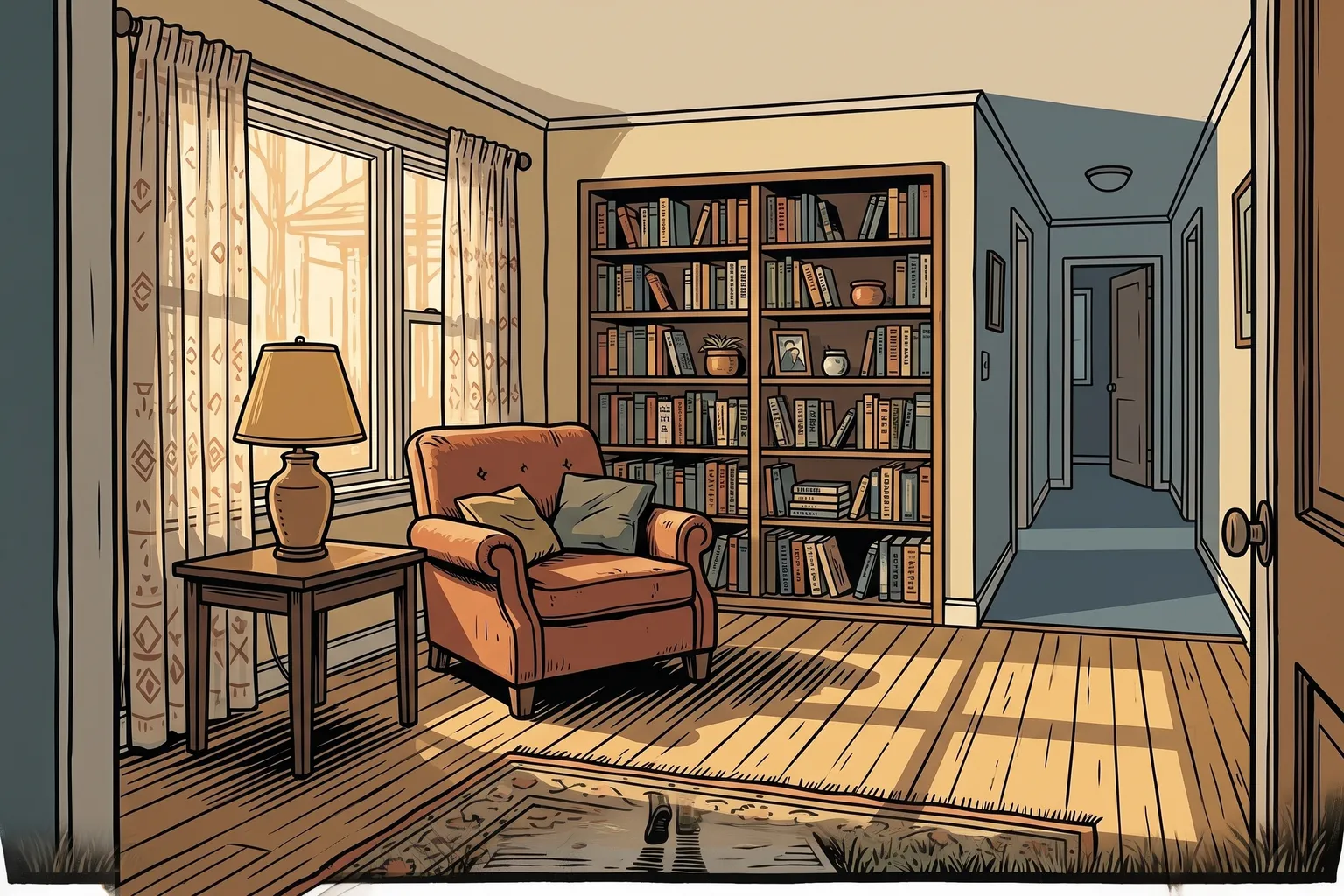
The recognition doesn’t arrive the way you’d expect. Not with a conversation over dinner. Not with a fall on the stairs or a winter the driveway doesn’t get shoveled. It arrives on a Tuesday afternoon, standing in a room you’ve lived in for thirty years, and something shifts. Not the room. You.
Beverly can tell you exactly when it happened for her. March, a Tuesday, Granville, Ohio. She’d walked into the living room to get a book, glanced around at everything she’d arranged and tended for three decades, and thought: this doesn’t fit anymore. Not the house. Her.
She didn’t tell her husband Don right away. She carried it for six weeks, the way you carry something you’re not sure is real yet. Finally, one Saturday morning at the kitchen table, she said: “I think we need to start thinking about leaving.”
Don put down his coffee. “I was wondering when you’d say that,” he said. He’d been thinking it for eight months.
This is what I’ve learned in the conversations I’ve had over the years with people who’ve stood at this crossroads: the recognition almost never arrives for both people at the same time. It comes to one person first. And that person carries it alone until the weight gets to be too much.
What the recognition feels like
There’s a particular grief in it. Not the grief of losing something. The house is still there, still standing, still yours. The grief is more precise than that. It’s the grief of realizing that the house that was once exactly right for you no longer is.
When a house fits, it fits completely. The rooms correspond to your life. The kitchen is the right size for the way you cook. The yard is the right size for the children who ran through it. The third bedroom was a nursery, then a teenager’s room, then a guest room, then the room where the treadmill lives. The house tracks your life the way a journal tracks a year: faithfully, without judgment, accumulating everything.
And then one day it doesn’t. The guest room hasn’t had a guest in two years. The yard is more obligation than pleasure. The stairs are something you think about in a way you didn’t used to. The house is still recording your life, but what it’s recording now is the distance between who you were when you moved in and who you are today.
That distance is what the recognition is about. Not the house. You. I wrote about the practical reckoning that follows, the question of when the house has become too much and what to actually do about it. But that comes later. The recognition is its own thing, and it deserves to be looked at directly.
The ones who left
A man named Ray, seventy-three, lived in the same Columbus neighborhood for thirty-one years before he moved to a 55+ community on the east side of the city. His new place has a maintenance crew that handles the gutters and a common room with people in it most afternoons. He told me he used to spend every October quietly dreading November. The leaves. The gutters. The winterization list he’d accumulate and work through on weekends he’d rather have used differently.
“I thought I liked it,” he said. “The house stuff. The maintenance. I thought it was just what you did.”
He paused.
“I didn’t realize how much energy I was spending managing that house until I stopped having to.”
This is the thing people say, almost without variation, after they’ve made this move. Not relief, exactly. Something closer to exhale. The realization that they’d been so focused on sustaining the house that they’d stopped asking whether the house was sustaining them.
When Ray and his wife finally decided to go, they worked with a senior moving service that helped them get from a four-bedroom house to a two-bedroom apartment in six weeks. He said the packing wasn’t the hard part. Walking through the empty rooms for the last time was. Letting them be just rooms again, without thirty-one years of life stored in them.
“I cried for about fifteen minutes,” he told me. “Then we locked the door and I felt about forty pounds lighter.”
I’ve heard some version of that sentence from a lot of people who made this move. They didn’t know what they were carrying until they put it down. They’d been holding the weight of the house so long they’d stopped feeling it as weight. They thought it was just what they were.
The ones who stayed
I want to be careful here, because not everyone leaves. And the ones who stay aren’t wrong.
Gale is seventy-eight. She’s lived in the same house in Lancaster, Ohio, for forty-one years. Her husband died in 2018. Her children have suggested, gently and regularly, that she might want to consider something smaller, something with a smaller yard, something with people closer by. She has considered it. She’s decided to stay.
“This is the place that still makes sense to me,” she said. “Every room is where I remember being with Jim. That sounds like it would be hard. Mostly it isn’t. Mostly it’s company.”
When I asked her how she thinks about when to move to assisted living, she said: “I’ll know when. I’m not there yet.” And then: “Everybody thinks they know when I should move. But it’s my house. When I’m ready, I’ll say so.”
There’s no defensiveness in her voice when she says it. She sounds like a woman who has thought carefully about her own life and arrived at an honest answer. That’s different from avoidance, and it took me years of clinical work to learn to tell the difference.
Gale’s daughter has arranged additional help: someone who comes twice a week, assists with the heavier cleaning, drives Gale to appointments. Gale describes this as entirely sensible. She isn’t pretending the house is effortless. She’s choosing it anyway, with both eyes open, because the tradeoff makes sense for who she is right now.
That’s making peace with staying. That’s not the same thing as refusing to see clearly.
The question under the house question
The house decision is never just a housing decision. I keep coming back to this in the conversations I have, and in my own quieter thinking about the house I share with Robert. The question under the house question is: who are you now, and where does that person need to live?
That question is harder than square footage. It asks you to look at the distance between who you were when you moved in and who you’ve become, and to be honest about which one you’ve been living for. If the house was built around children who grew up and left, a self that had different energy and a different relationship with a flight of stairs, a version of your life that you’ve kept tending long after it changed its shape, then the recognition has probably already come. You’ve had it. You’ve stood in a room on a Tuesday afternoon and felt it.
What you may be waiting for is permission. Or enough time to feel sure. Or someone to tell you that there’s no version of this that doesn’t involve sitting with some loss, and that the loss doesn’t mean you chose wrong.
Beverly and Don are looking at places now. Ray has a two-bedroom apartment and doesn’t dread November. Gale is in her house in Lancaster with her husband’s chair still in the living room and the helper who comes Tuesdays and Fridays.
What the three of them share is that they let themselves have the recognition when it came. They didn’t push it away or wait until a crisis made the decision for them. They sat with the feeling, and then they asked what to do about it on their own terms, in their own time.
That’s the part I keep coming back to. Not where you land. How you get there.