You don’t decide all at once. That’s what people get wrong about it.
They think there’s a moment. A conversation over dinner. A fall on the stairs. A winter where the driveway doesn’t get shoveled for eleven days and the neighbors start looking at you differently. Maybe that happens. But before that moment, there are a hundred smaller ones, and they don’t announce themselves. They just accumulate, the way dust does in rooms you’ve stopped entering.
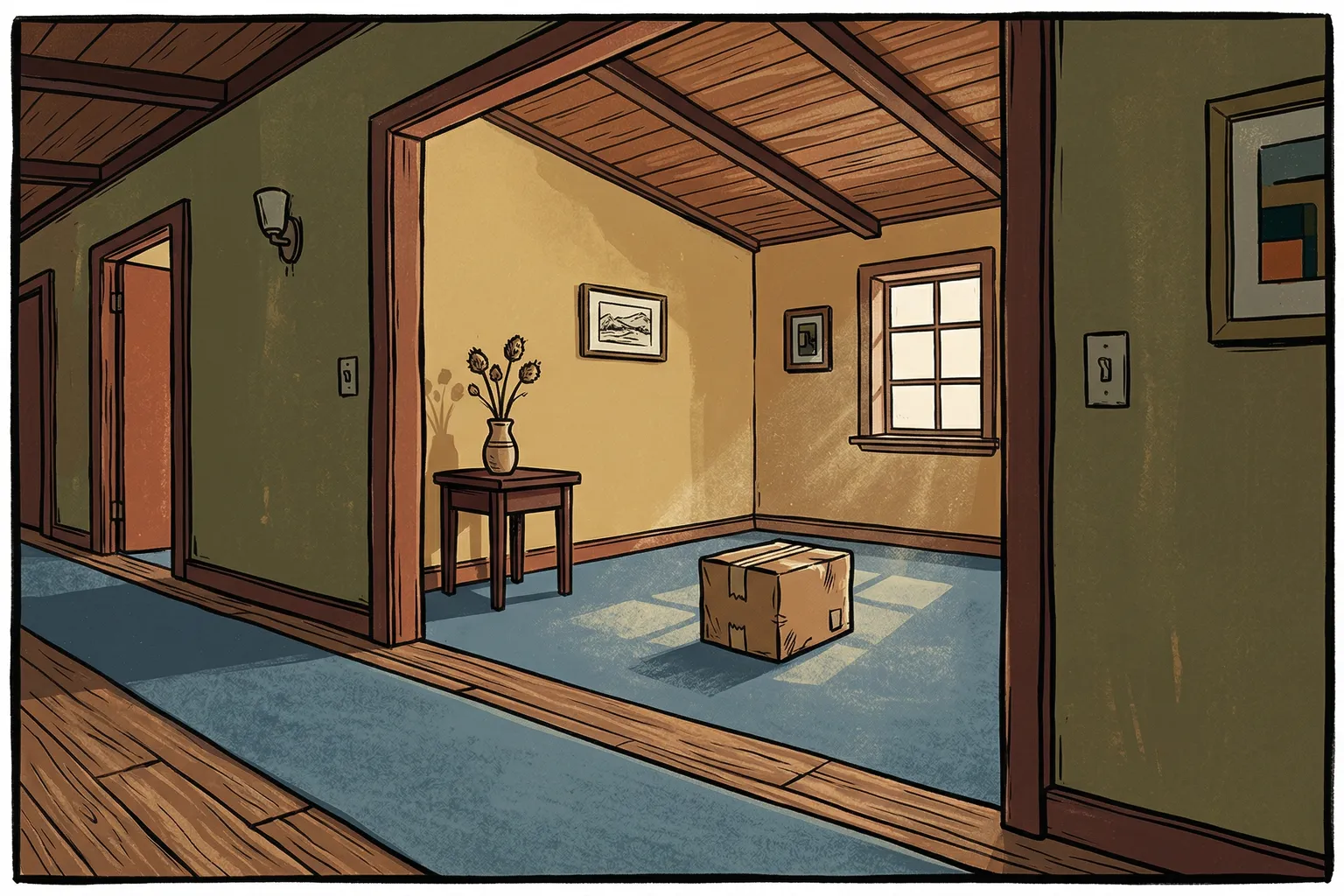
I know this because I’ve been watching Robert walk past the third bedroom for three years now. He doesn’t go in. There’s nothing wrong with the room. The door works fine. The carpet is the same carpet we put in when Grace was eleven and wanted blue. It’s still blue. Nobody sleeps in it. Nobody has slept in it since Marcus was home for four days at Thanksgiving in 2019, and even then he slept on the foldout because his old bed had been replaced by a sewing table I used twice.
The room is fine. The room is also a question neither of us has asked out loud.
The Conversation Before the Conversation
Here is the truth about downsizing that nobody puts in the brochure: the hardest part isn’t the move. It isn’t the real estate agent or the boxes or figuring out whether the couch will fit. The hardest part is the conversation you have with yourself before you have it with anyone else.
That conversation goes something like this: I can’t keep up with this house. The gutters. The furnace filter I keep forgetting. The garden I said I’d get back to in spring and then spring comes and I don’t. And then, immediately: But this is my house. My children grew up here. Robert and I painted the kitchen together in 2003 when we were still the kind of people who painted their own kitchen. My whole life is in this house.
Both things are true at the same time. That’s what makes it hard. Not the logistics. The logistics are just tasks. What’s hard is sitting with two truths that don’t fit together and admitting that one of them is winning.
I sat with a woman named Charlene in a grief group in Portsmouth in 1988 who told me she knew it was time to leave the house when she realized she was cleaning rooms she didn’t enter. She cleaned them because they were there. Because that was the deal. You have a house, you maintain it. But the rooms had stopped being rooms. They had become obligations with carpet.
She said: “I wasn’t living in a house anymore. I was maintaining a museum of my own life.”
I wrote that down. I’ve been carrying it for thirty-seven years.
What the House Knows
The thing about a house is that it holds your story whether you ask it to or not. The pencil marks on the doorframe where you measured the kids. The scuff on the hallway baseboard from the wheelchair after Robert’s knee surgery. The spot in the garage where the Christmas decorations live, stacked in the same order every year because the system works and nobody wants to be the one to say the system no longer has a reason to exist.
When you start thinking about leaving, you’re not thinking about square footage or property taxes or which retirement community has the best walking trails. You’re thinking about what it means to stop being the person who lives in this house. You’re thinking about the version of yourself who moved in, who was younger and different and had plans for every room. You’re looking at the gap between that person and who you are now, and the house is the only thing that’s been standing in the gap, holding the two versions together.
That’s what makes it a shape of loneliness nobody talks about. Not the loneliness of an empty house, exactly. The loneliness of standing in a house that remembers a life that isn’t yours anymore.
The Children Probably Don’t Want What You Think They Want
I need to say this gently, because I know how it lands.
I’ve talked to dozens of people in their sixties and seventies who delayed downsizing because they were holding things for their children. The oak dining table. The china. The bedroom set that belonged to a grandmother. They kept these things not because anyone asked them to, but because the keeping felt like a duty that hadn’t expired.
Here is what I’ve learned, and it took me longer than it should have: your children probably don’t want the dining table. They don’t have room for it. Their apartments are smaller than your house. Their lives are shaped differently. They love you, and they love the memory of Sunday dinners, but the table is not the memory. You are the memory. The table is furniture.
I know this because I offered Marcus the writing desk I bought at an estate sale in 1996, the one I’ve written at for thirty years, and he said, gently, “Mom, I don’t have anywhere to put it.” And I wasn’t offended. I was something else. I was confronted with the fact that the objects I’d wrapped my identity around didn’t carry the same weight for the people I’d raised around them.
This is useful to know early. Not because it means the objects don’t matter. They matter to you, and that’s enough. But the reason you’re keeping them matters too. If you’re keeping them for yourself, keep them. If you’re keeping them because you believe someone will want them later, have the conversation now. It’s one of those conversations we keep not having until it’s too late to have it well.
Starting with What You Haven’t Touched
The practical downsizing tips that actually help aren’t complicated. They’re just honest.
Start with the rooms you don’t enter. The closet you haven’t opened in three years. The boxes in the basement that survived the last move without being unpacked. If you haven’t reached for something in three years, it isn’t serving your life. It’s serving your memory of a life, and those are different things.
Sell, don’t store. This is the advice I give to everyone and the advice I find hardest to follow myself. A storage unit is just a way to pay monthly rent on a decision you don’t want to make. Everything in storage is a deferred goodbye. Some of those goodbyes need to happen.
Go room by room, not category by category. Marie Kondo was fine for people who needed permission to throw away a sweater. But what we’re talking about here is harder than sweaters. We’re talking about the spare bedroom that was going to be a home office and then a nursery when the grandchildren visited and then a guest room and is now a room with a treadmill you don’t use and a closet full of things that don’t belong anywhere else. That room isn’t cluttered. It’s a record of your changing expectations for your own life. You can’t sort that with a system. You have to sit with it.
Decluttering for Yourself, Not for the Move
Here is something I wish someone had told Charlene, and wish someone had told me earlier: you don’t have to be moving to start this. Decluttering isn’t something you do in preparation for leaving. It’s something you do in preparation for being honest about what your life actually looks like now.
Robert and I aren’t moving. Not yet. Maybe not for years. But I’ve been going through the house slowly, one shelf at a time, and what I’m finding isn’t just stuff. I’m finding who I thought I was going to be. The fabric from the quilting phase that lasted eight months. The bread machine from the year I was going to bake our bread. The birdwatching field guide I bought when we talked about spending more time outside and then didn’t.
None of these are failures. They’re the evidence of a life that kept changing its mind about what it wanted, the way lives do. But holding onto all of it is a kind of dishonesty. It’s pretending you’re still the person who was going to bake bread, when the person you actually are is the one who writes in a notebook at the kitchen table while Robert makes soup.
There’s freedom in that honesty. Not the forced, bright-eyed freedom of the decluttering influencers who want you to believe that getting rid of things will change your life. It won’t change your life. But it might let you see it more clearly.
The Conversation You Eventually Have
Robert and I will have the conversation eventually. About the house, about what’s next, about whether we want to be the seventy-eight-year-olds trying to manage a property that was built for a family of four, or whether we want to be honest about the life we actually have and find a place that fits it.
I’m not in a hurry. Neither is he. But I’ve sat with too many people who waited until the decision was made for them, by a fall or an illness or a winter that finally proved the point. I’ve sat with people whose children had to fly home and handle it because the conversation never happened when it could have happened on everyone’s terms.
The house doesn’t care about your feelings. It just keeps being a house. The furnace runs whether you’re in the living room or not. The gutters fill with leaves. The rooms you don’t enter still need heat in February.
But you care about your feelings, even if you’ve spent sixty years pretending you don’t. And the feeling that the house has become too much isn’t a failure. It’s not a sign that you’re diminished or that the best years are behind you. It’s a recognition. That’s all. An honest look at what is, instead of what was.
Robert walked past the third bedroom again this morning on his way to the kitchen. He didn’t look in. I didn’t say anything.
But I’m going to. Soon. Not because the house is too much yet. Because the conversation is ready, and I’ve learned what happens when you wait too long to have the ones that matter.