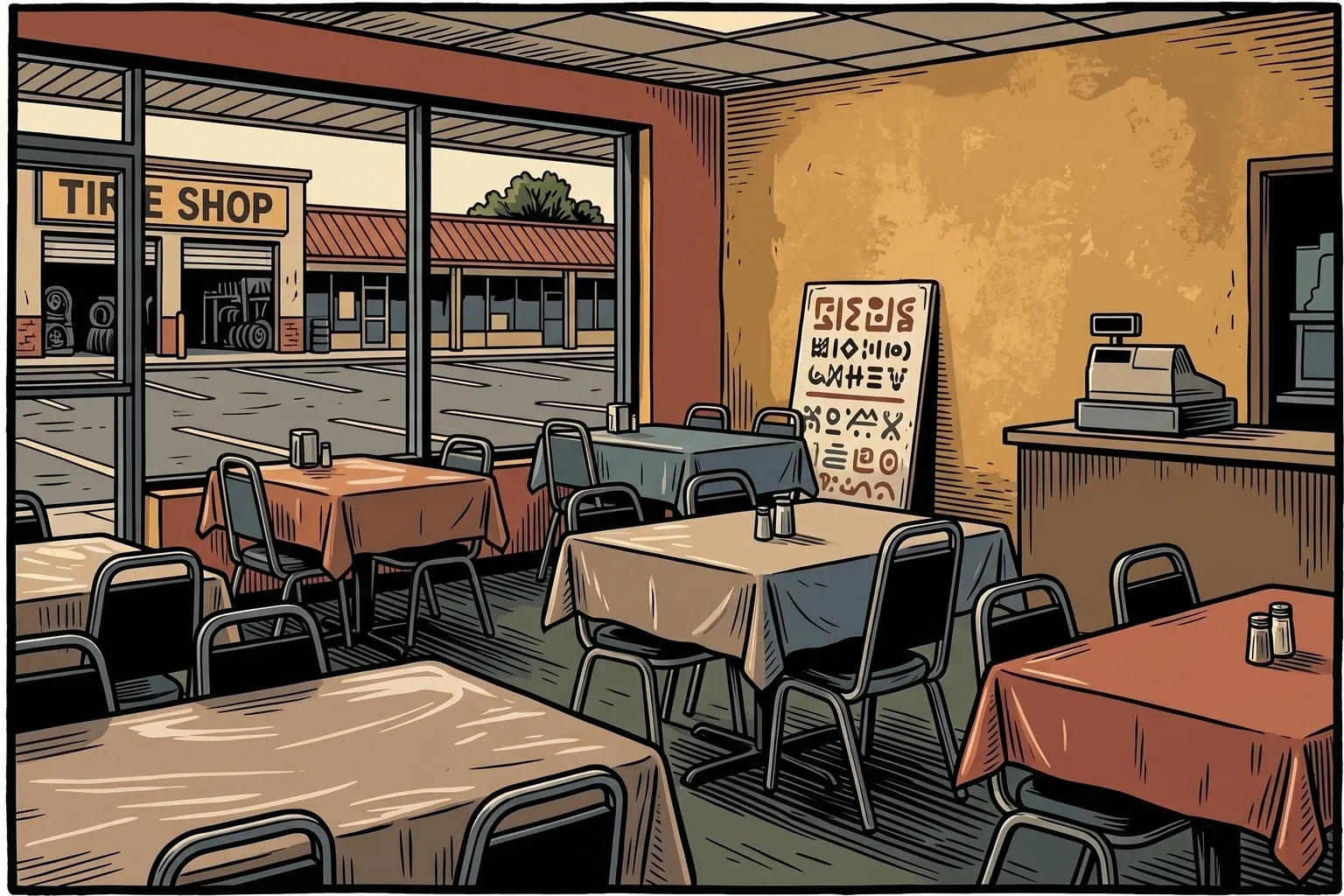
There was a place on the south side of San Antonio that I ate at for eleven years. I won’t tell you the name because it doesn’t matter now. The sign is down. The parking lot is empty. The building is still there, between a tire shop and a check-cashing place, but the kitchen is dark and the tables are gone. If you press your face to the glass, which I did last Tuesday like a man with no dignity, you can see the marks on the floor where the booths used to be.
It was a Mexican restaurant. Not Tex-Mex, though Tex-Mex is fine and I have no argument with it. This was Mexican food the way my grandmother Consuelo would have recognized it: birria on Saturdays, pozole when they felt like making it, enchiladas every day in a red sauce that took four hours and three kinds of dried chiles. The tortillas were handmade. The beans were cooked in lard. The rice had that toasty, tomato-stained quality that means somebody fried it in oil before adding the broth, which is the only way to make Mexican rice and I don’t care to hear otherwise.
The couple who ran it had been there seventeen years. He cooked. She worked the register and managed the dining room and carried plates when the one server they employed was in the weeds, which was most Friday nights. Their daughter helped on weekends. The dining room sat maybe thirty people. The chairs didn’t match. The tablecloths were plastic. A small TV near the register played telenovelas during lunch and soccer during dinner, and nobody ever changed the channel because nobody needed to.
A plate of enchiladas with rice and beans cost nine dollars. Birria with tortillas and onion and cilantro and lime was eleven. The most expensive thing on the menu was a combination plate, a tamale, an enchilada, a chile relleno, rice, and beans, and it cost thirteen dollars and it was more food than any reasonable person could finish. Elena and I went there at least once a month for eleven years. That’s something like a hundred and thirty meals. I don’t think we ever spent more than thirty dollars for two people including tip.
That’s what I want to talk about. Not the food, though I’ll get to the food. The thirty dollars.
A restaurant that charges nine dollars for a plate of enchiladas isn’t making money the way you think it’s making money. The margins on a nine-dollar plate in a city where commercial rent has doubled in ten years are thin enough to read through. The food cost alone, if you’re using good dried chiles and real lard and handmade tortillas, is probably three-fifty. Add labor, rent, utilities, insurance, the health department permit, the grease trap service, the broken refrigerator that needed replacing last March. You’re looking at a plate that costs the restaurant between seven and eight dollars to put in front of you. The profit on your nine-dollar enchiladas is a dollar. Maybe a dollar and a half.
A dollar and a half. For a plate of food that somebody stood in a kitchen for four hours to make possible.
The restaurant closed in February. I found out the way you find out these things now: someone posted about it online and the comments filled with people saying how much they loved the place and how sad they were it was gone. I read those comments with the specific frustration of a man who has been writing about this for thirty years. If all of you loved it so much, where were you on a Tuesday night in January?
That’s not fair. I know it’s not fair. People have lives. People cook at home. People are watching what they spend. The question isn’t whether any individual customer failed the restaurant. The question is whether a city can sustain a restaurant that charges nine dollars for enchiladas when the landlord wants four thousand a month and the minimum wage just went up and the price of dried chiles has risen twenty percent in two years. The answer, increasingly, is no.
I talked to the owner a week before they closed. He wasn’t angry. He was tired. He said the rent went up eight hundred dollars at the last renewal and he couldn’t raise his prices enough to cover it because his customers, his neighbors, the people who lived within a mile and ate there every week, couldn’t afford fourteen dollars for enchiladas. So he was trapped between what the food costs to make and what the people who eat it can pay.
“We didn’t go broke overnight,” he told me. “We went broke a dollar at a time.”
This is what happens when the good cheap place closes. The people who ate there don’t move to a more expensive restaurant. They eat at home, or they eat at a chain, or they drive through somewhere fast. The neighborhood doesn’t get a better restaurant. The neighborhood gets a gap. A building with marks on the floor.
I’ve watched this happen in San Antonio, in Austin, in Houston, in every Texas city I cover. The good cheap restaurant is an endangered species, and the threat isn’t competition from better restaurants. The threat is the distance between what food costs to make and what the people who eat it can afford to pay. That distance used to be manageable. It isn’t anymore.
Elena says I get too worked up about this. She’s probably right. She’s also the one who noticed, last week, that the check-cashing place next to the empty restaurant is now empty too. “When the restaurant goes,” she said, “the foot traffic goes. When the foot traffic goes, everything goes.”
She’s right about that too. A good cheap restaurant isn’t just a place that feeds people. It’s an anchor. It’s the reason you drive down that block. It’s where you stop after the tire shop, where you eat before the soccer game, where you go when you don’t feel like cooking and you don’t want to spend forty dollars for two people. Take it away and the block gets quieter, and quiet, on a commercial street, isn’t the same thing as peaceful.
I don’t have a solution. I’m a food writer, not an economist, though I’ve spent enough time reading restaurant leases to play one on Sundays. What I have is this: when you find a good cheap restaurant, go there. Go on a Tuesday. Go when you don’t feel like it. Go when you could cook at home and save the money. Spend the thirty dollars. Leave a good tip. Tell someone about it. Do what the woman at Elena’s community garden did when she told us about a place south of town worth the drive: be specific about what’s good, and send people there.
The knowledge that keeps these restaurants alive isn’t just the knowledge of how to cook. It’s the knowledge that the restaurant exists. It’s the word-of-mouth. It’s the recommendation that brings someone through the door on a slow night when the owner is staring at the books and wondering if next month’s rent is going to work out.
My grandmother Consuelo’s tamale recipe died when she died because the knowledge lived in her hands and she never wrote it down. That restaurant on Zarzamora didn’t close because the food got worse. It closed because not enough people walked through the door in time.
I’m still thinking about those enchiladas. The red sauce had a depth that came from chiles that had been toasted until they were almost black, then soaked until they softened, then blended with garlic and cumin and a little bit of Mexican oregano. You could taste the char. You could taste the earth. Nine dollars. I would pay it again right now if the door were open.
If you know a place like that, you know what I’m talking about. If you don’t, go find one. They’re still out there. Not as many as there used to be, but they’re out there, on a side street somewhere, in a strip mall between a laundromat and a tire shop, with a hand-painted sign and a parking lot that’s full at noon. They need you more than they need this column.
Go eat. The good cheap place can’t wait forever.