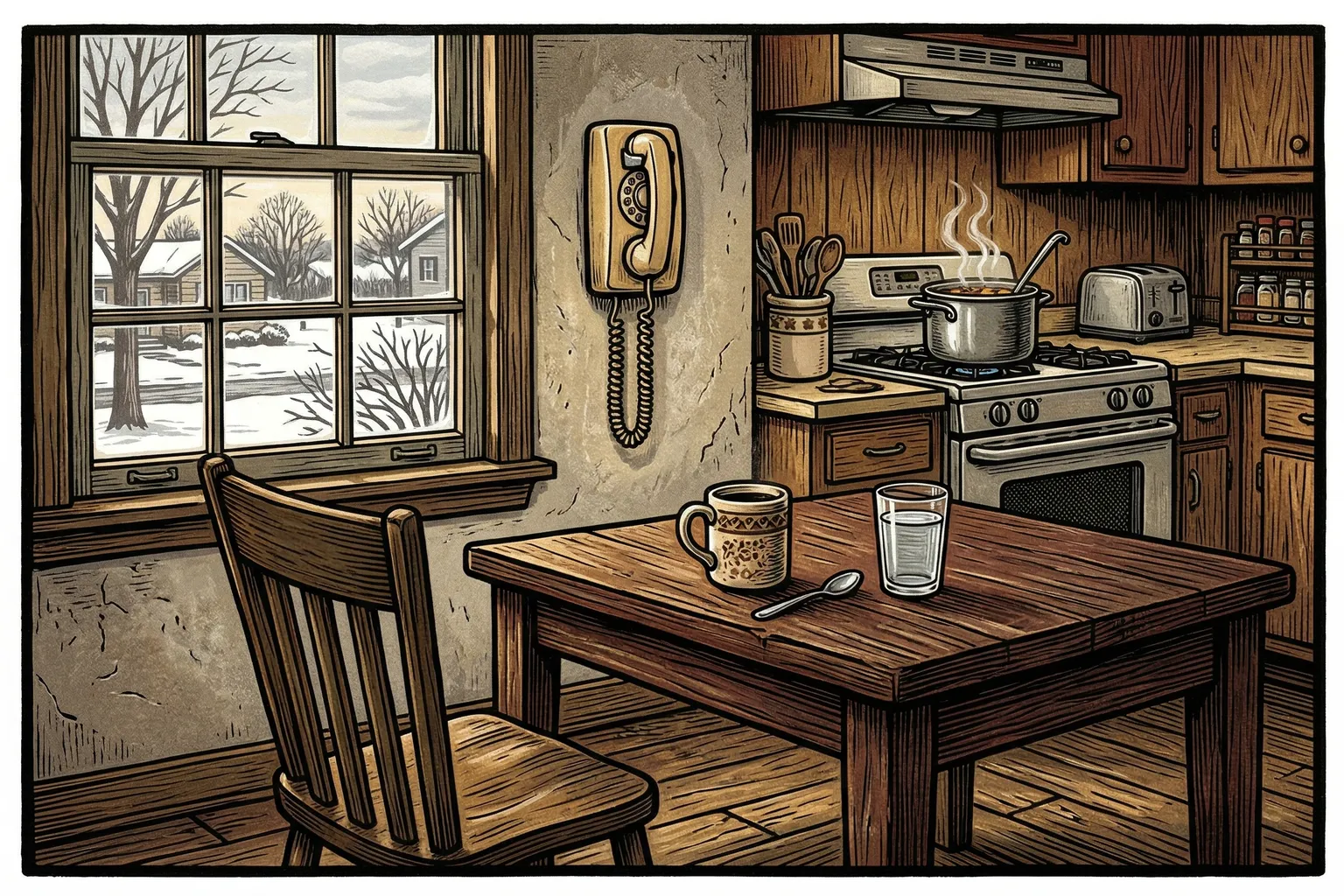
My son called on a Sunday in February, the way he does. Every two weeks, sometimes three. He was in his car. I could hear the turn signal.
We talked for eleven minutes. I know because I looked at the phone afterward, which is the kind of thing you do when you’re not sure if you’re being ridiculous or paying attention. He told me about a project at work. I told him about the ice on the back steps. He said he’d call again soon. I said that would be nice.
It was a perfectly fine conversation. He wasn’t cold. He wasn’t distant. He was my son, calling his mother on a Sunday afternoon, and the call was warm and ordinary and it lasted eleven minutes, and when I hung up I sat at the kitchen table for a long time and I could not have told you what I was feeling except that it was heavy and it didn’t have a name.
Robert was making soup. He didn’t ask how the call went. He’s learned not to, because the honest answer is always more complicated than the question, and I don’t always want to get into it at four o’clock on a Sunday.
I want to be careful here. I’m not describing estrangement. Estrangement is its own country, with its own geography, and I don’t want to conflate the two. I know families that have broken. This isn’t that.
This is the other thing. The quieter thing that almost no one talks about, I think because it doesn’t feel large enough to name.
Your daughter lives forty minutes away. She comes for dinner once a month, sometimes six weeks. She schedules it the way she schedules everything, because she’s busy and competent and she has a life she built, which is exactly what you raised her to do. The dinner is pleasant. The food is good. She asks about your knee. You ask about Lily. She leaves by eight-thirty because the babysitter has a curfew, and you stand at the door and wave, and the house gets very quiet very fast.
Your son calls on Sundays. Or he used to. Now it’s every other Sunday, and sometimes it’s a Wednesday text that says thinking of you, Mom with a heart emoji, which is kind and means something and is not the same as hearing his voice.
The holiday that everyone agreed went well. And it did. The food was right, the grandchildren were beautiful, your daughter brought that cranberry thing you taught her. Everyone was present. Everyone was kind. And you stood at the sink at ten o’clock washing the good plates and felt like a guest at something that used to be yours.
Here is the thing I don’t think we say enough: this is supposed to happen.
The drift is correct. It’s healthy. It’s what you worked for, if you’re honest about it. You spent twenty years trying to raise a person who could leave, and they left, and they built something, and the building required them to stop needing you the way they used to. That is the entire project of parenthood. You succeeded.
And the success has a cost that nobody warned you about. Not in the parenting books, not in the articles, not in the conversations with other mothers at the kitchen table when the kids were small. Nobody told you that the reward for doing it right is a kind of loneliness that doesn’t match any of the categories. It’s not depression. It’s not empty nest, exactly, because the nest has been empty for years and you’ve filled it with other things and you’re fine. You are fine.
You’re just not who you were to them. And they don’t know that, or if they know it, they don’t know how much it weighs.
I want to be honest about something. I’m not writing this from outside.
Marcus is in Nashville. He has a life I’m proud of and a family I love and I talk to him on Sundays, when he remembers, which is most of the time. Grace is forty minutes away in Columbus. She’s a good daughter. She calls, she visits, she brings Lily. I have no complaint that would survive scrutiny.
But I’ve been a mother for forty-five years, and there was a period, a long one, where being Marcus and Grace’s mother was the organizing fact of my days. Not the only fact. But the one that structured everything else. The meals, the schedule, the worry, the two a.m. listening for the car in the driveway. And then that period ended, the way it’s supposed to, and I got my life back, and I found I missed the old one in ways I hadn’t expected and couldn’t quite justify.
Because what do you say? I wish my kids called more? That’s true and it’s also not the whole truth. The whole truth is harder and stranger. I miss the version of the relationship where I was essential. Where my opinion was the first one sought, not the third. Where a holiday meal was mine to run, not mine to attend. I miss being necessary in the way I was necessary when they were young, and I know that missing is unreasonable, and I feel it anyway.
This is not their fault. I want to say that clearly. This is not about blame. It’s not about what they owe me or what I deserve. It’s about what happens inside a parent when the central relationship of their adult life quietly reorganizes itself into something managed and periodic and perfectly pleasant.
It’s about the eleven-minute phone call that was warm and fine and left me sitting at the kitchen table.
I’ve talked to enough women my age to know this isn’t unusual. It’s so common it’s almost universal, and almost no one says it out loud because saying it out loud sounds like complaining, and complaining about your adult children is the thing nobody wants to be caught doing. You’re supposed to be proud. You are proud. You’re supposed to be grateful they turned out well. You are grateful.
You also miss them in a way that doesn’t map onto any available script.
A woman I know, a retired teacher, told me she drives past her son’s house sometimes on the way home from the grocery store. Not to stop. Just to see the lights on. She said she wasn’t sure if that made her a good mother or a crazy one. I told her it made her a person.
I don’t have a fix for this. I distrust anyone who does.
What I have is a suggestion, and it’s small. Tell them. Not as an accusation. Not as a guilt delivery system. Not as the conversation that starts with “You never call” and ends with everyone feeling worse. But as the truth, offered plainly.
I love you. I miss you. Not because you’ve done anything wrong, but because you were the center of my life for twenty years and you aren’t anymore, and that’s correct, and it still costs me something, and I wanted you to know.
That is a hard thing to say. I know.
I think the not-saying is harder. I think the not-saying becomes years. I think the years become a shape, and the shape becomes the relationship, and then one day it’s the relationship and nobody remembers it was supposed to be more.
I don’t know if my children need to hear this from me. I think they might. I think I need to say it, regardless of whether they need it, because carrying it silently is its own kind of distance, and I’ve written too many columns about the cost of silence to keep practicing it in my own kitchen.
Robert’s soup was good that Sunday. He makes a white bean thing with rosemary that I have never successfully replicated, and I’ve stopped trying. We ate and I didn’t bring up the phone call, and he didn’t ask, and the evening was fine.
Fine is not the same as full.
I’m learning that.