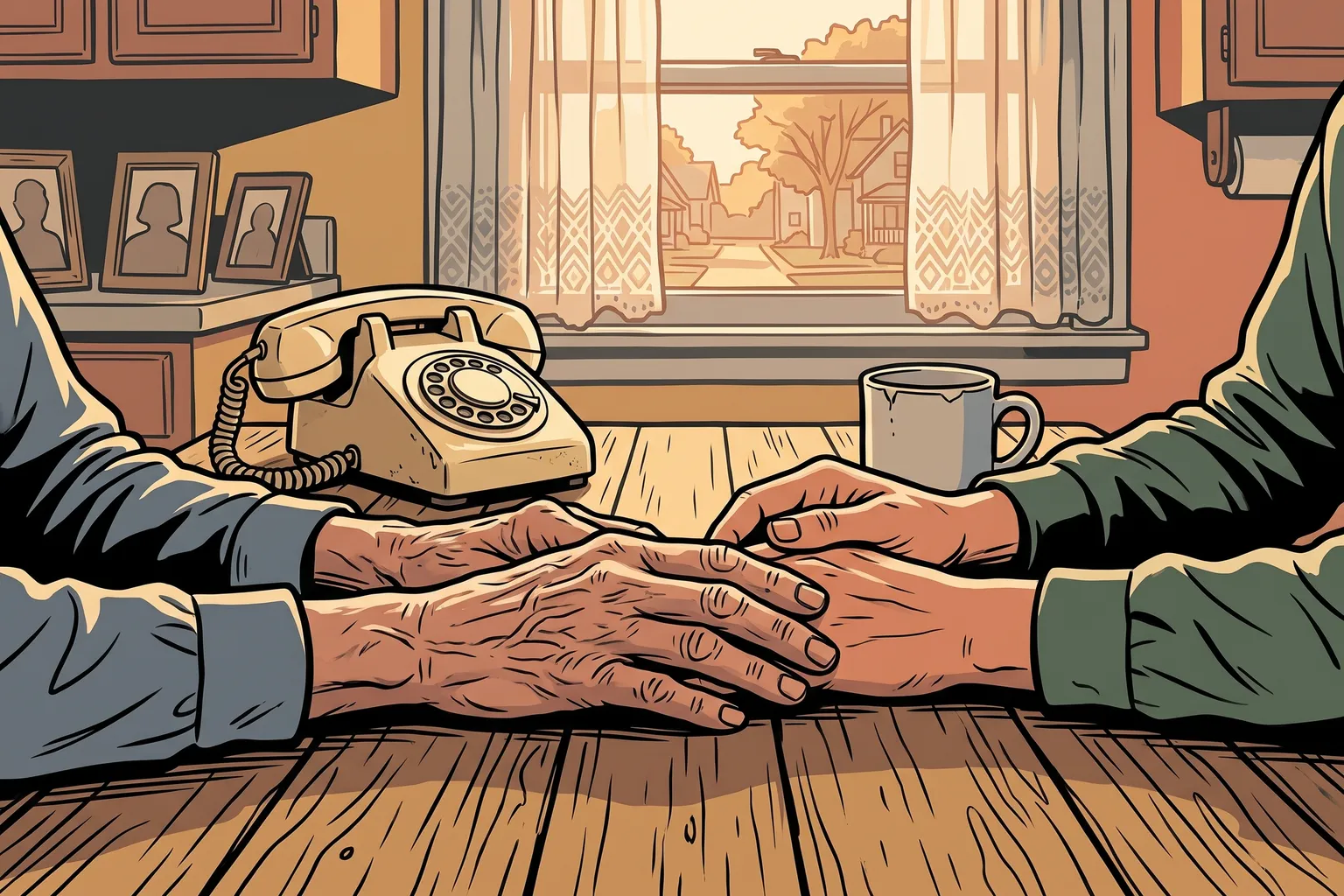
My brother Carl called me on a Tuesday in November, about four months after our mother’s funeral. It wasn’t planned. He just called.
We talked for an hour and twenty minutes.
That was new. Not that we don’t talk. We do. Carl and I have managed a kind of maintenance contact for most of our adult lives: a call at Christmas, an exchange around birthdays, a few texts when something notable happens. But an hour and twenty minutes on a random Tuesday, about nothing in particular and everything at once? That hadn’t happened since we were both in our twenties and still figuring out what we were going to be.
I’ve been sitting with that phone call for years now, trying to understand what loosened. Our mother had been the one who held us together, the person who made sure we called each other on birthdays, who remembered everyone’s anniversary, who could tell you exactly what your brother was going through with his back and what your sister’s youngest was up to in Columbus. When she died, we lost the relay system.
What I didn’t expect was that losing the relay system would eventually force us to talk directly.
I’ve heard this from enough people that I’ve stopped being surprised by it: the death of the last parent does something to adult siblings. Not always quickly, and not always well. But something. The intermediary is gone. The holiday house is gone or soon will be. The reason to all show up in the same room is suddenly unclear. And some siblings, under that pressure, fall further apart. But others, more than you’d think, fall toward each other.
Before that phone call, Carl and I had been in a long, mild drift that neither of us would have called a rupture, because it wasn’t. It was something quieter: the simple accumulation of years in which the main event of each other’s lives (children growing up, careers, the ordinary texture of a marriage) unfolded in separate houses in separate cities, and we became, to each other, a set of facts rather than a presence.
I knew the facts. I could have told you his wife’s name, his kids’ names, the general shape of his work. But I couldn’t have told you what he was most worried about. I couldn’t have told you what he regretted. I couldn’t have told you what he found funny anymore.
This is how sibling drift happens. Not in a fight. Not in a deliberate turning away. It happens in the same quiet way that all relationship maintenance fails when life is full: incrementally, invisibly, by omission rather than commission. You stop investing and the account empties slowly, and one day you look up and realize you’re maintaining connection with someone you no longer quite know.
Most siblings in the middle years, fifties and sixties, when work is at full weight and the children are grown and the parents are still alive and requiring attention, are running a relationship on whatever capital was built thirty years ago. You’re coasting on the version of each other you knew at twenty-five.
The version of each other you knew at twenty-five is, of course, not really the adult. It’s the sibling role, the assignment you were given, or claimed, or had pressed on you at eight years old and were still playing decades later, sometimes without noticing.
I grew up the middle of five. I know how this works from the inside. My oldest brother took on responsibility almost from birth, it seemed, the one who drove our mother to appointments when our father’s health declined, the one everyone assumed would handle things. This was never officially assigned. It just accumulated, the way things do in families.
My youngest sister was the baby in every sense: given more latitude than the rest of us, handled gently by default, treated at fifty-eight as though she required protection she’d never asked for. I used to resent this, and then I recognized it for what it was: a role with its own costs. The baby has to stay small. There’s a ceiling built into it.
The middle, and I’ll speak for myself here, disappears a little. Not entirely, but enough. You learn early that flexibility is how you survive. The middle child reads the room fastest, because they had to. The family translator. The one who holds everyone’s contradictions.
These roles don’t end when you leave for college. They follow you into the room at Thanksgiving when you’re sixty-two, and before you’ve said ten words to your brother, you’re already inside the old pattern. It’s a costume you put on without deciding to.
This isn’t always bad. Roles carry their own kind of intimacy, the shorthand of people who have known each other at close range since childhood. Your sibling can read your face in a way your spouse sometimes still can’t after forty years, because they watched you become who you are. That’s not nothing.
But the roles do freeze you at the age you were when you wore them first. At sixty, you might want to be known as the person you’ve become rather than the eight-year-old you were still carrying.
Researchers who study adult family bonds have documented something worth paying attention to: sibling relationships are, for most people, the longest they’ll have, often spanning seven or more decades. Sociologist Ingrid Connidis, who has spent years studying adult sibling ties across many populations, has written about how siblings in later life tend to move toward something closer to a chosen relationship, one that has to be actively maintained rather than sustained by circumstance. The siblings most likely to reconnect after the parents are gone are those who decide to, who treat the relationship as the thing itself rather than as the background of something else.
Retirement changes this too. When work ends, the schedule and colleagues and professional identity that organized your days disappear, and what’s left is time and the question of how to fill it. Some people find themselves calling their siblings more. Not because something happened but because something ended, and the person on the other end of the line knew you when you were nothing yet, and that turns out to matter more than you expected.
I’ll say what follows only once, and briefly, because I don’t want to make it the center of something it’s only the edge of.
My younger sister Patricia died in 2018. We had twenty-three months between her diagnosis and her death, and what I remember most about those months is not the illness itself but the conversations we had that we’d never had before. She said things she’d never said at full weight. I said things I’d been carrying since childhood. We talked with the particular freedom of people who have run out of reasons not to.
What I’m saying is: it doesn’t have to wait. That’s all.
If you’re reading this because your relationship with a brother or sister has gone cold, not from a fight, not from real estrangement, but from that long slow drift into mutual strangeness, I want to say that the repair is usually simpler than it looks from the outside.
Not easy. Simpler.
The obstacle is almost never what happened. It’s the accumulated silence around what happened. A small wound that was never tended, scar tissue that formed over it, and then years in which neither person could figure out how to acknowledge the scar without reopening everything. What’s under there is often not as bad as the silence made it seem.
Sometimes it is that bad. Sometimes there’s real damage, a betrayal, something said that left a mark. And then repair requires something harder. I’ve written before about what forgiveness actually involves, because it isn’t a moment and it isn’t a destination. It’s a practice, and it has its own particular work.
But most cold siblings don’t have a wound. They have distance. And distance yields to proximity. You call. You visit. You ask a question you’ve been not-asking for twenty years. You show up in the room and stay in it longer than is strictly necessary.
What I found with Carl, in that hour and twenty minutes on the Tuesday in November, was that I still recognized him. Not the facts, but the person behind the facts. The way he goes quiet when something matters to him. The dry humor I remember from when we were both kids in Gallipolis, still there at sixty-eight, still catching me off guard.
Two of five. The oldest and youngest I speak to occasionally. Carl and I talk most weeks now. We are, at this point in our lives, becoming people to each other in a way we weren’t at forty.
I don’t know if there’s a word for that. Reconciliation feels too formal. What it actually is feels more like a slow return. You drift and you come back. You come back because you’re old enough to know that the people who were there at the beginning are rare, and getting rarer, and the window to know them before it closes is smaller than you think.
My bracelet. The silver one on my left wrist, the one that was Patricia’s. I put it on at the funeral in 2018 and I haven’t taken it off. It’s not grief, exactly. It’s more like: she knew me. And I want to carry something that says so.
You have people like that. They might be on the other end of a phone you haven’t picked up in too long.
That’s a good enough reason to pick it up.