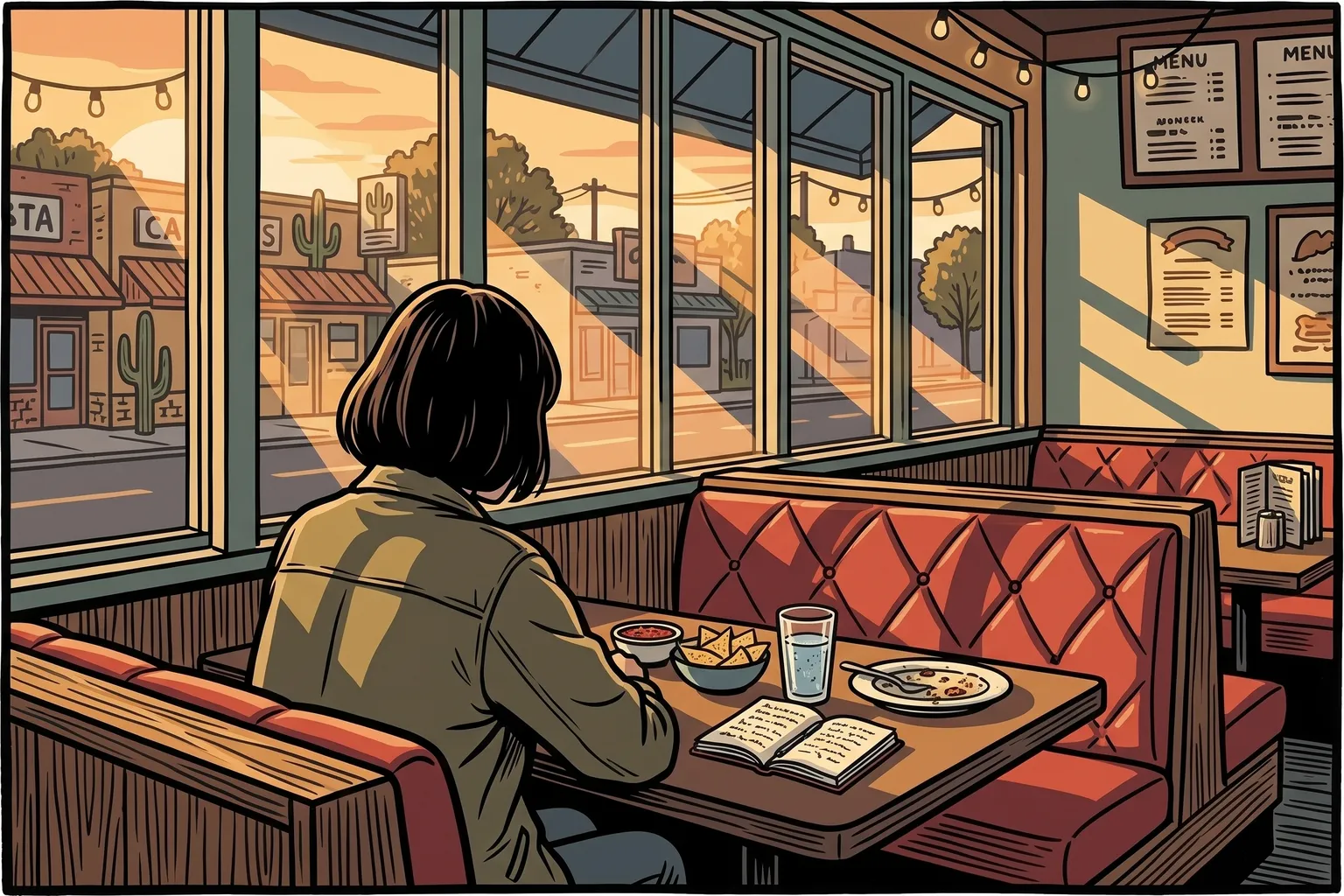
The booth is in the corner, left side if you’re walking in from the parking lot, right side if you’re facing the kitchen. It’s a four-top that seats two comfortably and four in the way that restaurant designers call intimate and the rest of us call tight. The vinyl is deep red, faded to something closer to brick at the center where the cushion has compressed under years of people deciding how they want their enchiladas. The table tilts slightly toward the window. I know this because I’ve been sitting at it long enough to put my glass on the high side without thinking.
This is a Mexican restaurant in the King William District, in a converted Victorian two blocks from where Elena and I have lived for the past thirty years. The owner’s mother makes the salsas. Her son runs the kitchen. His wife runs the front of house. I know all of this because I’m a regular, which means I’ve been coming often enough and for long enough that the restaurant has let me into its life in the particular way a place lets you in when it’s decided you’re worth the bother.
Being a regular isn’t something that happens to you. It’s something you earn. The first time I ate there I sat at a table in the middle of the room and ordered the chicken fajitas, which is what every person who has never been to a Mexican restaurant orders at a Mexican restaurant they’ve never visited. The fajitas were fine. They are always fine. Fajitas were invented to be fine. I came back two weeks later and ordered the green enchiladas with egg on top, which is what you order when you’ve started paying attention. I came back six more times over four months. I sat in different seats. I ordered different things. I talked to the owner’s wife about the mole negro she was adding to the menu. I told her I’d driven to Oaxaca in 2003 specifically to eat mole and that I had opinions. She said she had more opinions than I did and was probably right.
One Tuesday evening in the fourth month she brought Elena and me to the corner booth without asking where we wanted to sit. She didn’t say anything about it. She handed us menus we didn’t need and went to get our drinks. I looked at Elena. Elena looked at me. We were regulars.
I want to be precise about what changed. It wasn’t the service, which had always been attentive. It wasn’t the food, which had always been good. What changed was the room.
There is a difference between eating in a room and belonging to one. When you’re a stranger in a restaurant you spend a portion of every visit managing information: where do I sit, what do I order, is this expensive, will I like it, how long will it take. This is the low-grade anxiety of any new experience, and most of us have learned to tolerate it well enough that we don’t notice it until it’s gone. When someone walks you to the corner booth without asking, the anxiety is gone. You sit down into familiarity the way you sit into a chair you know.
What you get instead is your attention back. Your appetite goes to the food, not to the menu. You start noticing things you couldn’t notice before because you weren’t present before, not fully. I noticed that the family across from us orders the same thing every Friday and that the grandmother always gets the caldo and eats it slowly, with the concentration of someone who has been eating caldo for eighty years and has earned the right to take her time. I noticed that the kitchen turns tables fast on weekends and slow on Tuesdays and that by eight-thirty on a Tuesday evening you can hear someone laughing back there, which is the sound a kitchen makes when the pressure has come off. I noticed the way the light comes through the side window at six o’clock in November, flat and gold, and makes the salsa the color of something in a painting.
And there’s the name. The first time the owner’s wife said “Mr. Navarro, the usual?” I felt something I wasn’t prepared for. It’s a small thing. Restaurants have been doing it for as long as restaurants have existed. And still, to hear your name in a room that isn’t yours, spoken by someone who is glad you’re there, is a form of recognition that is rarer in American life than it should be.
The owner told me last spring that his commercial lease is up in January and that the building’s new owner has sent a number seventeen percent higher than the current rate. He said this the way people in the restaurant industry discuss money, which is with the practiced calm of someone who has been absorbing bad news for years. I asked what he planned to do. He said he didn’t know yet. He said the enchiladas were on him and went back to the kitchen.
That conversation hasn’t left me.
The neighborhood restaurant isn’t closing because people have stopped wanting neighborhood restaurants. Our hunger for them, if anything, has increased. The restaurant that knows you, that keeps your table, that understands the tortillas should arrive before you ask, has become scarce enough that people will drive twenty minutes and pay forty dollars a plate to find even a pale version of it. The problem isn’t appetite. The problem is the math.
A restaurant like this runs on the loyalty of its regulars the way a neighborhood bar or a good barbershop runs on loyalty. The regulars don’t just provide revenue. They provide the room’s character. They’re the people who know the grandmother with the caldo, who laugh at the right moment, who give the place its texture. When a restaurant closes, it isn’t just a business that closes. The room closes. And all the things that were known in it go with it.
I’ve watched four restaurants I was a regular at close in the last decade. One was a lunch counter on Fredericksburg Road where the owner knew my order before I sat down and the coffee came in a mug with a chip in the handle and cost two dollars. One was a Salvadoran place on South Flores that made a pupusa I haven’t found anything close to since. One was a barbecue trailer that parked in a lot off the highway every Tuesday, Wednesday, and Thursday from eleven to two, until the owner went back to Laredo when her mother got sick and didn’t come back, which isn’t a story about economics but about life, and the distinction sometimes feels thin.
The fourth was a place I’m not ready to write about yet.
The corner booth is still there. The owner told me last week he’s signing the new lease. His wife is taking catering jobs on weekends to help with the margin. He’s dropping two items that cost too much to make at the prices he needs to charge. He lost a dishwasher last month and hasn’t replaced him. He’s making it work the way people who run neighborhood restaurants make it work, which is by absorbing what they can absorb and not talking much about it.
Elena and I went on a Wednesday in July. The mole negro had been on the menu six weeks. I ordered it. It came with rice and two handmade flour tortillas in a cloth that held the heat. I ate in the corner booth at the tilted table with my glass on the high side and I didn’t open the notebook for the first twenty minutes, because I wasn’t there as a critic. I was there as a regular. The food tasted better for it. It always does.