The first time I had real mole, I was in Oaxaca in 1987. Elena and I had gone there specifically to eat, which we called a research trip so it sounded like there was a professional justification. A woman in the central market was making mole negro for her daughter’s quinceañera, and her neighbor, who sold pottery at a stall near the zócalo, invited us to sit with the family. I had been eating mole for fifteen years by then. The jarred kind. The restaurant kind that comes from jarred paste. The kind you order because you know what it is and don’t need to translate anything on the menu.
I didn’t know what it was.
What I knew was a dark, moderately spiced sauce over chicken. Earthy, a little sweet from the chocolate, adequate. Something to order when you wanted something heavier than enchiladas. I thought that was mole.
What the family in Oaxaca served me was something else: dark and glossy over turkey, intensely complex, with bitterness and sweetness and something smoky underneath that I couldn’t name, and heat that arrived fifteen seconds after I swallowed and stayed. Elena took one bite and went quiet. Elena doesn’t go quiet over food very often. “This tastes like someone really knew what they were doing,” she said. She didn’t mean it as a general compliment. She meant it as a recognition of something specific.
That’s what I want to explain here. Not how to make mole. How to understand what it is.
Mole isn’t a sauce. That’s the first correction.
Mole is a family of sauces, and the family is large. The word comes from the Nahuatl word molli, meaning sauce or concoction. The Aztecs were using it before the Spanish arrived. It’s not a specific recipe any more than “soup” is a specific recipe. When a Mexican grandmother says she’s making mole, you need to know her region, her family tradition, and the occasion before you know anything at all about what’s coming out of the pot.
Puebla and Oaxaca both claim mole as their homeland, and both claims have real support. Puebla gave the world mole poblano, the dark reddish-brown sauce most Americans picture when they hear the word. Oaxaca’s contribution is broader: the state produces at least seven distinct moles, and that’s a conservative count. Oaxaca calls itself the land of seven moles, and that’s accurate the way Texas calls itself the Lone Star State: right, and also not quite the whole picture.
The seven moles of Oaxaca aren’t seven versions of the same sauce. Mole negro is the darkest and the most intense, made with charred chiles and dark chocolate. Mole rojo is red and earthy. Mole coloradito is similar to rojo but brighter, lighter in body. Mole amarillo is yellow, made with yellow chiles, less complex than the darker varieties. Mole chichilo is made with charred mulato chiles. Manchamanteles, which translates to “tablecloth stainer,” is sweet and fruity, made with plantains and pineapple alongside the chiles. And mole verde uses fresh jalapeños and tomatillos and pumpkin seeds, and it tastes like brightness rather than depth. It has no chocolate. It doesn’t need any.
These aren’t variations on a theme. They’re members of the same family the way cousins are family: related by origin and name, significantly different in personality.
Mole poblano is where most people’s understanding starts, and it’s also where most misunderstandings live. The biggest one is that mole is a chocolate sauce.
Chocolate is one ingredient in mole poblano. A traditional recipe contains twenty to thirty ingredients depending on the cook, and the chocolate comes in near the end of a process that’s already been going for hours. The chocolate deepens the sauce. It doesn’t define it.
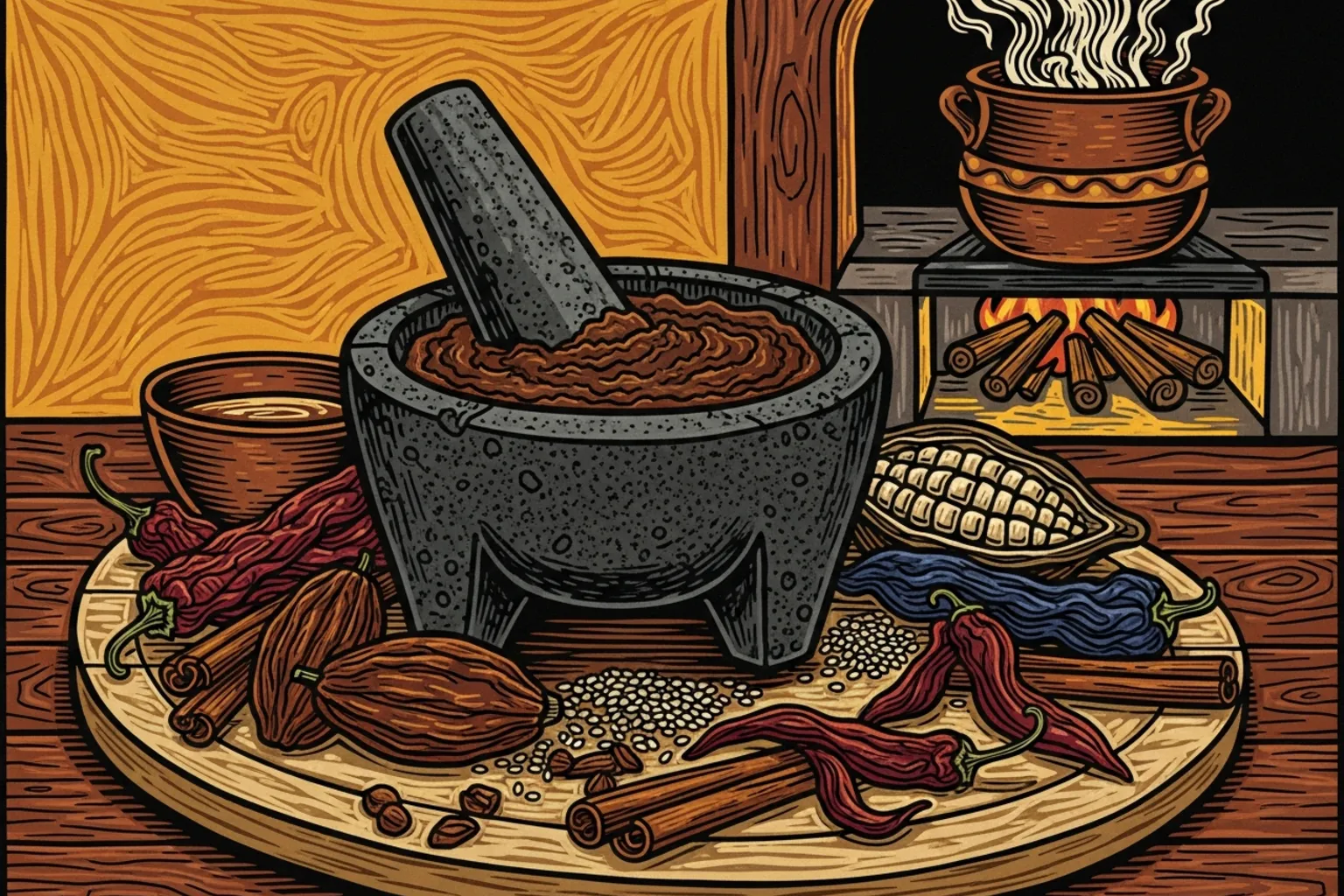
What defines mole poblano is the chiles. There are typically at least three varieties working together. Ancho chiles, which are dried poblano peppers, give the sauce its body and a mild heat with something fruity underneath, like dried fruit that got complicated and serious. Mulato chiles look similar to anchos but taste earthier, darker, closer to unsweetened chocolate, which is why they work so well in this context. Guajillo chiles are brighter and more tannic, with a sharpness that cuts through the fat of the sauce. These three together build something none of them could build separately.
Then there are almonds. Sesame seeds. Tomatoes and tomatillos. Onion and garlic. Cinnamon, cloves, black pepper, cumin. Raisins for sweetness. A piece of dried tortilla or bread for thickening. Each element gets toasted or fried separately before it goes into the pot, because each one needs its own application of heat to give what it has. Then everything gets ground into a paste, in a blender now or on a stone metate the traditional way, and the paste goes into hot lard and gets cooked again before the stock is added.
This is why a real mole poblano takes a day.
I’ve watched mole made twice in my life. Once in Oaxaca in 1987, and once in San Antonio at a neighbor’s house when her mother came up from Michoacán to cook for a birthday party. She started the day before. She didn’t use a recipe card. She moved through the kitchen the way you move through a familiar room in the dark, by memory and by smell and by the sound of the chile on the comal telling her when it was time to flip it.
The specific knowledge involved in that process doesn’t reduce to a set of instructions. How dark to char the mulato chile before it crosses from toasted to burned. How long to fry the paste before it’s ready for liquid. When the mole is done. These aren’t things you learn from reading a recipe. They’re things you learn from watching someone who already knows, and then doing it yourself for ten or twenty years until your hands know it too.
I think about this every time I pick up a jar of mole paste at the grocery store. That jar isn’t lying to you. It’s a real version of a real thing, and it’ll get dinner on the table. But it holds the ingredients without holding the knowledge. The knowledge that lived in the cook’s hands isn’t in the jar, and there’s no way to put it there.
My grandmother Consuelo made tamales every Christmas for forty-two people and never wrote the recipe down because she didn’t think of it as a recipe. She thought of it as a conversation between her hands and the masa, and the conversation lasted sixty years, and when she died in 1998 the other side of it went silent. Real mole, the kind that takes a day and that someone spent years learning to make, belongs to the same category. The jar gets you the ingredients. The day of making gets you the conversation.
The chiles are worth understanding on their own terms, because mole is, at its core, a study in what dried chiles can do when you know how to work with them.
I wrote last month about how agave variety shapes what ends up in a glass of mezcal, and mole works on the same principle. What Is Mezcal covers the idea that you’re tasting the plant’s history rather than just its alcohol. Mole works the same way. You’re tasting the specific history of specific chiles, dried to different degrees, charred or toasted or fried, combined in proportions that took someone years to calibrate.
The ancho is not the mulato. The mulato is not the pasilla. Pasilla chiles are long and narrow, black-brown when dried, with a savory raisin quality and moderate heat. They’re common in mole negro and in many central Mexican preparations. The chilhuacle negro used in Oaxacan mole negro is a different chile with its own flavor, specific to that region, and it’s not easy to find outside of Mexico. Substituting another dried red chile gets you something that works at the technical level without tasting the same.
Not all mole is dark, and not all of it has chocolate. Mole verde uses fresh jalapeños and tomatillos and pumpkin seeds, and it’s lighter and greener and brighter than anything from the dark side of the family. Pipián, which is sometimes treated as its own category, is built around toasted and ground pumpkin seeds, which give it both its texture and a nuttiness that dried chiles don’t have. Pipián predates the Spanish arrival in Mexico. It has nothing to do with chocolate.
The point is that what is mole sauce is a question with a long answer, and the answer depends on which mole you’re talking about.
When we got back to San Antonio from Oaxaca in 1987, Elena spent two months trying to find mole negro in the city. Not from a jar. The real thing. She found it eventually at a small place on the south side run by a family from Oaxaca, and she ordered it three times before she was satisfied she understood what she was eating. That’s how Elena approaches something she wants to understand. Not once. Not twice. Enough times to be sure.
The place closed a few years later. The economics caught up with it, as they do with most of the places I’ve loved in this city.
If you’ve only had the shortcut version, the question of what is mole sauce is worth revisiting. Find a Mexican restaurant that makes mole in-house and order it. Ask which kind. Ask what chiles are in it. You’re not asking because you’re uninformed. You’re asking because someone spent a day making it, and that deserves more than a guess.
The approach is the same as asking about an unfamiliar wine list: say what you want to know and let the person who knows the kitchen explain it. If you’ve ever felt awkward asking those questions in a restaurant, What Is a Sommelier covers why you shouldn’t, and how to have that conversation without feeling like you’re admitting something.
For mole, the questions worth asking are: is it made in-house, which region, and which variety. The answers will tell you more than the menu description will.
The sauce is complicated. That’s not a criticism. That’s the point of it. When someone spent a day building layers of toasted chiles and nuts and spices into something that doesn’t taste like any of its parts, the complication is the achievement. What I tasted in that courtyard in Oaxaca in 1987 was the product of knowledge accumulated over generations, carried in hands rather than written in notebooks, and served over turkey at a teenager’s quinceañera because that’s what the occasion called for.
A jar of mole paste is useful. It is not that.