Elena has been drinking mezcal for twelve years. I ignored it for eleven of those years because I thought I already knew what it was: smoky tequila, served with a worm in the bottle, ordered by people who wanted to seem interesting at a bar. I was wrong about most of that.
A bartender named Rodrigo corrected me about eighteen months ago in a small spot on the south side of San Antonio. He didn’t lecture me. He put a small clay copita in front of me and said, “Drink it first. Then I’ll tell you what it is.”
I drank it. It tasted like roasted agave, smoke, and something mineral underneath that I couldn’t name. It didn’t taste like anything I’d had before, and I’ve been paying attention to what things taste like for a long time.
“Now,” Rodrigo said, and leaned on the bar.
Mezcal is made from agave. That’s the essential fact, and everything else grows from it.
Agave is not a cactus, though people call it one. It’s a succulent. There are hundreds of agave varieties growing in Mexico, and more than forty of them can legally be used to make mezcal. The heart of the plant, called the piña because it resembles a pineapple once the leaves are stripped away, is what gets cooked, fermented, and distilled. Depending on the variety and how long the plant has been in the ground, a piña can weigh anywhere from fifty pounds to more than three hundred.
That “how long it’s been in the ground” part matters more than almost anything else on the label.
A blue agave plant for tequila takes seven to ten years to mature. Espadín, the most common agave variety used for mezcal, is similar. But move into the wilder varieties and you’re dealing with plants that spend fifteen, twenty, sometimes twenty-five years in the ground before anyone harvests them. Tobalá grows at high altitude and takes fifteen to twenty years. Tepeztate can take twenty-five or more. You’re not just buying a bottle. You’re buying the end of a very long wait, and there’s no shortcut to it.
Tequila, by the way, is mezcal in the original sense. The word mezcal once referred to all spirits made from agave, and in the broadest historical meaning it still does. But in the modern regulatory sense, tequila is its own protected category: made from one specific agave variety, the blue Weber, in a defined region centered on the state of Jalisco. Mezcal’s denomination of origin covers nine Mexican states, with Oaxaca producing the large majority.
When someone asks what is mezcal and wants the simplest honest answer: it’s what happens when you cook an agave heart, ferment it, and distill it. The differences between one mezcal and the next come from which agave, where it grew, how long it waited, and how the piña was cooked.
That last part is where the smoke enters, and the smoke is where most people’s understanding of mezcal stops and also where it shouldn’t.
Tequila producers steam their piñas in above-ground industrial ovens, sometimes in pressurized autoclaves. It’s efficient, it’s scalable, and it produces a consistent spirit. What it doesn’t do is introduce smoke.
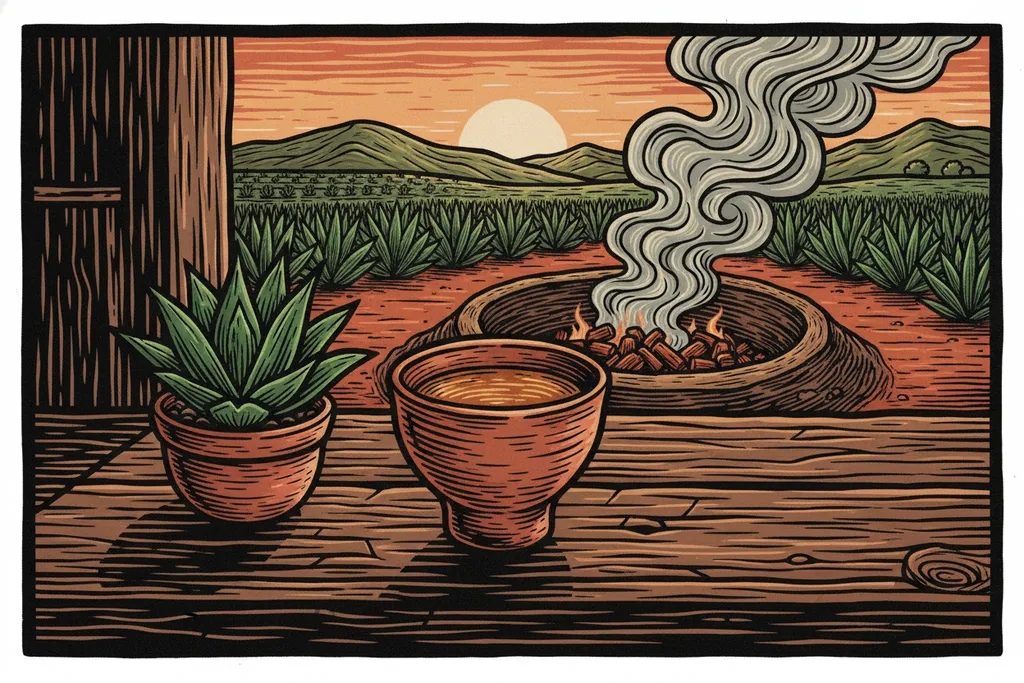
Traditional mezcal producers cook their piñas in underground pit ovens. The piñas go in, hot rocks go in with them, and the pit gets covered with agave fiber and earth and left to roast for several days. The smoke from the burning wood and the roasting agave works into the piña before it ever reaches the still. It’s not a flavoring. It’s baked in at the source.
This is why you can’t just describe mezcal as smoky tequila and be done with it. The smoke is not a characteristic added to mezcal the way liquid smoke gets added to a bottle of cheap barbecue sauce. It’s the record of how the agave was prepared. Different woods, different pit depths, different durations, different altitudes: all of it ends up in the glass. Some mezcals are aggressively smoky, the kind that arrive at the table announcing themselves. Others carry only a suggestion, something underneath the fruit and the mineral and the agave itself. The roast varies by producer, by region, by the maestro mezcalero who has been doing this for forty years and knows when the pit is working right without a thermometer.
There are mezcals with almost no smoke at all, made by producers who use above-ground ovens or steam, and they’re still mezcal. The category is wider than the marketing suggests.
Espadín accounts for the majority of commercial mezcal, and it’s where to start if you’re new to the category. It’s cultivated more widely than other varieties, which keeps the price accessible relative to what’s in the bottle. It tastes like agave: some smoke, some fruit, sometimes a little sweetness underneath. It’s the workhorse of the category for good reasons, not just practical ones.
Move past espadín and the range opens considerably. Tobalá grows wild at high altitude and produces something more vegetal, almost mushroom-like, with a brightness that espadín doesn’t have. Arroqueño is big in body, herbal, with less smoke than you’d expect. Mexicano runs floral and lighter. Tepeztate, when you find it, is unlike anything else in the category: a long-fermented wild agave that spent more than two decades in the ground, and it tastes like it has thought about things.
The logic here is the same as grape varieties in wine. A bottle made from tobalá doesn’t taste like a bottle made from espadín for the same reason a Pinot Noir doesn’t taste like a Cabernet: the plants are different, the chemistry is different, the time in the ground is different. You’re tasting the variety before you’re tasting the producer. Once you understand this, a mezcal list starts to make sense.
The economics follow the same logic. Espadín mezcal can start around thirty-five dollars and be excellent. A tobalá or tepeztate from a respected producer will cost eighty, a hundred, or more. You’re paying for the plant’s time in the ground. Twenty-five years is not a number that bends to the market. A harvest is a harvest, and the next one is decades away.
Most of the mezcal worth knowing comes from Oaxaca, in the mountains south of Mexico City. The state produces roughly eighty percent of what’s made, and its central valleys and mountain communities are where most of the category’s character was built. The town of Santiago Matatlán calls itself the world capital of mezcal and has a reasonable claim.
The palenques, small traditional distilleries, are where the work happens. Open-air fermentation in wooden vats, using wild ambient yeast rather than commercial cultures. Distillation in clay pots or copper alembics, depending on the producer and the tradition passed down. And the maestro mezcalero overseeing all of it with accumulated knowledge that does not come from a manual and cannot be replicated at scale.
I have a particular feeling about knowledge that lives in hands rather than on paper. My grandmother Consuelo made tamales every Christmas for forty-two people and never wrote the recipe down because she thought of it as a conversation between her hands and the masa, not a set of instructions to be followed. The maestros mezcaleros I’ve read about, and the one I spoke with briefly at a San Antonio tasting, carry something similar. The ability to read a fermentation, to know when the pit is ready, to taste from the still at the right moment: skills built over decades that no label communicates and no industrial process replaces.
This is part of what separates artisanal mezcal from the industrial category. It’s also part of why the cheapest mezcal, made at scale with modern equipment and pit ovens swapped for autoclaves, doesn’t taste like what Rodrigo put in front of me.
A few practical things, because practical things matter.
Drink it neat, at room temperature, in a wide-mouthed glass or a clay copita. A few drops of water open it up the way they do with a good scotch, revealing things that were sitting behind the initial hit of smoke. I started doing this with whisky and found it works equally well with mezcal, and I wrote about why in The Best Scotch Under $100 Is Better Than You Think. Not cold. Ice closes things down rather than opening them.
At a bar, a flight of small pours is useful if you’re learning the category. Different varieties side by side shows the range faster than any description. Ask the bartender what’s in the flight, where the agave came from, what to notice between them. A good mezcal bar will have someone who can explain this without making you feel like a student. The approach is the same as with any serious list: say what you like, say what you’re willing to spend, and let the person who knows the selection do their job. If you’ve wondered how that conversation works in the context of wine, What Is a Sommelier covers the same dynamic from a different angle.
The worm in the bottle, the gusano, tells you less than you think. It’s a larvae that lives in agave plants and appears in traditional Oaxacan cuisine in other forms. It was popularized as a commercial hook in twentieth-century mezcal marketing. Its presence in a bottle doesn’t indicate quality or tradition. Its absence doesn’t either. Let it go as a deciding factor.
Elena started drinking mezcal because she liked it, which is the only good reason to drink anything.
She grew up in Corpus Christi, close enough to the border that Mexico was never foreign, in a kitchen that ran on Mexican cooking the way ours in San Antonio still does. The first time she tasted mezcal, she said it tasted like something her grandfather would have kept a bottle of. She didn’t mean this as unqualified praise. She meant it was honest. That it tasted like where it came from and hadn’t been cleaned up for an audience that might not understand.
That’s what I missed for eleven years. Most of what we drink has been standardized past the point where the plant, the region, the hands, the time in the ground survive in the glass. Mezcal, at least the good kind, hasn’t been standardized out of itself yet. You can still taste what it is and where it came from. In a category full of spirits that have been engineered to taste like nothing in particular, that’s not nothing.
Elena was right about this a decade before I was ready to sit down and listen. That’s fairly typical, in my experience.