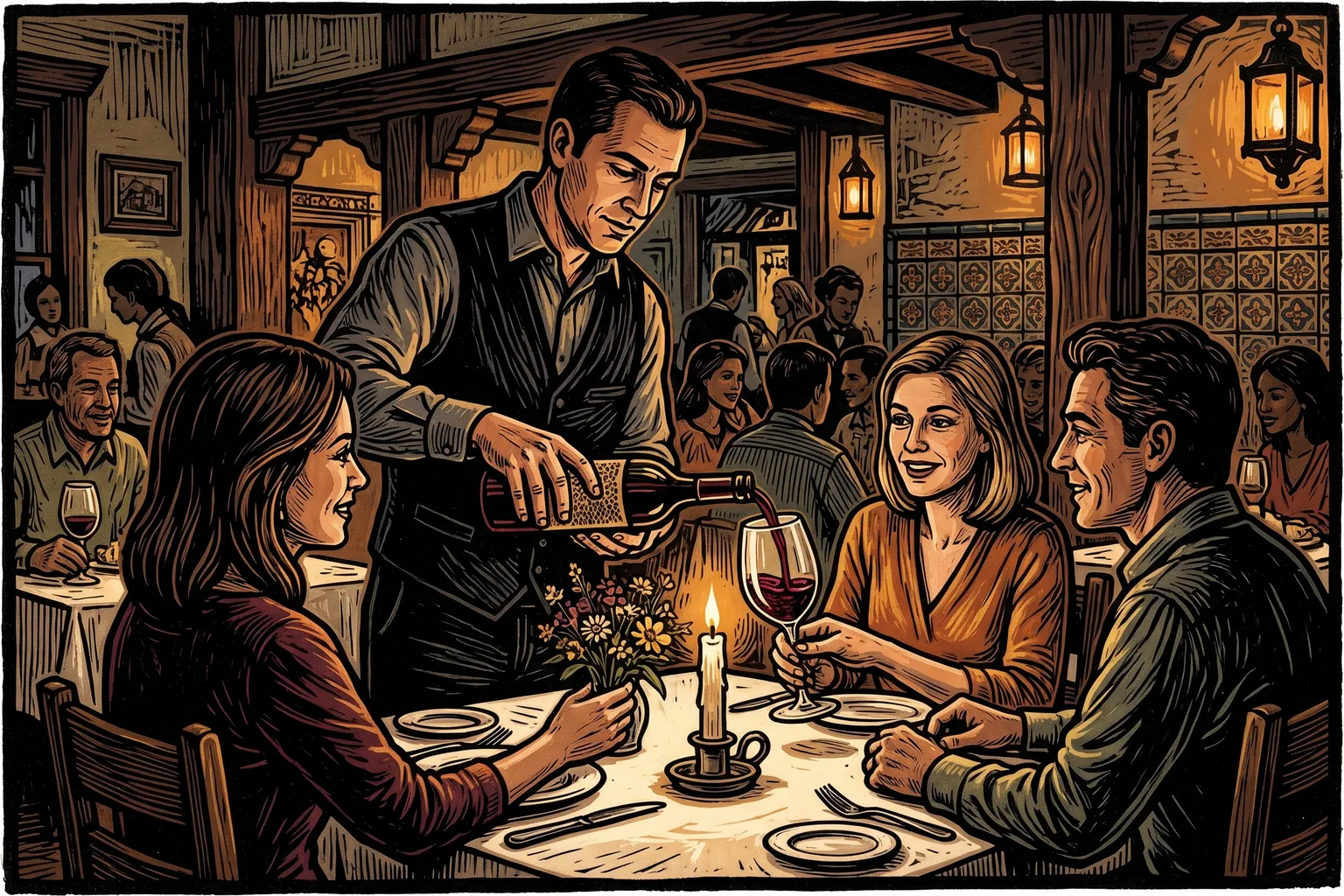
The sommelier came to the table and the couple next to us immediately became very interested in the bread. They tilted their heads down. They studied the rolls with the concentration of people who’d been told there’d be a quiz. The wine list was on their table, unopened. When the sommelier moved on to us, Elena watched this happen and got the expression she gets when she’s noticed something I haven’t written down yet.
“Why did they do that?” she asked.
“Same reason people pretend to check their phone when someone asks if they need help at a hardware store,” I said. “They don’t want to look like they don’t know what they’re doing.”
I’ve been eating in restaurants for four decades. I’ve known sommeliers personally, eaten alongside them at other people’s tables, watched how they work a room during a busy service. I’ve been on the other side of that interaction probably two thousand times. And what strikes me every time isn’t the expertise on display. It’s how many people spend the entire interaction performing confidence they don’t have, ordering the third wine from the bottom of the list without asking a single question, and then quietly wishing they’d gotten something better.
That’s what I want to fix.
A sommelier is a person who knows about wine and whose job is to help you choose one. That’s it. The ceremony and the pins and the tastevin, that little silver cup they used to wear around their necks to taste wine before restaurant lighting improved, can obscure this basic fact. A sommelier is a guide. They work in a restaurant. They want you to enjoy your meal. Everything else is a detail.
At a serious restaurant, a sommelier manages the wine program. They buy the wines, write the list, train the other servers on what’s in the cellar, and then during service they walk the floor and talk to tables. At a more casual restaurant, the same person might also be a server, a manager, or somebody’s cousin who took a weekend certification course and has been handed the list because nobody else wanted the responsibility. The title covers a real range of expertise. The job is the same across all of it.
That job: figure out what you’re eating, what you like, and what you want to spend, and find you a bottle that makes the dinner better.
There are professional organizations that certify sommeliers, and the certifications range from accessible to genuinely brutal. The Court of Master Sommeliers runs the most demanding program in the United States. To become a Master Sommelier, you pass a three-part exam covering theory, service, and a blind tasting that is widely considered one of the hardest tests in any professional field. Only a few hundred people worldwide have earned it across the program’s entire history. But a Master Sommelier at dinner isn’t taking your order. They’re running a program. The person who walks to your table is probably at an earlier level of certification, and an earlier level done well is exactly what a good dinner requires.
The pin on their lapel doesn’t tell you everything. The conversation will.
Restaurant wine markups are not a secret, but most people don’t know how they actually work. A bottle that costs twelve dollars at a retail shop typically appears on a restaurant list at thirty to thirty-five. A bottle that retails for forty might be ninety at the table. The markup is usually two to three times retail, sometimes more. The restaurant isn’t just selling you wine. It’s selling you the storage, the glassware, the temperature-controlled cellar, the service, and the labor of the person who carried the bottle from downstairs.
I’ve written about the economics of the restaurant industry before, how thin the margins on food actually are, how a nine-dollar plate of enchiladas might net the restaurant a dollar fifty. The wine list is part of how a restaurant stays solvent. That’s not a criticism. It’s a fact about how the business works.
The by-the-glass pour is where it gets interesting. A standard pour is five to six ounces. A standard bottle is twenty-five ounces, which is four to five glasses. Restaurants typically price a single glass at roughly a quarter of the bottle price. That means the first glass from any bottle gets back what the restaurant paid for it. The remaining three or four glasses are margin.
When the Good Cheap Place Closes is worth reading if you want to understand what restaurants are actually managing financially. The wine program is one of the few places they can breathe.
Knowing the economics should change how you talk to the sommelier. You now understand that a wine list is organized in part around what’s most profitable, and that the sommelier’s job is, inevitably, part of the business of the restaurant. A good sommelier balances this honestly. A less careful one steers you toward the expensive bottle without asking what you wanted to spend.
Here’s how to tell the difference: give them your budget before they start describing the cellar. Not the exact number if that feels too clinical, but a range. “We’re thinking around fifty dollars for the bottle.” Say it out loud. A sommelier worth their certification will say “okay, here’s what I’d suggest in that range.” One whose interests don’t quite align with yours will say “we do have this lovely bottle at ninety that really would be spectacular with your entrée.”
The second answer doesn’t mean they’re lying. The ninety-dollar bottle might actually be spectacular. But you gave them a number and they went over it without asking whether you wanted to reconsider. That’s worth noting.
Also tell them what you’re eating and what you tend to like. “We’re both having fish tonight and we prefer wines that are more crisp than fruity” is a complete instruction. A good sommelier can do a lot with that. If they look at you blankly after you’ve given them the food, the flavor direction, and the budget, find a server who knows the list and ask the same questions.
There’s a tendency to think of sommeliers as creatures of fine dining. The French-trained expert who appears at the three-hundred-dollar tasting menu, the person with a language for wine that sounds designed to make you feel uninformed. But a sommelier working a good steakhouse is doing the same job under different conditions. The list is shorter. The cuisine is narrower. The clientele is less likely to have opinions about Burgundy versus Bordeaux. The expertise required takes a different shape, but the job is identical.
A steakhouse sommelier who knows which of their by-the-glass pours can hold up to a ribeye and which ones collapse next to it is providing exactly the service the title requires. I’ve gotten better wine recommendations at a steakhouse in Dallas than at a prix fixe restaurant in Chicago that devoted two paragraphs of its reservation confirmation to the wine program. The tablecloth doesn’t tell you anything. The question tells you everything.
Judge the service by what it delivers, not by how formal the room is. This holds for restaurants generally. The full experience of dining out, as I’ve argued in a different context when writing about why every restaurant is so loud now, is about more than what’s on the plate. The wine conversation is part of that experience, and a good sommelier at a casual restaurant is every bit as valuable as one at a white-tablecloth place.
Wine goes corked when a naturally occurring compound contaminates the cork. The wine smells like wet cardboard, or a damp basement, or a dog who ran through rain, sometimes all three at once. It’s flat and dull and something seems subtracted from it. The aroma disappears where it should open up.
If your wine smells corked, say so. “I think this might be corked” is a complete sentence. You don’t need to apologize. You don’t need to build a case. A corked bottle is a defective product and any restaurant worth returning to will replace it without argument. The sommelier will smell it, confirm it, and bring you a new bottle. That’s the whole transaction.
Studies on cork taint vary in their estimates, but a meaningful percentage of bottles sealed with natural corks are affected, enough that sommeliers encounter it regularly and think nothing of it when a guest raises the issue. You’re not making a scene. You’re flagging a quality problem.
If you’re not certain whether the wine is corked or you just don’t love it, smell it again. A wine you don’t like smells like a wine you don’t like. A corked wine smells wrong in a specific, identifiable way. If you’re genuinely unsure, say “something seems off with this bottle” and let the sommelier smell it. They’ll sort it out. That’s what they’re there for.
Here’s the whole script, if you need one: “We don’t know much about wine. We’re having [food]. We’d like to spend about [amount]. What would you suggest?”
Three sentences. That’s it. Those three sentences will get you better wine than most people get after ten minutes of menu-studying, because most people give the sommelier nothing to work with. You’ve given them a cuisine, a budget, and permission to guide you. They’ll run with it.
Elena figured this out years before I did. She’s always been easier in restaurants than I am. I walk in with my notebook and my accumulated opinions, and she walks in ready to be fed. She learned a long time ago that telling a sommelier what you don’t know is more useful than performing knowledge you don’t have. Their entire job is to close the gap between what’s in the cellar and what you actually want at your table, and they can’t do that if you’re studying the bread and hoping they move on to someone else.
The person with the wine list isn’t testing you. They’re not keeping score. They’re not going to think less of you for saying you prefer something that doesn’t cost too much and goes well with salmon. They’re going to be glad you said something, because now they can actually help you.
You’ve been eating in restaurants all your life. You know what you like. Tell them that. Let them do the rest.