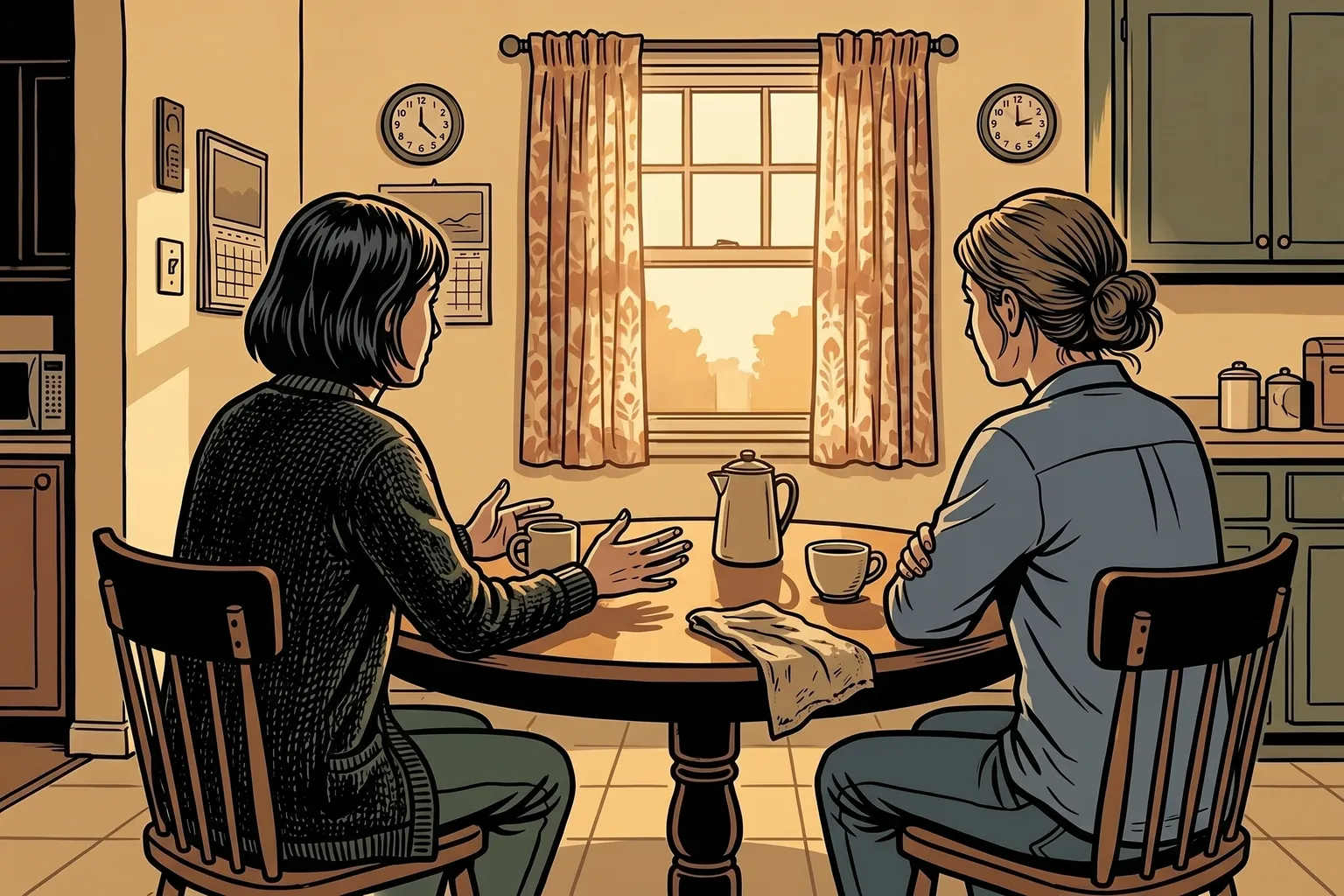
Marlene had known Sandra for thirty-two years. She said the number the way people say something they can’t quite believe. Thirty-two years. They had survived husbands and job losses and a cross-country move Marlene made and then reversed. They had attended each other’s children’s weddings. They had sat in each other’s hospitals. And yet Marlene had started, some years back, coming home from visits with Sandra feeling emptier than when she arrived. Not devastated. Not obviously hurt. Just less. Like something had been taken, quietly, in increments too small to name on any single day.
She’d never used the phrase “toxic relationship signs.” She had read it somewhere. She was fairly sure it was about something else. Abuse. Manipulation. The dramatic, nameable things. Her friendship with Sandra wasn’t dramatic. Sandra never yelled at her or stole from her. By most measures anyone would apply, Sandra was a good friend. She showed up when things were hard. She remembered birthdays. She called.
Marlene came to see me because she felt like she was losing her mind.
I’ve been doing this work for thirty years. First in counseling rooms and crisis centers in southern Ohio, then running grief groups in church basements, now in the writing that comes from all of that. And what I find in almost all of it isn’t the explosive, obvious harm. It’s the quiet pattern. The thing that happens so gradually and so consistently that the person living inside it starts to wonder if they’re the problem.
The phrase “toxic relationship” has gotten a lot of use lately and I understand the resistance to it. It can feel like diagnostic overreach, like we’re labeling ordinary difficulty as something clinical. I keep using it anyway, because I haven’t found a better word for the specific quality I’m describing: a relationship that consistently takes more than it gives, that teaches the person inside it, over time, to make themselves smaller.
These relationships are almost never with strangers. They’re with people we love, or used to love, or feel obligated to because of blood or history or thirty-two years of showing up for each other. That’s exactly what makes the toxic relationship signs so hard to see. You’re not looking for them in those places. You’ve been trained not to look.
The first pattern I learned to recognize is the person who keeps score. Their generosity has a ledger attached to it. They remember every favor, every sacrifice, every time they put themselves out for you, and they carry a running balance that surfaces in the moments when you’ve disappointed them. The score doesn’t reset. Gratitude doesn’t zero it out. You can spend years feeling vaguely in debt to someone you’ve also given a great deal to, and not understand why the debt never clears.
This isn’t always dramatic. It lives in small comments. “After everything I’ve done.” “I was there for you when.” Even just the particular sigh that precedes a favor you asked for. It can look like love. It has the texture of love. But love doesn’t keep score. Love doesn’t require you to be grateful enough, often enough, in exactly the right way.
The second pattern is harder to name and just as common: the person who takes your good news and makes it about themselves. You tell them something you’re proud of, something that took a long time to get to. And within thirty seconds you’re somehow talking about them. Their similar accomplishment. Their different version. Their opinion about whether what you’ve achieved is as significant as you think. Not all of this is conscious. Some of it is just the habit of a person who has spent so long at the center of their own world that they can’t find the edges of it.
What it produces in you, over time, is a reluctance to share the things that matter most. You learn to manage information. You calibrate. You decide what you can tell them and what will get redirected. This is one of the quieter toxic relationship signs because it doesn’t feel violent. But a friendship where you’ve stopped sharing your joy isn’t a friendship at full capacity. You’re doing significant work just to stay in the room.
The third pattern is the one people find hardest to name, because the behavior attached to it looks, from the outside, like help. This person shows up. They bring the casserole, make the phone call, arrive when you need them. But something comes with it every time. A comment about how you got yourself into this situation. A reminder, later, that they were there when you needed them. A hovering quality that makes the help feel less like a gift and more like a transaction you’re now inside of. You start to dread needing anything from them. You calculate, each time, whether the cost of the help is worth it.
I watched this in family systems work for years. It shows up in marriages. It shows up in parent-child relationships that never converted to adult-to-adult once the children grew up. It shows up in friendships that formed during a crisis and never got renegotiated once the crisis passed. The help is real. The cost is also real. Seeing both of those things at the same time isn’t betrayal. It’s just accurate.
And then there’s the person who controls the room without anyone naming it. Every family has one. The one whose moods set the weather at the dinner table. The one everyone is watching, tracking, softening around. Nobody announced this. You’ve never had a meeting about it. But ask any two people in that family who they’re all managing around, and they’ll give you the same name. The one whose absence at Thanksgiving produces a particular, private relief. The one who, if you suggest something that doesn’t align with their preference, creates a chill without raising their voice.
This is the hardest pattern to name because the person doing it often isn’t doing it consciously. They’ve never been told they do it. The family has accommodated it so thoroughly, for so long, that challenging it feels like overturning something structural. The accommodation gets labeled as love. We don’t say certain things around him because it upsets him. What doesn’t get said is what this has cost everyone, across decades.
Sandra’s pattern was the second one. She took Marlene’s good news and made it her own.
Marlene had stopped bringing Sandra good news years before she could put words to it. She’d started parceling out what she shared, keeping the things she was most proud of for the people who could receive them. She’d made this adjustment so smoothly, so unconsciously, that she hadn’t noticed she’d done it until she sat with me and began listing the things she’d stopped telling Sandra.
The list was long.
That’s what thirty years of small adjustments looks like from the inside. You think you’re being considerate. You tell yourself you’re not rubbing your wins in someone’s face. And then one day you realize you’ve stopped telling the person you’ve known longest about the things that matter most.
I want to say something about where these patterns live, because I think this matters.
We talk about toxic relationships almost entirely in the context of romance. The partner who controls or diminishes. The marriage that bruises. That conversation is important and I’ve had it many times. But the patterns I’ve described above live everywhere. They live in the sibling who has always made you feel smaller in the rooms where you both grew up. They live in the colleague you stayed friends with after you both retired because the friendship was part of who you were, even though it was never exactly nourishing. They live in the thirty-two-year friendship that has become a habit more than a choice.
The person in your family who controls the room has probably been doing it since before you were old enough to name it. The friend whose help always comes with a cost may be the person who was most present during the worst year of your life. You love them. The history is real. The difficulty and the love aren’t opposites.
None of this requires deciding that these people are villains. I haven’t found that framing useful in thirty years of sitting with people inside these patterns. Most people who keep score were kept score on themselves. The person who turns your joy into their own may have spent their whole life in rooms where nobody paid attention to them. The person who helps with a cost probably has a parent who helped with a cost. This doesn’t make any of it acceptable in your life. It just means they’re not characters in a story about you. They’re people with patterns, the way we’re all people with patterns, most of which we didn’t choose.
Recognizing the pattern is the first act of self-respect. Not the last act. Not a verdict. The first act.
Once you can see it clearly, you have real choices. You can name it directly to the person, if the relationship can hold that conversation. Some can. You can change the terms, see them less, bring less of yourself to the visits. You can decide that the real affection that is also present is worth the cost of a relationship that doesn’t fully nourish you. You can decide it isn’t.
I’ve written before about what it takes to apologize inside a long relationship that’s broken down and about the grief that comes from losing the people who have held your whole story. Both of those pieces came from the same place this one does: the belief that most people deserve a truer account of their own lives than the one they’ve been handed. You can be inside a difficult relationship and love the person in it. You can see clearly what the relationship costs you and also understand what it has given you. Those aren’t contradictions. They’re the truth, which is almost always more complicated than a verdict.
What I want you to have after reading this isn’t a list of people to remove from your life. I want you to have better vision. The ability to sit across from someone at dinner and name, quietly, what is actually happening. Not as an accusation. As information.
The moment you can see it clearly is the moment you stop blaming yourself for it. And once you stop blaming yourself, you can actually decide what you want.
Marlene was seventy years old when she finally put words to what had been happening in that friendship for thirty-two years. She looked up from what she’d been describing and said: “I’ve been managing her the whole time, haven’t I.”
It wasn’t a question.
Yes, I told her. You have been.
She sat with that for a while. Then she said: “I’m tired.”
I told her that made perfect sense. Thirty-two years of managing someone is a great deal of work. And she’d been doing it while calling it friendship.
She didn’t end the friendship, as far as I know. She changed what she brought to it. She stopped trying to share the things Sandra couldn’t receive and found other people for those things. She stopped blaming herself when she came home feeling less.
That’s not a dramatic ending. But it’s a real one. Sometimes that’s what seeing clearly gets you. Not freedom from the difficult person. Just freedom from not knowing what was happening.
That’s worth something. It’s worth quite a lot, actually.