I carried my bag for twenty-eight years. A Sun Mountain canvas carry bag, dark green, replaced once in 2009 when the zipper on the ball pocket finally gave up. I carried it because carrying it was part of the game. The weight of fourteen clubs and a dozen balls and a rain jacket and two sleeves of tees and a rangefinder and whatever else accumulates in a golf bag over the course of a season is not trivial. It is somewhere around thirty pounds, depending on how many balls you brought and how honest you’re being about how many you’ll lose. That weight distributed across a double strap on both shoulders was, for most of the years I played, something I did not think about. It was like thinking about the weight of your boots. You wore them. You walked.
The first time I noticed the bag was on the back nine at the course I’ve been playing since 1997, the walking course twenty minutes from the house. It was a Tuesday in August, 2023. Ninety-one degrees, which is rare for northern Michigan but not impossible. I was walking up the hill on thirteen, which is a two-hundred-yard par three that plays fifteen yards uphill, and I felt the bag. Not the straps. Not the buckle. The bag. The whole accumulated weight of it pulling on my shoulders and lower back in a way that was not painful but was, for the first time, present. I was aware of it in the way you become aware of your heartbeat when you’re lying in bed at night. Once you notice, you can’t stop noticing.
I finished the round. I shot 79, which was fine. I did not mention the bag to Terry Greve, who I was playing with, because there was nothing to mention. I went home and hung the bag in the garage and did not think about it for two weeks.
Then I thought about it for two months.
Here is the thing about carrying a golf bag that nobody tells you, because nobody has to tell you. The bag is not just weight. The bag is how you interact with the course. You approach your ball, you drop the bag, you pull a club, you hit. You pick up the bag. You walk. The rhythm of that sequence is the rhythm of golf for anyone who has carried, and it is distinct from the rhythm of riding, which is a different game played on the same course. When you carry, the walk between shots is uninterrupted by anything except your own feet and the weight on your shoulders. It is continuous. I loved it.
What I did not fully understand until I stopped carrying was how much of my attention the bag was consuming. Not a lot. Not a burden’s worth. But a steady low hum of physical management that took up space in my awareness the way a headache you’ve had for three hours stops being pain and becomes background. I was adjusting straps. I was shifting weight between shoulders on uphill holes. I was choosing where to set the bag down so it wouldn’t roll on a sidehill lie. I was doing all of this without thinking about it, which is not the same as not doing it.
I bought the push cart in October 2023. A Clicgear 4.0, which is what everyone buys because it works and folds flat and doesn’t require a degree in engineering to operate. I ordered it online and it sat in the garage for three weeks before I used it.
The first round with the cart was a Tuesday. Late October. Terry and I and a man named Phil Becker who plays with us when his schedule allows. I did not announce the cart. I just showed up with it. Terry looked at it and said, “About time.” Phil said nothing, because Phil already used one.
The mechanics are simple. You push. The cart rolls. You park it near your ball, pull a club, hit, put the club back, push. The sequence is different from carrying in ways that seem minor and are not. The bag is not on your body. Your shoulders are free. Your lower back is free. Your hands are occupied with the push bar, which means they are doing something, which matters, because idle hands on a golf course lead to fidgeting with tees and scorecards and other nervous habits that do not improve anyone’s game.
What I was not prepared for was the silence.
I don’t mean actual silence. I mean the silence inside the walk. When the bag came off my shoulders, something opened up. The low hum of physical management stopped, and in its place was a kind of attention I had not had on a golf course in years. I noticed the course. Not in the way you notice it when you’re reading a green or choosing a club. In the way you notice a place you’ve been a hundred times when you’re suddenly not carrying anything.
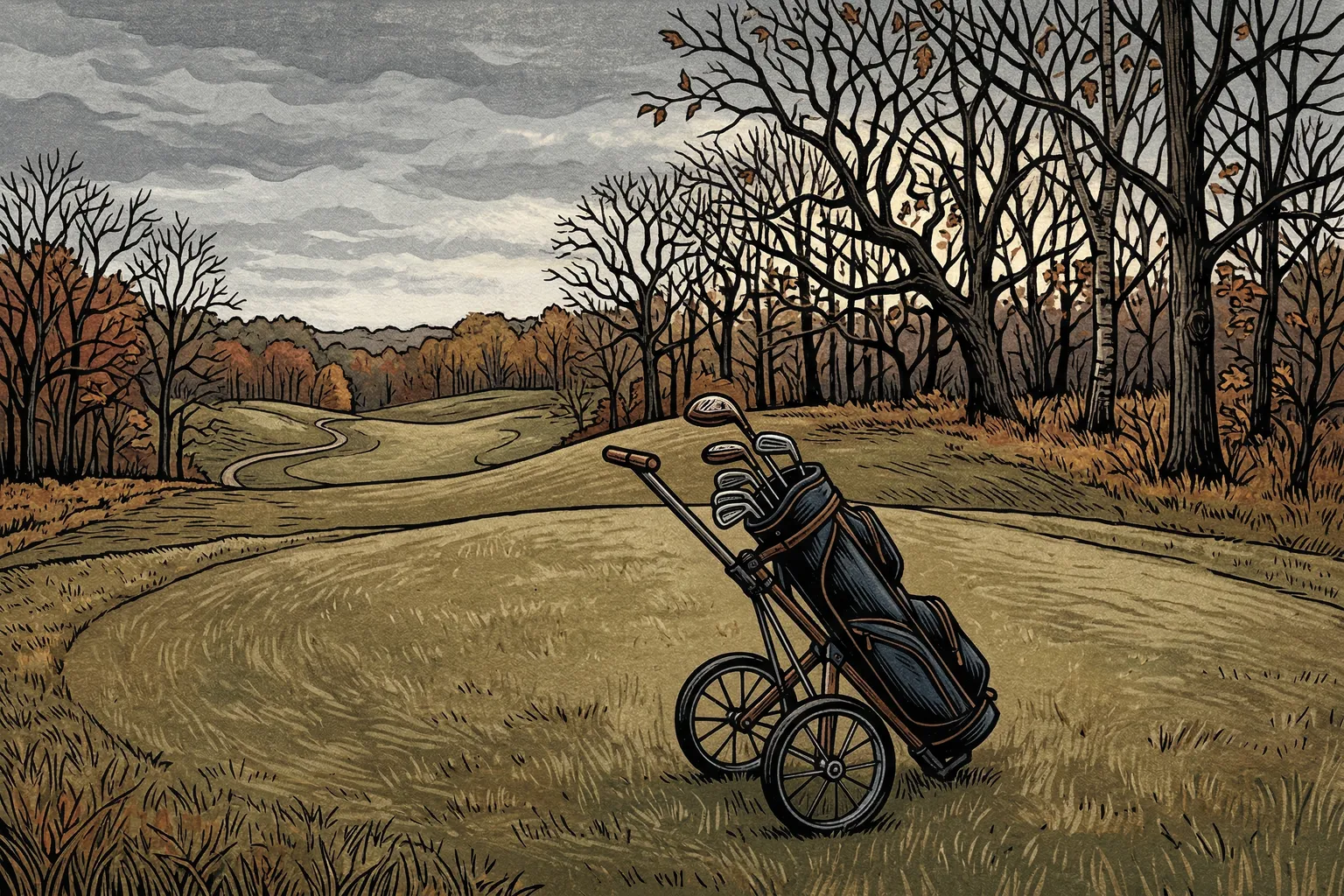
I noticed the way the light came through the maples along the fifth fairway in late October, the leaves mostly down, the branches making a lattice against a gray sky. I noticed the sound of the creek that runs behind the seventh green, which I have been walking past for twenty-seven years and which I could not have described to you with any specificity before that morning. I noticed that the turf on the downhill side of fourteen, where the fairway tilts toward the tree line, has a different texture than the rest of the course, spongier, wetter, the kind of ground that holds a footprint.
I had been walking past all of this for decades. I had been managing thirty pounds on my shoulders and calling it part of the game and it was part of the game and it was also, I now understand, a filter. Not a thick one. A thin one. The kind that doesn’t block the view so much as slightly reduce the resolution.
I don’t want to overstate this. The push cart didn’t transform golf into a spiritual experience. It didn’t fix my swing or my chipping or the persistent slice I develop in August when I stop committing to the follow-through. I still play the same course with the same men on the same Tuesdays. I still shoot in the high seventies on good days and the low eighties on honest ones.
What changed is the walk. The walk got better. Not easier, though it is easier. Better. I am more present on the course now than I was when I was carrying, and the reason is simple: I have more attention available. The thirty pounds are on wheels instead of shoulders and the difference in available awareness is larger than the difference in available energy, which is the part I did not expect.
Terry, who has used a push cart for six years, told me after that first round that the same thing happened to him. He said he didn’t mention it because it sounded like the kind of thing a person says when they’re trying to justify a decision they didn’t want to make. He’s not wrong about that. There is a version of the push cart story that is just a man explaining why the thing he gave up wasn’t important. That isn’t what I’m doing. Carrying was important. I miss it sometimes, the way I miss wading without a staff and driving without reading glasses. I miss it the way you miss any physical competence that was once automatic and is now a calculation.
But the calculation is worth making. The course is still there. The walk is still there. The game is still the game. What the push cart took from me was thirty pounds of weight and a particular version of how I thought the game was supposed to feel. What it gave me was the fifth fairway in late October with the maples bare and the light coming through and the time to see it.
I’ll take that trade.