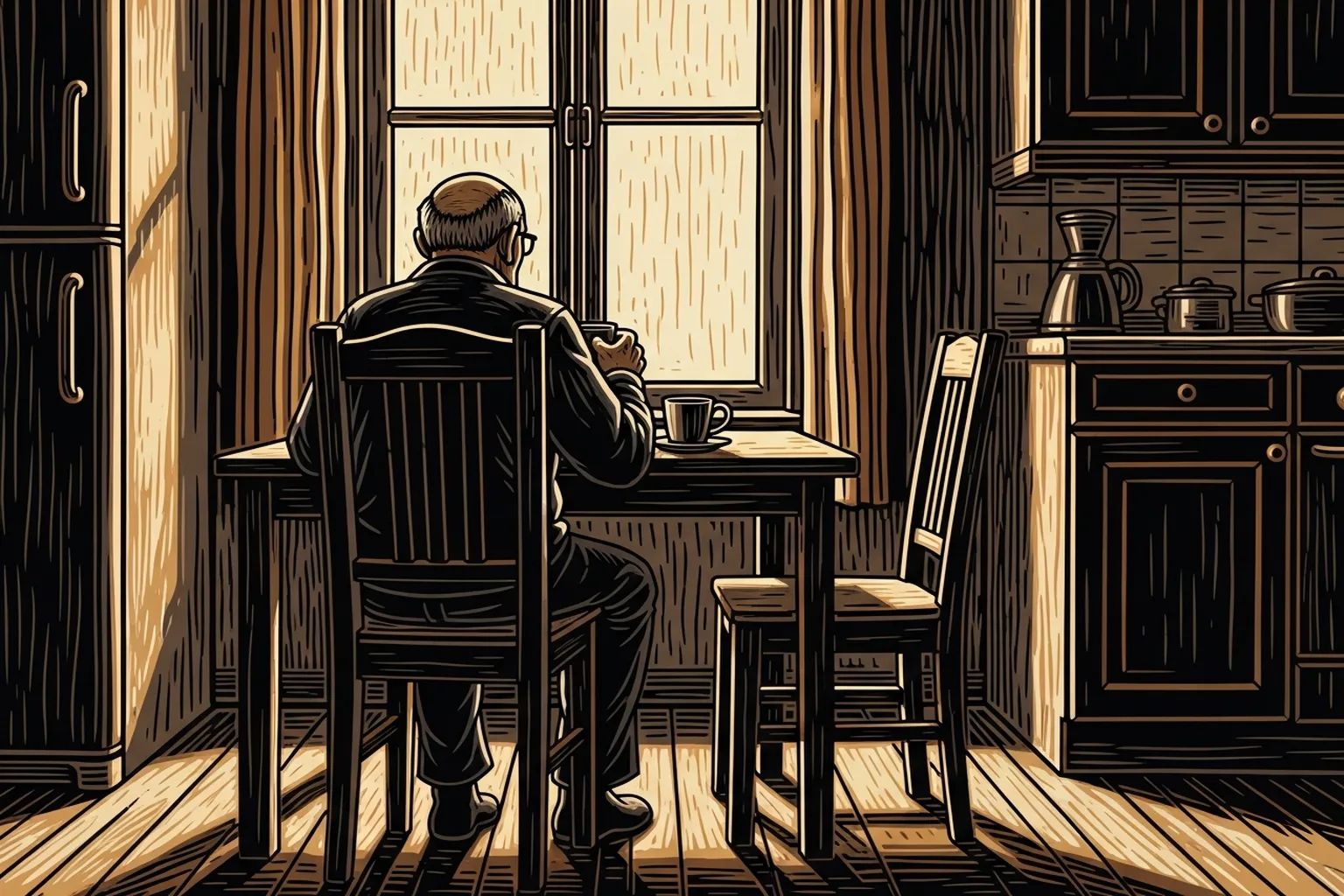
His name was Raymond. He came to the grief group three weeks after his wife died and sat in the corner with his arms crossed, the way men sit when they haven’t decided yet whether to stay.
He stayed.
For two months he said almost nothing. He ate the cookies the church ladies left by the door. He listened. He nodded sometimes when someone said a thing he recognized. Week six, he spoke.
He said: “I’ve been trying to figure out who to call.”
He meant practical things at first — the furnace making a noise, an insurance form he couldn’t parse. But the room went quiet in the particular way rooms go quiet when someone is saying something larger than the words. So he kept going.
“I don’t really have anybody to call,” he said. “I have people. My son calls on Sundays. I have neighbors. But somebody to call when things are genuinely bad?”
He looked at his hands.
“I don’t know when that happened.”
I have been in a lot of rooms like that one. Church basements in Portsmouth, Ohio. Community centers that smelled like folding chairs and bad coffee. I have watched a lot of men arrive at what Raymond arrived at: the mildly surprised discovery that the friendship infrastructure they assumed was there, quietly wasn’t.
Not because anyone took it. Not because something dramatic went wrong.
Because nobody tends what nobody was taught to tend.
Here is what I have watched happen, across thirty years and many rooms.
A man builds his friendships the way he builds most things: around function. Work friends. Sports friends. Neighbor friends. These are real friendships. I’m not dismissing them. But what holds them together is the shared activity. When the activity ends, most men don’t know how to replace it with the thing underneath. The actual relationship.
He retires. The work friends go. Not dramatically — just gradually, the way water finds its level. The lunch they meant to keep having becomes the lunch they kept meaning to have, which becomes a Christmas card, which stops after three years because one of them moved.
The kids leave. The neighborhood friendships that ran on school events and proximity — they thin. Life reorganizes around the couple. Around the TV. Around the grandkids when they visit.
The body starts requiring its own maintenance. Golf gets harder. The fishing trips are less frequent. And the friendships built on fishing trips don’t know how to exist without the boat.
He looks up one day and there is his wife. She is the whole of it. The friend, the confidant, the person who knows him. She carries all of it because she is the only relationship he maintained. Not by design. He didn’t decide this. He just stopped doing the upkeep on everything else, and she didn’t, and here they are.
And then, for some of these men, she dies.
And Raymond is sitting in the corner with his arms crossed, saying: I don’t know when that happened.
I want to be precise about something.
I am not describing a character flaw. I am describing a skills gap.
Nobody taught these men to maintain friendships the way their wives were taught. Nobody told them that friendship, like a marriage or a house or a garden, requires ordinary, unglamorous, ongoing attention. That the coffee you have once a year with your college roommate is not really a friendship anymore. It is a touching memorial to one.
That you have to be in contact with people — consistent, regular contact, asking real questions and tolerating real answers — before the relationship becomes the kind that can hold weight when weight is required.
This is learnable information. It is not complicated. These men never received it because the culture they grew up in decided they didn’t need it. Toughness was self-sufficiency. Disclosure was liability. You handled your own interior life quietly, or you didn’t handle it at all, and you called neither of these things loneliness because loneliness was for people who hadn’t managed things well.
That’s a failure of the culture, not the men.
The loneliness statistics for men over sixty are bad. They’ve been bad for a long time. But the statistics don’t capture what I keep watching in these rooms, which is the mild bewilderment of it. The slightly confused look on Raymond’s face. He wasn’t devastated when he said it. He was genuinely puzzled. He hadn’t tracked the losing. It didn’t happen all at once. It was a series of phone calls he meant to make, a drift he noticed and told himself he’d correct later, and then the later arrived and the friends were gone and he was standing in the kitchen with the furnace making a noise and nobody to call.
The loneliest men I know are not men who chose isolation. They are men who thought they were fine. Who had a full life — productive, recognized, busy. Who reached their late sixties and discovered that the full life didn’t contain what the second half requires. That they’d built something solid for the first forty years and assumed the second forty would look similar.
It doesn’t. And they don’t have the tools.
I want to say something directly to the men reading this. Not around them, not about them. To them.
You are not too old to do this differently.
I know that sentence sounds like something off a motivational poster. I mean it clinically. I have watched men in their seventies learn, in grief groups and therapy rooms and Tuesday coffee appointments, to do what they were never taught. It is not comfortable at first. It requires saying things that don’t fit the vocabulary of how they were raised — I’ve been thinking about you, I’d like to talk more, I miss you — and the first time you say something like that to another man you will feel exposed in a way that is uncomfortable and correct.
Say it anyway.
Raymond stayed in that group for eight months. By month three he was talking. By month six he’d exchanged numbers with another widower named Thomas, and they were getting coffee on Tuesdays. Nothing remarkable. Just coffee, just Tuesday. But Raymond told me once it was the first regular appointment he’d made that wasn’t a doctor’s office since he retired. He said he’d been eating breakfast alone for two years and stopped noticing it, until he had someone to eat with.
He noticed now.
There is a man reading this right now who has a friend he hasn’t really talked to in over a year. Someone who was real to him once. Someone who would pick up the phone.
He hasn’t called because there’s no particular occasion.
I want to offer him a different frame.
There is an occasion. The occasion is that you’re both still here, and neither of those things is guaranteed, and the low hum of something-not-quite-right that you’ve been calling tired or preoccupied or just how it is — that’s the loneliness. It’s real. It’s costing you something. And it doesn’t have to.
You don’t need a reason to call. You don’t need to have something to say.
You just need a Tuesday.
What are you waiting for? Not rhetorically — specifically. What condition are you waiting on before you reach out to the person whose name came into your head just now?
I don’t expect you to answer me.
I think you need to answer yourself. Tonight, honestly, when the quiet settles in.
I’ve sat with a lot of men who ran out of time. Almost none of them told me they wished they’d been more guarded.