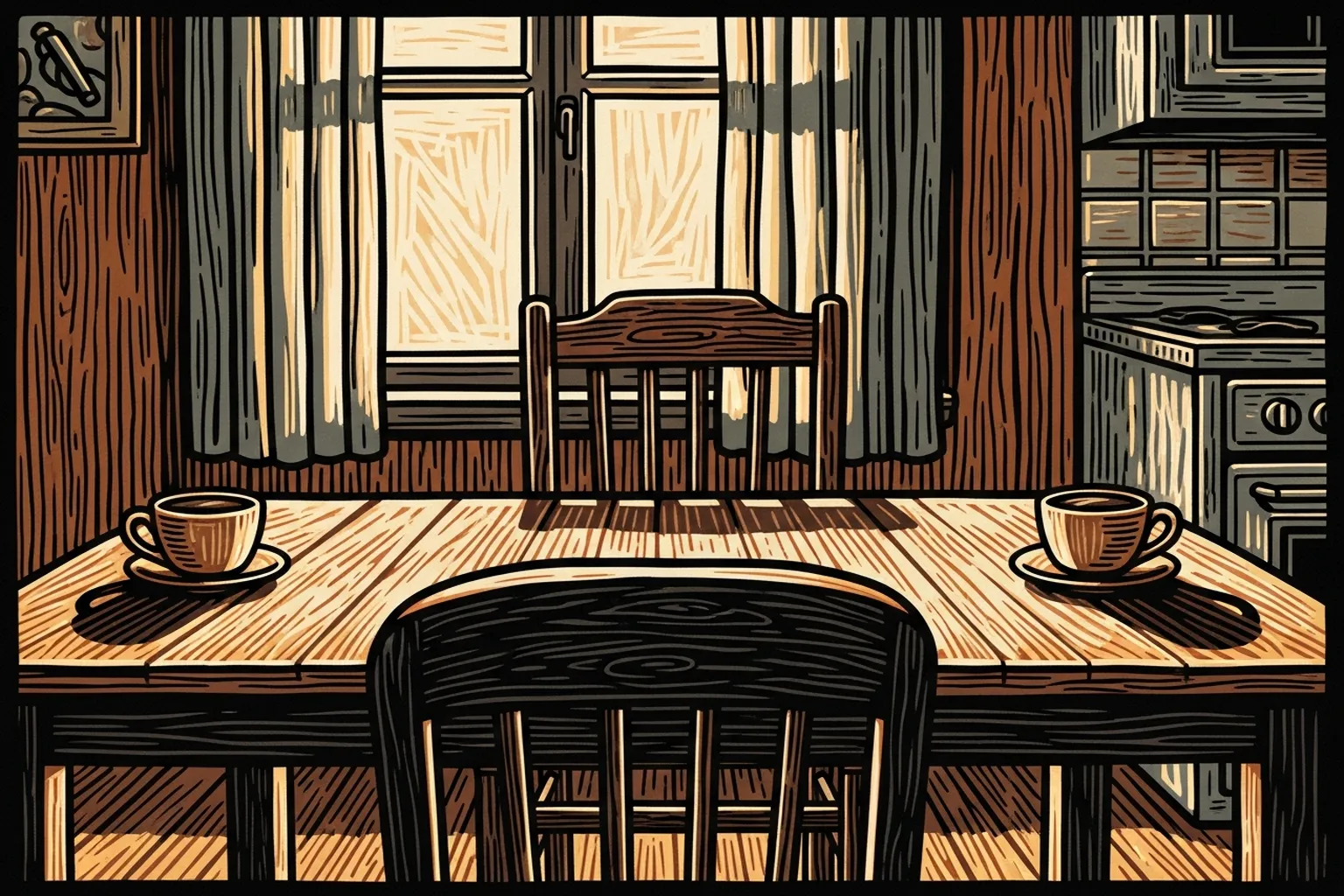
They were driving to the hardware store on a Saturday morning. She was looking out the passenger window. He was looking at the road. The radio was on, tuned to something neither of them had chosen, and neither of them changed it.
She thought about saying something. She had read an article that morning about a woman their age who had taken up pottery, and she thought Robert might find it funny, the way she described the clay exploding in the kiln. But she didn’t say it. Not because he wouldn’t have laughed. He might have. She didn’t say it because starting a conversation felt like effort, and she couldn’t remember when that had happened.
They drove fourteen minutes to the hardware store. He bought a hose nozzle. She waited in the car. They drove home. Neither of them mentioned the silence because it wasn’t a silence, exactly. It was just how Saturday mornings had become.
I’m telling you this because I think you recognize it. Maybe not the hardware store. Maybe it’s dinner. Maybe it’s the hour between eight and nine when you’re both in the living room and the television is doing the talking and you realize you haven’t said anything real to each other since Tuesday. Maybe it’s the way you sleep now, each of you turned to your own edge of the bed, not out of anger but out of habit, the way a river slowly carves two banks and doesn’t notice it’s getting wider.
This is not a story about a bad marriage. That’s the thing I want to be clear about. This is a story about a long one. A good one, even. One that did the hard things: raised children, buried parents, survived a job loss and a health scare and a year that almost broke it. A marriage that worked. And then, somewhere in the working, went quiet.
I have been married twice. The first time, I was twenty-four, and I thought love was a feeling you had and marriage was the container you put it in. The feeling would sustain the container. The container would protect the feeling. I was wrong about both of those things, but it took me a decade to understand why.
The second time, I was forty-four. Robert was fifty-one. We had both been through enough to know that love is not a feeling you have. It’s a thing you do. A practice. Something closer to maintenance than magic. We went in with our eyes open, which is a phrase people use to mean they expected difficulty, and what I actually mean is we expected to have to keep choosing each other, because we’d both learned what happens when you stop.
And still. Still, there were years inside this marriage when we drifted.
Not dramatically. We didn’t fight. We didn’t stop caring. We didn’t look at each other across the kitchen and think: I don’t love you anymore. It was quieter than that. It was the accumulation of small absences. The conversation you didn’t start because you were tired. The question you didn’t ask because you already knew the answer, or thought you did. The evening you spent in separate rooms not because you wanted to be alone but because being together had started to require something you didn’t have the energy for.
I sat with this for a long time before I could name it. And the name, when it came, surprised me: loneliness.
Not the loneliness of being alone. I know that loneliness. I was single for six years between marriages and I know what an empty house sounds like at eleven o’clock on a Wednesday. This was different. This was loneliness with another person in the room. Loneliness with someone whose breathing you could hear from the next room over. That kind is harder to identify because it doesn’t match the picture. You’re not alone. You’re married. You have someone. So what is this feeling, and why does it sit in your chest like something unfinished?
Here is what I’ve learned, from my own marriage and from thirty years of sitting with people in theirs.
The quiet doesn’t arrive all at once. It accumulates. It starts with the small things, the daily exchanges that seem trivial and are not. You stop telling each other about the article you read. You stop mentioning the odd thing that happened at the grocery store. You stop narrating your inner life to this person who used to be the first one you told. Not because anything went wrong. Because the telling started to feel unnecessary. You’ve been together thirty-two years. They already know you. What is there to report?
Everything. That’s the answer. Everything.
Because the person you married at thirty is not the person sitting across from you at sixty-seven. And the person you were at thirty is not the person you are now. You have both been changing, slowly, the way a house settles, and if you don’t keep asking who the other person is becoming, you wake up one morning next to someone you used to know.
Robert and I had a year like that. I’ve written about it before, but not from this angle. The year was 2008. My sister Patricia had been diagnosed, and I went into a kind of preemptive grief that I didn’t recognize as grief because she was still alive. I pulled away from everyone, but mostly from Robert, because he was closest and closest is where the pulling hits hardest. He didn’t chase me. That’s not his way. He’s a man who respects closed doors. And I closed a lot of doors that year.
What saved us was that someone said the thing out loud. It was our therapist. She looked at us in a Tuesday afternoon session and said: “You are both lonely. In the same marriage. At the same time. And neither of you has told the other.”
She was right. We were both sitting in the same quiet and neither of us had named it. Robert thought I needed space. I thought Robert didn’t notice. We were both wrong, and we were both protecting each other from a conversation that felt too heavy to start, and the protection was the problem.
I don’t want to make this sound simple. It isn’t. The loneliness inside a marriage is complicated because it’s tangled up with love. You don’t drift from someone you’ve stopped caring about. You drift from someone you care about so much that the distance feels impossible to name. How do you say to a person you’ve shared a bed with for twenty-five years: I feel alone with you? How do you say that without it sounding like an accusation?
I’ll tell you what I’ve told the couples I sat with in my counseling years, and what I’ve told myself on the nights when the quiet got loud.
It’s not an accusation. It’s an observation. And the difference matters.
An accusation says: you did this to me. An observation says: this is happening to us. The loneliness in a long marriage is almost never one person’s fault. It is a thing that grows in the space between two people who stopped tending the space. Both people live in it. Both people built it, one skipped conversation at a time, one quiet Saturday at a time, one evening of separate rooms at a time.
I am not going to give you five steps to fix this. I don’t believe in five steps. I believe in one: say the true thing out loud to the person you love.
Not the comfortable thing. Not “we should spend more time together,” which is true but bloodless. The true thing. Which sounds something like: “I miss you. You are right here and I miss you. And I don’t know when that started but I want it to stop.”
That sentence is terrifying. I know. I’ve said it. I said it to Robert in the kitchen on a Thursday in 2009, and my voice broke on the word “miss,” and he put down the dish towel and looked at me and said, “I know. Me too.” Three words. And the room changed.
It won’t always go like that. I know. Some of you are reading this and thinking: my husband wouldn’t respond that way. Or: my wife would hear it as criticism. Or: we’re too far gone. And maybe some of you are right. I can’t promise the conversation fixes everything. I can promise that the silence won’t.
The quiet in a long marriage is not peace. I want to be very clear about that. Peace has warmth in it. Peace is two people who have said what needs to be said and are resting. The quiet I’m describing is two people who have not said what needs to be said and have mistaken the absence of conflict for the presence of connection.
They are not the same thing.
Robert plays guitar on Friday evenings. Badly. I’ve written about this before, the particular sound of a man you love playing guitar badly in the next room. What I haven’t written about is what that sound means to me now. It means he’s still here. Not just in the house. Here. Present. Arriving. Choosing to fill the room with something, even something imperfect, rather than let the quiet win.
That’s all I’m asking. Not perfection. Not the passion of thirty years ago. Not grand gestures or weekend getaways or the kind of romance that belongs to people who haven’t earned the complexity you’ve earned. I’m asking you to fill the room. Say the thing you almost didn’t say. Ask the question you think you already know the answer to. Tell them about the article you read. Tell them about the weird thing at the grocery store. Tell them you miss them.
Because the opposite of the quiet is not noise. It’s presence. And presence is a choice you can make on any Saturday morning, in any car, on the way to any hardware store, for as long as you are both still here to make it.