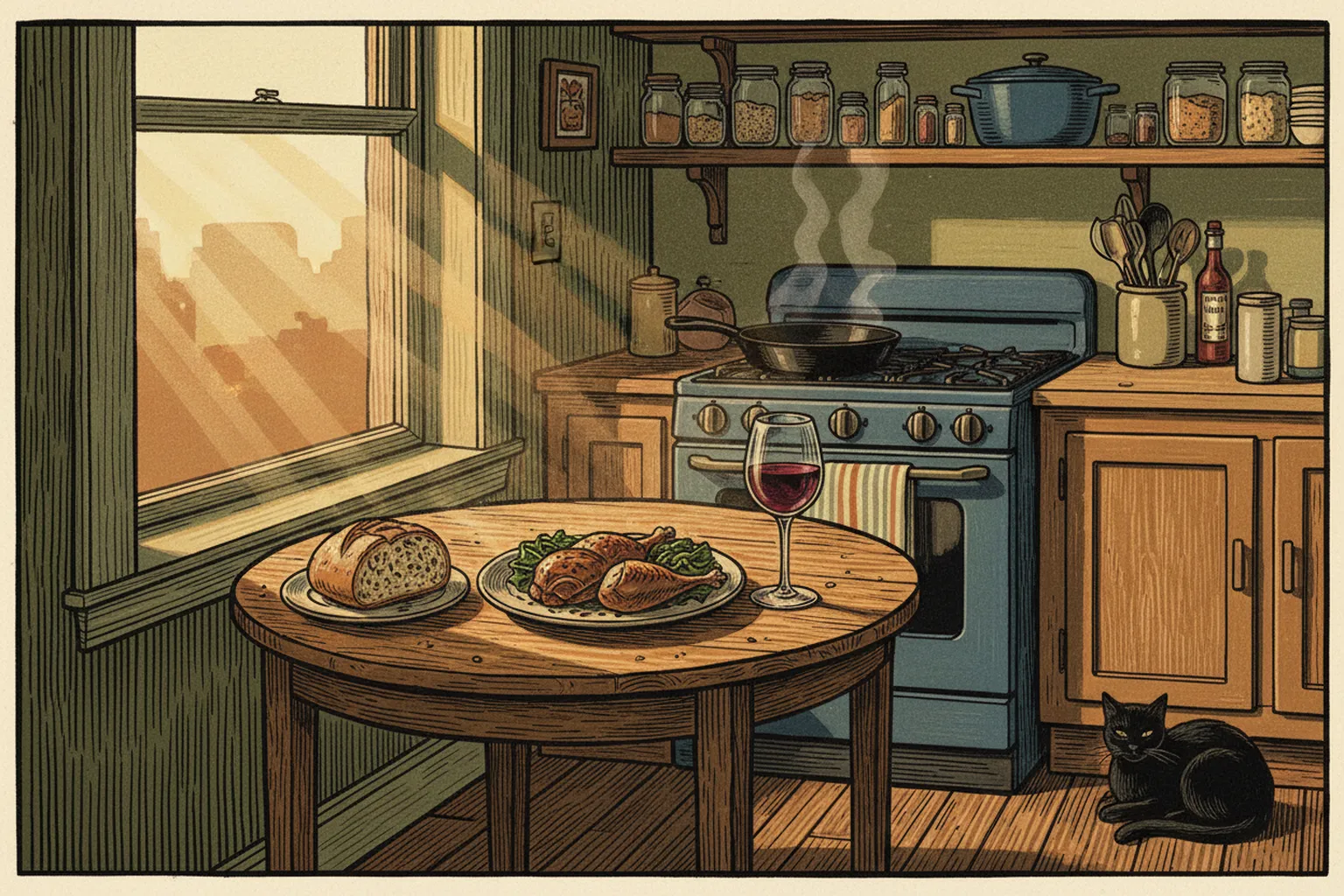
The chicken thigh is not a glamorous cut. I want to say this plainly because I think it matters. Nobody has ever photographed a chicken thigh for the cover of a magazine, and nobody has ever stood over a pan of them browning in olive oil and thought, I should post this. They are small and homely and slightly irregular and they don’t inspire performance. This is why I love them. This is why they are the center of my Tuesday.
I have been cooking Tuesday dinner for myself for a long time now. Not every Tuesday, but most Tuesdays, and with a seriousness that I didn’t arrive at naturally. For years, decades really, Tuesday was the least important meal of the week. When Melissa was in school and Gary was home and the house on Broad Street in Columbus was full in the way a house with a child is full, Tuesday was the night I made whatever required the least of me. Spaghetti from a jar. Grilled cheese. Something from the freezer reheated with the kind of half-attention that said: this is not the important night. Saturday is the important night. Thanksgiving is the important night. Tuesday is just getting through.
I was wrong about this for twenty years, and the fact that I was wrong is not something I am bitter about. I simply didn’t know. I was cooking for three people and working full time and the weeknight meal was a problem to solve, not an occasion to honor. I solved it the way most mothers solve it: quickly, adequately, without complaint, and without anyone noticing. That was fine. It was honest work and I don’t regret a single jar of store-bought sauce opened on a school night in 1993.
But I know something now that I didn’t know then. The Tuesday dinner, the nothing-special weeknight meal cooked in a quiet kitchen for one person or two, is the truest form of cooking there is.
I don’t say that to be poetic. I say it because it is accurate. On Tuesday there is no audience. There is no holiday. There is no guest to impress and no family arriving and no reason to cook except that you are alive and it is evening and you are hungry and the kitchen is there. The Tuesday dinner exists for the person making it, and the person making it is also the person eating it, and there is a kind of dignity in that closed loop that I didn’t understand until I was in my fifties and cooking alone.
My mother understood it, though she wouldn’t have called it that. Doris Hadley cooked on Tuesday with the same attention she cooked on Sunday, because she didn’t believe in categories of effort. Dinner was dinner. You showed up for it. The pot went on the stove at the same time every day and the table was set at five-thirty and that was that. She didn’t distinguish between the important meals and the unimportant ones. To her they were all important, because they were all feeding someone.
I think about this when I brown the chicken thighs on a Tuesday evening in late March, in the kitchen that I bought this house for, in Yellow Springs, with Bernard watching from the doorway because he can hear the oil and knows something is happening. The pan is my mother’s cast iron, the ten-inch, which is exactly the right size for two chicken thighs, which is exactly the right number for one person who wants dinner tonight and lunch tomorrow. I season them with salt and pepper and a little smoked paprika, which my mother wouldn’t have recognized and which I bought at the Dayton market from a man who grinds it himself and talks about it with the kind of passion that is either admirable or exhausting depending on your mood.
The thighs go skin-side down in the hot pan and I don’t touch them. This is one of the things forty years teaches you: to leave it alone. The instinct when you are young is to move things, to check, to lift the edge and peek. The instinct when you have been cooking for four decades is to listen. The sizzle tells you. When it calms from a violent hiss to something more conversational, more of a steady murmur, the skin has rendered and begun to crisp and you can turn them. This takes six or seven minutes and it requires nothing of you except patience, which is either the easiest or the hardest ingredient depending on the kind of day you’ve had.
I flip them. The skin side is golden and tight and lacquered in a way that would, honestly, photograph well, though I don’t photograph it. I let the other side go for three or four minutes, then I take the thighs out and set them on a plate and pour off most of the fat, leaving just enough to soften a handful of shallots, sliced thin, which I do now, stirring them in the pan so they catch all the brown bits stuck to the bottom. My mother called these “the good stuff” and she was right, and I have never found a more technical term that improves on hers.
When the shallots are soft and beginning to go gold I add a generous splash of white wine, whatever is open, and let it bubble and reduce by half. Then a cup of chicken broth, a few green olives sliced in half, a sprig of thyme from the pot on the back step that has somehow survived the winter. The thighs go back in, skin up, and the whole thing goes into the oven at 375 for twenty-five minutes while I set the table.
I set the table. I want to say something about this. For a while after my divorce, I ate standing up, or on the couch, or at the kitchen counter with a book propped against the salt cellar. This felt efficient and it was also a form of hiding. If I did not set the table, I did not have to look at the other chair. If I did not sit down to eat properly, I did not have to reckon with the fact that the table was smaller now, not because the table had changed but because the number of people at it had.
The moment that shifted this, for me, wasn’t dramatic. It was a Tuesday in maybe 2004 or 2005. I had made something simple, I don’t remember what, and I went to eat it on the couch and I stopped and looked at the small round table by the window and thought: that table is for eating. That is what it is for. Sit down.
So I did. I put a plate down and a fork and a glass of water and I sat and ate in the quiet and the evening light, and it was fine. It was better than fine. It was the first time in a long time that the meal felt like a meal and not like an errand.
I have set the table every night since. Even when it is just me and a bowl of leftover soup and a piece of bread. Even when Bernard is the only other presence in the room and he is asleep. The table is set because the meal is happening and the meal matters and the person eating it deserves a plate and a place to sit.
The chicken comes out of the oven. The skin has stayed crisp on top, which is the small miracle of this method, and the sauce underneath has reduced into something that is not quite a gravy and not quite a braise liquid but somewhere in between, silky with the olives gone soft and the thyme fragrant in the steam. I put one thigh on the plate with some of the sauce spooned over and a pile of whatever green thing I have, usually spinach wilted quickly in the same pan with a little garlic and lemon.
I eat it at the table, by the window, where the last of the March light is doing what it does in Yellow Springs at six o’clock, which is turning everything amber and quiet. The chicken is tender in the way that only dark meat browned slowly and braised gently can be. The olives give the sauce a briny depth that surprises me every time, though it shouldn’t surprise me anymore, because I have been making this for years.
The second thigh is for tomorrow. This is part of the design. When you cook for one, you learn to cook for two, because Tuesday’s dinner is Wednesday’s lunch, and there is nothing sad about this. It is planning. It is care directed forward in time. It is my mother setting the table at five-thirty every day regardless of what else was happening, because the meal was happening and someone needed to be fed.
My mother fed five people from that kitchen in Zanesville, and I feed one person from this kitchen in Yellow Springs, and the scale is different but the act is the same. You decide that it matters. You show up for it. You put the plate on the table.
That is what Tuesday teaches.
Braised Chicken Thighs with Olives and White Wine (for One, with Tomorrow in Mind)
Season two bone-in, skin-on chicken thighs generously with salt, pepper, and a little smoked paprika. Heat a tablespoon of olive oil in a ten-inch cast iron skillet or oven-safe pan over medium-high heat until it shimmers. Place the thighs skin-side down and leave them alone for six to seven minutes, until the skin is deeply golden and has released from the pan on its own. Flip and cook another three minutes on the other side. Remove to a plate.
Pour off all but a thin film of the rendered fat. Add two shallots, sliced thin, and cook over medium heat, stirring to pick up all the browned bits, until they soften and go gold, about three minutes. Pour in a third of a cup of dry white wine and let it bubble until it reduces by half. Add one cup of chicken broth, a handful of green olives (Castelvetrano are mild and buttery, but any decent olive will do), halved, and a sprig or two of fresh thyme.
Return the chicken thighs skin-side up so the skin stays above the liquid. Transfer the pan to a 375-degree oven and cook for twenty-five minutes. The skin will stay crisp. The sauce will reduce into something worth eating with a spoon, though you should probably use bread.
Serve one thigh tonight with the sauce spooned over and something green alongside. Spinach wilted in the same pan with garlic and lemon is right. The second thigh goes into the refrigerator, covered, and is your lunch tomorrow. Reheat it gently in a low oven or eat it at room temperature with a good piece of bread and a handful of greens and call it a salad if you need to call it something.
This is a Tuesday meal. It doesn’t require your best wine. It doesn’t require an occasion. It requires a pan and a little patience and the decision that tonight’s dinner is worth sitting down for.