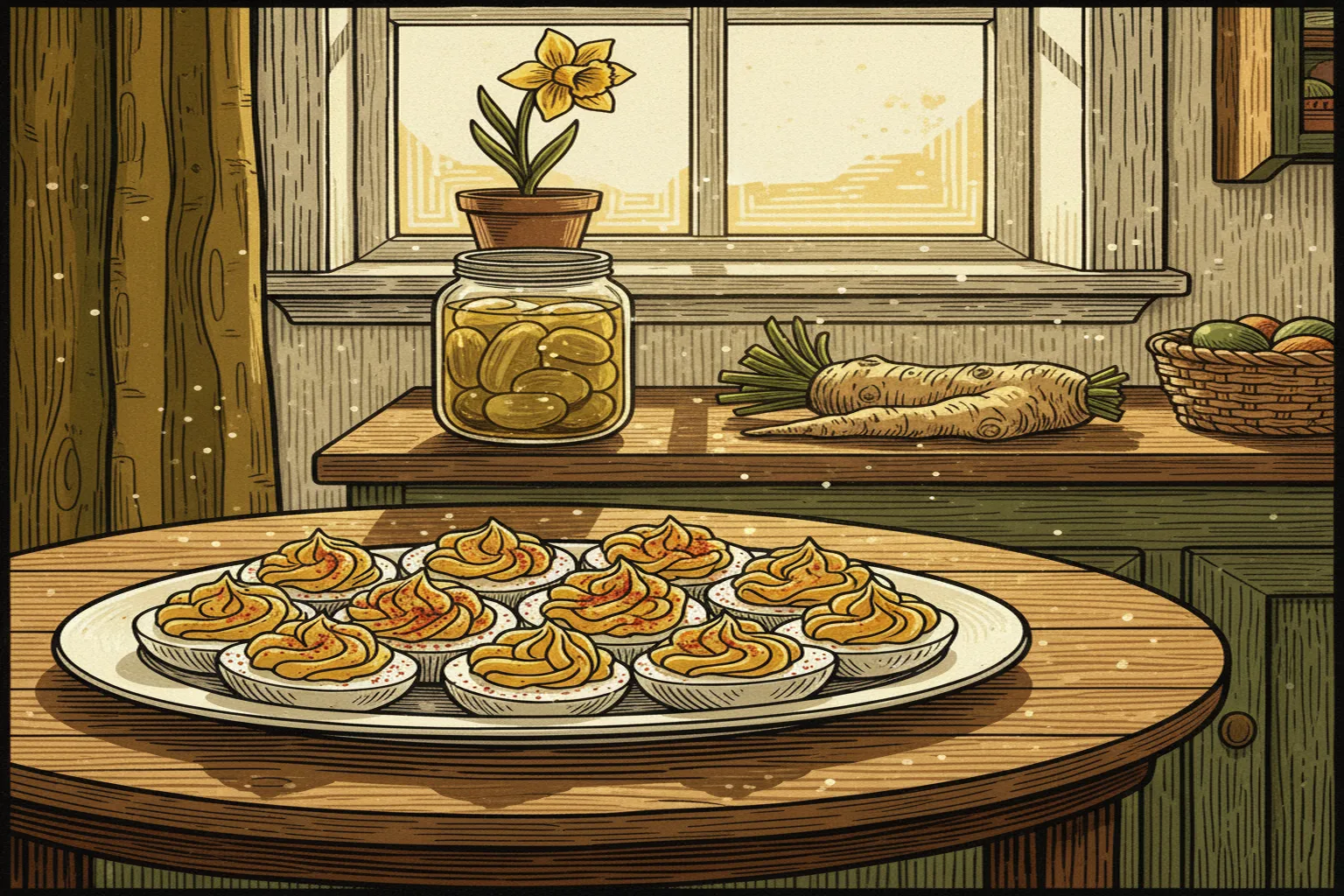
I boiled the eggs this morning.
It is a week before Easter and I am already boiling eggs, which is earlier than I need to. The eggs take an afternoon, not a week. But I boiled them anyway, fourteen of them, in the big pot with a tablespoon of vinegar and a confidence in the timing that took me twenty years to trust, and I set them in the refrigerator on a kitchen towel and felt the thing I always feel at the end of March when I start this: a small, specific gladness. The work has begun.
Easter in this kitchen isn’t what it used to be. There were years when it meant twelve people in the dining room in Columbus, the long table opened to its full length with the extra leaf Gary carried in from the coat closet. Melissa was small. Gary’s parents came down from Coshocton. My parents drove up from Zanesville. My sister Jan brought her kids. The ham was the center of everything and around the ham was potato salad and green beans and rolls and the deviled eggs, always the deviled eggs, on the oblong white platter that I still have and that has a chip on the rim now that I consider a mark of service.
Those years aren’t available to me anymore. My parents are gone. Gary’s mother, Ruth, is gone. Gary and I divorced twenty-five years ago. Melissa lives outside of Cincinnati with her husband and their boy, Caleb, and they come to Yellow Springs sometimes for Easter and sometimes they don’t. This year they’re going to his family’s. I told Melissa this was perfectly fine and I meant it, mostly, in the way you mean things that are true but that still land somewhere tender if you’re not paying attention.
So this Easter it will be me. Me and the eggs and Bernard, who doesn’t observe the holiday but who will observe, from his spot near the baseboard, the ritual of the kitchen with his usual skeptical attention.
I’m making the deviled eggs anyway. All of them. Fourteen eggs, twenty-eight halves, which is far more than one person can eat and which I intend to eat over the course of three days with the slow, repeated pleasure of someone returning to a plate in the refrigerator and finding it still there.
Here is why I cannot stop making them, even when the table has no one at it but me.
The deviled eggs are Ruth’s.
Ruth Hadley, Gary’s mother, who cooked with the particular authority of a woman who had never once consulted a cookbook in her life. Ruth was a tall woman with large hands and the kind of smile that arrived slowly and, once it arrived, made you feel you’d earned something. She and I didn’t always get along. She thought Gary married beneath him, geographically if not economically, and this mattered to Ruth in ways she was too polite to say and too transparent to hide.
But she could cook. My God, she could cook.
I learned the deviled eggs the first Easter I spent with Gary’s family, in 1980. We’d been married eight months. Ruth was in the kitchen and I was trying to be useful, which in Ruth’s kitchen meant staying near enough to help and far enough to not be in the way.
She peeled eggs under cold running water with a speed that I found mildly terrifying, her thumbs moving under the shell in one continuous motion, the egg emerging clean and white in about four seconds. I peeled eggs like I was defusing something. She peeled eggs like she was shelling peas.
Then she halved them and scooped the yolks and began to do the thing that made her eggs different from every other deviled egg I had eaten. The usual things first: mayonnaise, yellow mustard, salt, pepper. But then she reached for the jar of pickle brine on the counter, from the bread-and-butter pickles she put up every August, and added two tablespoons to the yolks. And then she grated in a knuckle of fresh horseradish, the real root, the kind that makes your eyes water and your sinuses open and that smells like the ground just gave you a warning.
The filling went from pale yellow to something slightly more golden, slightly looser, with a tang I could smell from where I stood. She piped it into the whites using a plastic bag with the corner cut off, dusted the tops with paprika from a tin so old the label had worn to an illegible red smear.
I ate one in the kitchen before they went to the table. The horseradish hit first, sharp and warm, then the sweetness of the pickle brine came under it like a counterweight, and then the whole thing resolved into something creamy and bright and entirely alive. I said, “Ruth, what is in these,” and she looked at me the way she looked at most things I said, which was with patience and mild surprise, and she said, “The same thing that’s always in them.”
I asked her for the recipe. She said there wasn’t one. I stood next to her the following Easter and watched her make them again, writing down everything I saw, timing the pours, estimating the horseradish by the size of the piece she used. I did this for three Easters in a row. By the fourth I had something I could reproduce.
I have been making Ruth’s deviled eggs every Easter since 1984.
Here is the part I didn’t expect.
When Gary and I divorced, in 2001, I assumed the deviled eggs would go with him. They were his mother’s. They belonged to his family’s Easter, not mine.
But that first Easter after the divorce, in 2002, I was alone in the Yellow Springs kitchen. Melissa was with Gary that year. I had planned nothing. I was going to treat it as a Sunday, which it was.
I went to the store on Saturday and bought a dozen eggs. I don’t know why. I came home and boiled them and peeled them with the speed I’d learned from Ruth and scooped the yolks and reached for the pickle brine and the horseradish and I made them. All of them. Two dozen halves for one woman on Easter.
I ate four at the kitchen table and I cried, which I don’t say to make you feel sorry for me. I cried because they tasted exactly right. They tasted like Ruth’s kitchen and like the years when the table was full and like a thing that I thought had ended but had not ended. The recipe was in my hands. It had been in my hands for twenty years. Learning is its own form of inheritance, and it doesn’t require a marriage to keep it.
Ruth died in 2009. I went to the funeral in Coshocton and sat in the back. I was not a Hadley anymore, but I was the person who knew how she made the eggs. This felt like something. It still does.
I am sixty-eight years old and I make deviled eggs for Easter every year regardless of who will be at the table. Some years Melissa and Caleb come and the eggs go fast and Caleb eats three and says they’re “fire,” which is apparently a compliment. Some years it’s just me and a plate of twenty-eight halves and a cat who would like to try one but won’t be allowed.
The pickle brine is the part that takes planning. I put up bread-and-butter pickles every August and keep the brine through the winter specifically for this. The brine is sweet and sharp and has the vinegar and the celery seed from the pickling spice, and it does something to the egg yolks that plain vinegar cannot do. It rounds the filling out. It makes it taste like someone put thought into it, which someone did, decades ago, in a kitchen I am no longer welcome in but whose best idea I carry forward every spring.
The horseradish I grate fresh. Grating it is an act of mild violence. Your eyes water. Your nose opens. The kitchen smells like the earth has something sharp to say. Ruth used more than I do. Ruth was a braver woman than I am, in the kitchen and generally.
Easter asks something different of you when the table is smaller.
It would be easy to let the holiday pass. Nobody requires my deviled eggs. Nobody has assigned me a dish to bring. The whole occasion, this year, is mine to make or to skip, and there is a voice in the practical part of my brain that says: you are one person. Buy a nice piece of fish. Let it be simple.
But I don’t want simple. I want the eggs.
I want the eggs because making them connects me to Ruth, who taught me. They connect me to those Easters in Columbus when the house was full and someone always brought too many rolls. They connect me to Melissa as a girl, reaching for the platter before anyone had said grace, because the eggs were the thing she wanted most and patience was not her strong suit at seven. They connect me to my mother, who made her own deviled eggs, plain ones, and who would have found the horseradish aggressive but would have eaten two and said they were very nice.
The cooking is how you hold the line. You don’t cook less because there are fewer people. You cook what you cook because the cooking is the memory. The cooking is the way you say: I was here, and they were here, and this is what we ate, and it mattered.
Next Sunday I will get up early. I will put on coffee and take the eggs out and peel them at the sink with Ruth’s hands, which are my hands now. I will make the filling the way I have made it every spring for forty-two years. I will set the table, one place, by the window, in the morning light. I will eat deviled eggs for Easter breakfast, which is not traditional and which I don’t care about, because the tradition is in the making, not the timing.
Bernard will watch. He always watches. He won’t get an egg.
And it will be Easter, because I decided it was.
Ruth’s Deviled Eggs (As Close as I Can Get)
Place fourteen eggs in a single layer in your largest pot. Cover with cold water by an inch, add a tablespoon of white vinegar. Bring to a rolling boil, then cover and remove from the heat. Let them sit for twelve minutes exactly. Drain and run cold water over them until they’re cool enough to handle. Refrigerate overnight if you can. Cold eggs peel cleaner and slice neater.
Peel them under a thin stream of cold water. Start at the wide end where the air pocket is. Work your thumb under the membrane and the shell will follow.
Halve the eggs lengthwise and scoop the yolks into a bowl. Mash them with a fork until they’re fine and crumbly. Add a third of a cup of good mayonnaise (Duke’s if you can get it, Hellmann’s if you can’t). Two teaspoons of yellow mustard, the plain kind. Two tablespoons of bread-and-butter pickle brine. If you don’t put up your own pickles, use the brine from a good store jar, not dill, not sweet gherkins. The brine should be sweet-sharp with a little warmth from the spices.
Grate in about a tablespoon of fresh horseradish from the root. This is not optional. This is what makes them Ruth’s. If you can’t find fresh, use two teaspoons of prepared horseradish, drained. It isn’t the same but it’s close enough. A quarter teaspoon of salt. Some black pepper.
Stir until the filling is smooth and slightly loose. It should be softer than you think. It will firm up in the refrigerator. Taste it. More brine if it needs brightness. More horseradish if you want the warmth. Ruth would want the warmth.
Spoon the filling into a plastic bag, cut a corner off, and pipe it into the whites in generous mounds. You want them full. Dust with Hungarian paprika, the plain kind, not smoked. Cover loosely with waxed paper and refrigerate at least an hour before serving. They are better cold.
Makes twenty-eight halves. Enough for a table of twelve or one woman over three days. Both are correct.