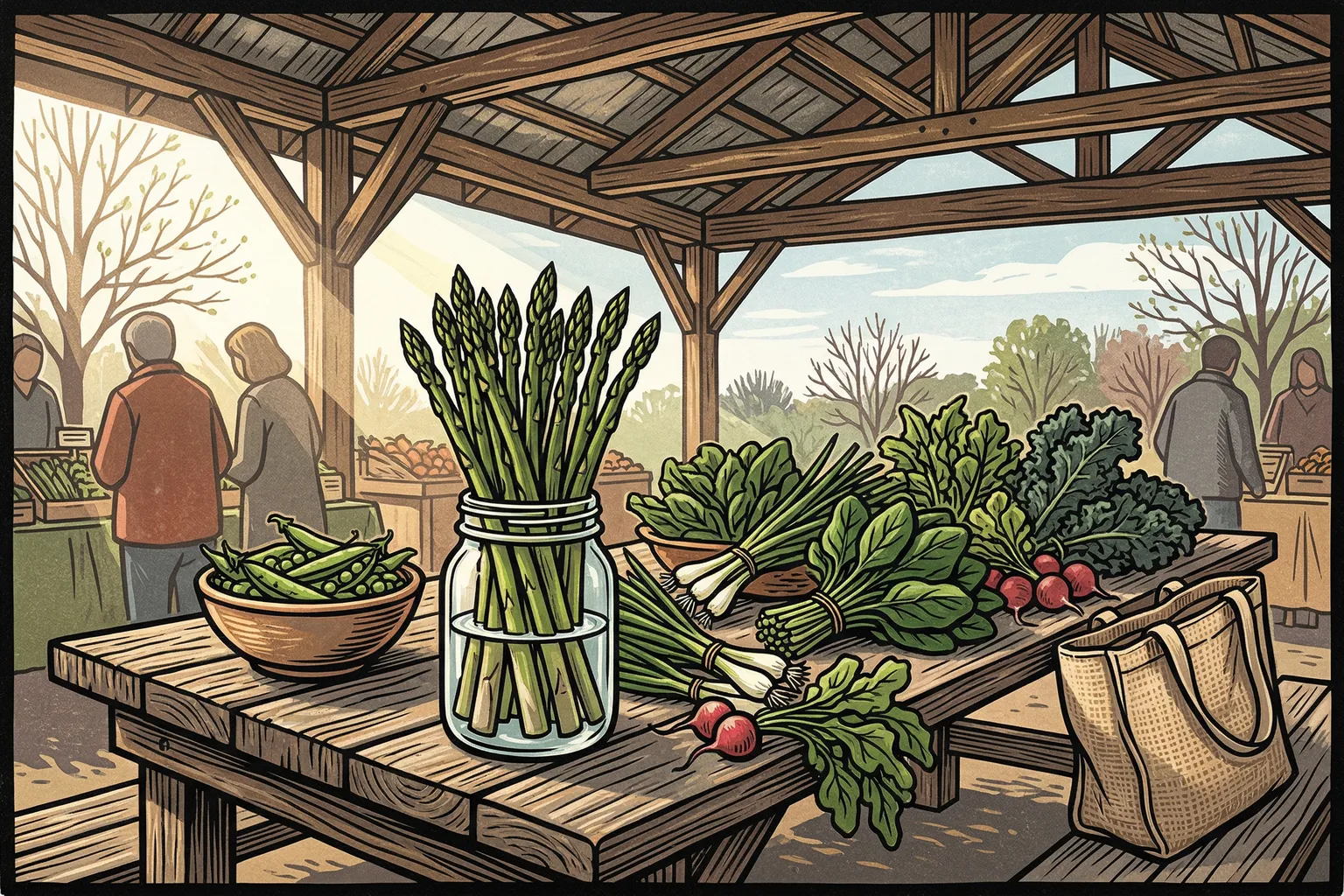
The asparagus was there before I was ready for it.
I go to the Yellow Springs Farmers Market every Saturday, have gone for the better part of eleven years now, and I know the rhythm of what appears and when. Late March in southwestern Ohio is not generous. The market in winter is root vegetables and storage onions and the last of someone’s canned goods and a kind of faith that keeps vendors showing up when the tables are mostly bare. I respect this faith. I go anyway. I buy what there is to buy and I talk to the people selling it, because the talking is half of why I go, and sometimes in February the talking is more than half.
But this past Saturday, walking up to the pavilion with my canvas bag and my coffee in the thermos I’ve carried every Saturday since I moved here, I saw the bundles from thirty feet away. Upright in a jar of water on Linda Matteson’s table. Dark green shading to violet at the tips, the stalks still tight and firm, not yet starting to fern. Asparagus. The first of the year.
I don’t know how to explain what this does to me without sounding like I’m making too much of a vegetable. I’ll try anyway. There is a moment in late March, if you have been paying attention to what the ground is doing, when something crosses over. The forsythia goes first, and the crocuses, and those are welcome but they’re ornamental. They’re for looking at. The first asparagus is for eating. It is the first thing the season gives you that you can take home and put on the stove and turn into dinner. It’s the difference between admiring spring and participating in it.
I picked up a bundle and held it. Linda said they’d come up fast after last week’s warm rain, that the bed she planted six years ago was finally producing the way she’d hoped. I asked if the ramps were in yet. She said another week, maybe two, depending on the woods. I bought two bundles, which is more than one person needs, and I didn’t care. You don’t buy the first asparagus of the year in reasonable quantities. You buy it the way you greet someone you haven’t seen since October: with more enthusiasm than the occasion technically requires.
I drove home with the windows cracked. Late-March air in this part of Ohio has a specific quality, a dampness that isn’t quite rain and isn’t quite fog, and it smells like soil waking up. The asparagus was on the passenger seat and I was already thinking about what I would make, which is the best part of the drive home from market, the planning that happens when the ingredient is still a possibility rather than a commitment.
My mother didn’t make asparagus. I want to be honest about this because it would be easy, and false, to say that the first asparagus of spring reminds me of her kitchen. It doesn’t. Doris Hadley cooked from what she knew, and asparagus was not part of what she knew. It was not a Zanesville vegetable. If it had appeared at the IGA on Maple Avenue it would have seemed like an affectation, which was a category of sin in her kitchen roughly equivalent to waste.
I came to asparagus on my own, in my thirties, in Columbus. A grower from Circleville brought bundles to the Saturday market and let people taste it raw, snapped in half, the way you’d taste an apple. I remember the snap. I remember the grassy sweetness of it, which was nothing like the canned asparagus I’d had once at a church supper and silently vowed never to eat again. This was a vegetable that tasted like it was still alive.
I bought a bundle and took it home and did the only thing I knew to do with a vegetable I’d never cooked: I sautéed it in butter. Too much butter, too high a heat, too long in the pan. It was more than fine. I ate it standing at the counter in the Columbus kitchen and I thought: where has this been.
That was 1991. I have been waiting for the first asparagus every March since.
There is something about the return of a seasonal ingredient that I don’t think you feel fully until you’ve been cooking for a long time. When you shop at grocery stores that fly things in from Chile and California, asparagus is available in January if you want it. The whole calendar has been flattened into a single unbroken season of availability, and this is convenient, and it has also taken something from the kitchen that I think matters more than convenience.
What it has taken is the reunion. I haven’t eaten asparagus since last June. Nine months. I haven’t been suffering. But the absence has been there, quiet and specific, the way a friend’s absence is there even when you’re not actively thinking about them. And then the friend comes back. And you remember.
The market in late March is a reunion in this way. Not just the asparagus. The people, too. Diane, who sells goat cheese, spent the winter in Kentucky with her daughter and is back now with the fresh chèvre I eat on toast with honey. The couple from south of Xenia who grow the best cherry tomatoes I’ve ever had, though those won’t come until July, and for now they’re selling lettuce starts and looking happy to be outside. By June the pavilion will be full and loud. In March it’s still intimate. You can talk.
I got home and put the asparagus in a jar of water on the counter, the way you’d put flowers in a vase. I wasn’t going to cook it immediately. Part of the pleasure is the anticipation, the looking at it, the planning. I’ve known for years what I make with the first asparagus of spring. It’s a frittata. Simple. And I’ll tell you why.
A frittata respects the ingredient. It doesn’t bury asparagus under cream sauce or pasta or anything else that would dilute the fact that you are eating the first green thing of consequence that the ground has offered you this year. The eggs are a vehicle. The cheese is a frame. The asparagus is the point.
I made it the next morning. Sunday. I cut the asparagus into pieces about an inch long, keeping the tips whole because they’re beautiful and because beauty in the kitchen is not frivolous, it is a form of attention. I sautéed them in olive oil in my mother’s cast iron, the ten-inch, over medium heat for about three minutes, until they were bright green and barely tender and the kitchen smelled like spring had actually arrived and was not just a rumor the forsythia was spreading.
I beat six eggs in a bowl with a fork, not a whisk, because a fork is what my hands reach for and because it leaves the eggs slightly uneven, which I prefer. Some salt. Some pepper. A handful of grated Parmesan from the wedge I keep wrapped in the refrigerator. I poured the eggs over the asparagus, let the bottom set for a minute or two, then scattered a little of Diane’s chèvre on top and put the whole thing under the broiler until it puffed and went gold.
I ate it at the table. Bernard was on the floor near the window, in the stripe of morning sun that crosses the kitchen around eight-thirty and which he has claimed as his. The frittata was exactly what I wanted. The asparagus was tender and sweet and tasted like the ground it came from. The eggs held everything together the way eggs do, quietly, without insisting on themselves. The chèvre melted into small pockets of warmth that you’d hit with your fork and think: yes. This.
It’s not a complicated thing I’m describing. A woman drives to the market, buys asparagus, makes eggs the next morning. There is no revelation in it. But I have been doing this, or some version of this, for thirty-five years now, and what I can tell you is that the first asparagus of spring, eaten at a small table in a quiet kitchen on a Sunday morning, is one of the things that organizes the year for me. It is how I know the season has turned. It is how the kitchen wakes up from its long winter of root vegetables and dried beans and soups that were good and necessary and that I am, by late March, finished with.
Something comes back with the asparagus that isn’t just the vegetable. It’s the whole Saturday morning. The early light. The drive to the market. The conversations. The canvas bag filling up. The planning on the way home. I’ve been doing this long enough that each spring’s asparagus carries the memory of the ones before it, and this is not nostalgia, it is accumulation. It is what happens when you pay attention to the same thing for a long time. The thing deepens. You deepen with it.
Next week, if the rain holds, there might be ramps. Linda said maybe, and Linda knows her woods. If there are ramps I will buy more than I need and I will pickle half and eat the other half scrambled into eggs with too much butter and I will stand at the stove and think: here we go. The season is open.
But that’s next week. This week, it’s the asparagus. And that is enough.
Asparagus Frittata with Chèvre (Sunday Morning, First of Spring)
Take a bundle of asparagus, the freshest you can find, and trim the woody ends by snapping them where they naturally want to break. Cut the stalks into pieces about an inch long. Leave the tips whole.
Warm a tablespoon of olive oil in a ten-inch oven-safe skillet (cast iron is ideal) over medium heat. Add the asparagus and cook for about three minutes, stirring once or twice, until the pieces are bright green and just beginning to soften. They should still have some snap to them. Don’t rush this and don’t crowd the pan.
Beat six eggs in a bowl with a fork. Add a good pinch of salt, some black pepper, and a handful of grated Parmesan. Pour the eggs over the asparagus in the skillet and let the bottom set undisturbed for about two minutes. The edges will begin to pull away from the pan slightly.
Scatter small pieces of fresh chèvre (goat cheese) over the top. A couple of ounces is right. You want pockets of it, not a blanket.
Slide the skillet under a hot broiler, about six inches from the heat, and watch it. Three to four minutes. The top will puff and turn golden and the cheese will soften without quite melting all the way. Pull it when it looks done to you. You’ll know.
Let it rest in the pan for a minute or two. Cut it into wedges. Eat it at the table.
This is a spring meal. It doesn’t need toast or salad or anything else, though it won’t refuse either one. It wants good asparagus and real eggs and a little time, which is the only seasoning that can’t be bought at the market.