There is a recipe I have been trying to write down for thirty years.
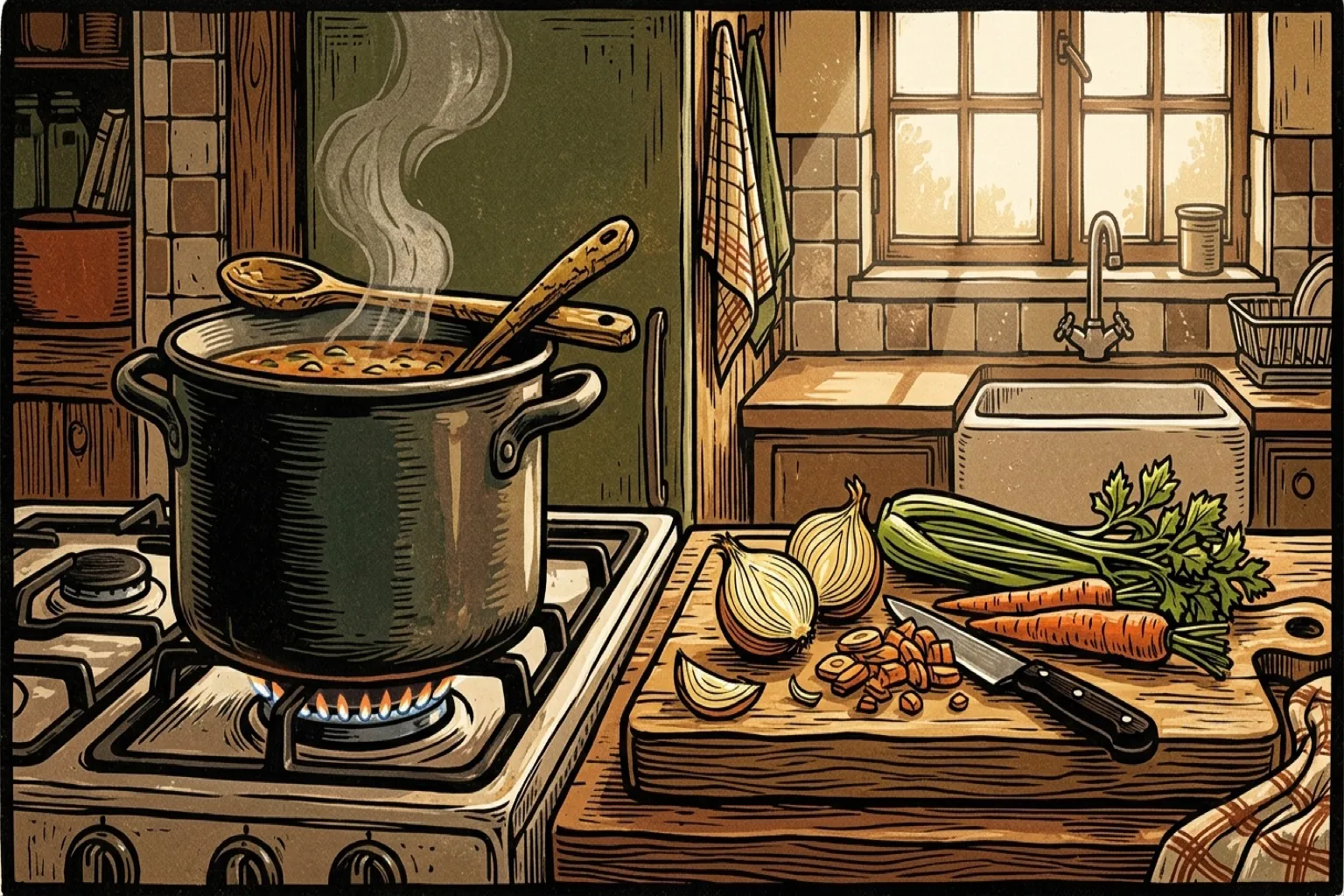
My mother made vegetable beef soup the way some women made Sunday bread — with a specific seriousness, as if the work required a certain amount of quiet, as if the kitchen was not a place for distraction when the pot was on. She started it on Saturday mornings. I remember the sound of the knife on the cutting board, the low clink of the Dutch oven lid, the smell that moved from the kitchen to the living room to the upstairs hallway over the course of an afternoon and settled there like weather. By evening it smelled like the house itself. By the next morning, when she reheated it for Sunday lunch, it smelled like home in the way that home smells when you are a child and have not yet learned to think about it.
Doris Hadley never wrote it down. This did not seem careless to her. She had made it so many times that writing it down would have felt like writing down how to tie her shoes. The ingredients were not the point. The ingredients were automatic. The point was the judgment — how much broth, how long, whether to add the tomatoes early or late, when to call it done.
She died in October of 2003, on a Tuesday, in Zanesville, in the house I grew up in. She was seventy-six. By that time the soup was an October thing in my memory, and October of that year arrived without her, and I stood in my Yellow Springs kitchen on the Saturday after she died and tried to make it.
I got the bones right. I used a cheap bone-in chuck roast the way she did, browned in batches until the bottom of the pan was deeply dark, then covered it with water and waited. I added the vegetables in the sequence I thought I remembered: onion first, then celery, then carrots, then the potatoes, then the canned tomatoes that I was reasonably sure she added at some point in the middle. I used dried thyme because I had never once in my childhood seen a fresh herb in that kitchen except parsley, which she grew in a pot on the windowsill and mostly used for garnish and didn’t really count. I used salt with the flat-palmed confidence she always used, the kind of confidence that comes from a lifetime of seasoning rather than measurement.
It smelled right. It tasted fine. It was a perfectly good soup.
It was not her soup. I knew this immediately and have known it every time I have made it since. There is something in her version — some ratio, some sequence, some decision she made casually and automatically over fifty years of making the same pot — that I have not been able to locate. I have come close. I have not arrived.
This is what I think about when I think about spring.
Which is an odd thing, because her soup was an autumn and winter dish, and March in Yellow Springs is not a soup month in the way January is. The trees are starting. The forsythia on the corner of Corry Street has gone yellow this week. The farmers market won’t have much until May, but the man I buy from at the Dayton market has greenhouse spinach and the first of the Egyptian walking onions, which look strange and taste alive.
But spring has always made me think about soup in the way that spring makes you think about things you’ve been avoiding. You open the windows and the cold air comes in and you are suddenly aware of the whole kitchen — the cast iron you haven’t cleaned as well as you should, the jar of dried mushrooms from last fall that still has some left, the Dutch oven that was her Dutch oven, the one with the chip on the rim from some impact long before I inherited it.
This spring I have been making a different soup entirely. Not hers. Mine, or mine now, which is something that took me a while to learn to say. A spring minestrone with the Egyptian walking onions and whatever greenhouse greens the market has and dried chickpeas that I put to soak the night before, which always feels like an act of optimism — soaking beans being a thing you do in faith that tomorrow will arrive and you will be there to drain them.
I make it for myself. This is the part I did not know how to do for a long time.
When you have cooked for a household for twenty years — and I cooked for a household for twenty years, first in Columbus with Gary and Melissa, then still in Columbus but differently, then in Des Moines and then here — the adjustment to cooking for one person is not about the math. The math is easy: use less of everything. The adjustment is about intention. For twenty years the pot on the stove had a reason that lived outside of me. It was for someone. The making of it was an act directed outward, and the warmth it generated in the kitchen was partly the warmth of being responsible for other people’s hunger and meeting that responsibility. That is not a small thing to lose.
For a year or two after my divorce, I ate badly. Not dramatically badly, not in a way anyone would have noticed, but with a kind of negligence that I recognized as grief and did not fully address. I made toast. I ate cereal at 6pm. I bought the prepared soups at the store that I had never bought when Melissa was young, because I had opinions about them, and I ate them from the can over the sink without tasting them very carefully. I was going through the motions of feeding myself rather than feeding myself.
The thing that brought me back was, of all things, a leek.
I was at the market on a November Saturday, maybe eighteen months after Gary moved out, and I bought a leek because I always bought leeks in November. Force of habit. I got home and put it on the counter and then remembered I had no reason to make the potato-leek soup I had apparently been planning to make when I bought it. I could make a small version. A single bowl. I stood there looking at the leek for a moment.
I made the soup. A small pot, one leek, two potatoes, some broth I had in the refrigerator. I ate it at the small table by the window. It was a dark afternoon, November, and the yard was bare. The soup was good. It was warm and it tasted of leeks, which is one of the most civilized flavors in existence, and I ate all of it. I sat there afterward for a while.
It was the first meal I had made with intention in months. I had made it for someone: for myself. I want to say this carefully because it sounds like a cliché and it is not a cliché. It felt like a decision. It felt like saying: this matters. You matter. You are the person at the table and someone should be feeding you and that someone is you, so here.
I have been making soup for myself ever since.
The spring minestrone I am making now is a lighter thing than my mother’s beef soup, and it would not have been recognizable to her as the same genre of activity, though she would have eaten it politely and complimented the chickpeas. She was suspicious of chickpeas — not hostile, just unsure. They were not a Zanesville thing.
It starts with the Egyptian walking onions, sliced thin, softened in olive oil in the Dutch oven that was hers, which she got at a Ben Franklin sale in 1971 and used until I inherited it and which I will use until my daughter Melissa inherits it, whether she wants it or not. The onions are mild and grasslike, more spring-forward than any storage onion has a right to be in late March. Then garlic, which my mother would have left out entirely, and a pinch of red pepper flake. Then the chickpeas, which have been soaking overnight and now cook in the pot with water and a Parmesan rind I keep in a bag in the freezer — a habit I picked up somewhere in my forties that I now consider non-negotiable.
While the chickpeas cook, I watch them. My mother would have found this tedious. She was a practical cook, not a contemplative one. She worked at the stove with her hands, not her attention. I am the opposite: I can stand at a pot for twenty minutes watching beans swell and think about nothing and be perfectly content. Bernard comes in eventually and sits near the baseboard and watches me watch the soup.
When the chickpeas are nearly tender — not quite, still with some resistance, because they will cook more — I add the greenhouse spinach and a squeeze of lemon. The spinach goes in dark and dense and wilts almost immediately to something tender and sweet. At this point the kitchen smells like March: green and damp and faintly hopeful.
I eat it with bread I bought from the bakery on Xenia Avenue, a good dense sourdough with a crust that requires actual effort. I tear it rather than slice it. I eat at the small table by the window, where the light is good in the morning and still decent at lunch, and I eat slowly because that is the thing I have learned to do, the thing that the years and the quiet have given me: the ability to eat without rushing, without the television on, without anything to do but taste what I made.
It does not taste like her soup. Nothing I make ever will. But it tastes like something that matters, and I made it for someone who was hungry, and she was grateful for it.
I always am.
Spring Minestrone with Chickpeas and Market Greens
Start the night before: cover a cup of dried chickpeas with cold water and leave them on the counter. In the morning they will have swollen and softened and be ready for you.
Drain the chickpeas and put them in your heaviest pot with enough water to cover by two inches and a rind of Parmesan if you have one. Bring to a simmer, covered, and cook until the chickpeas are nearly tender, anywhere from forty-five minutes to an hour and a half depending on how old the chickpeas are. Old chickpeas are stubborn. Patience is faster than frustration.
While they cook, slice three or four spring onions thin — walking onions if you can find them at a good market, otherwise whatever scallion or young onion is freshest. Soften them in olive oil in a wide pan over medium heat until they are translucent and beginning to go sweet. Add two cloves of garlic, minced, and a pinch of red pepper. Cook another two minutes.
When the chickpeas are nearly done, add the softened onion and garlic to the pot along with a can of good whole tomatoes, broken up with your hand over the pot — do this slowly, they will spray, and there is no graceful way to do it, only a careful one. Taste for salt. The Parmesan rind has been adding salt throughout, so go carefully here.
Add a large handful of spinach or whatever spring green you have — young kale, arugula, greenhouse chard all work. It will seem like too much and then it will wilt and seem like just enough. Add a squeeze of lemon. Taste again.
Serve it hot, with bread. A drizzle of your best olive oil on top if you have it. Parmesan grated over, if you are in the mood.
Eat it at the table, at a real table, not over the sink. Look out the window at whatever the season is doing. This part is not optional.