The first thing is the smell. Not in the pan yet, not cooked, just the smell of them in the paper bag when the vendor hands them across the table at the Yellow Springs Farmers Market on a Saturday morning in late April. Morels smell like the ground they came from. Damp leaves, old bark, something almost mineral. If you put your nose into the bag, and I always do, you get a whiff of the actual woods, the actual Ohio woods in spring, before the trees have leafed out all the way and the light still reaches the forest floor.
I don’t hunt morels. I want to be clear about this because in Yellow Springs, morel hunting is serious business, and claiming to be a hunter when you are not would be a kind of fraud. There are people in this town who have spots. Secret spots, back in Glen Helen or out past the Clifton Gorge, places they’ve been going to since their fathers took them when they were nine. They don’t tell you where. If you ask, they smile in a way that means they aren’t going to tell you. This is understood. The spots are inheritance, passed down like cast iron or stubbornness, and a person who has one doesn’t share it casually.
I buy mine from a man named Hal. I’ve been buying from Hal for eleven years now. He sets up at the far end of the market, near the soap vendor and the woman who sells goat cheese, and he brings them in shallow cardboard flats lined with paper towels. They sit there looking like something a fairy tale would invent: honeycomb caps, ridged and pale tan or dark brown depending on the week, hollow stems. They don’t look like food, exactly. They look like something the woods decided to show you.
Hal and I don’t talk much. He tells me what he’s got and how the season is going. I tell him they look good, which they always do. Sometimes he’ll say it was a slow week or a fast one, and I can tell from his hands whether he’s been out a lot. He has the hands of someone who spends hours crouching in the underbrush, turning over leaves. We aren’t close friends. We are something better, maybe, which is two people who have been doing the same small transaction for over a decade and who trust each other completely within its boundaries.
The season is short. That’s the thing about morels that no one who hasn’t waited for them quite understands. Three weeks, sometimes four if the weather cooperates. If the rains come right and the soil temperature hits the mid-fifties, the morels appear. If it stays cold, they hold off. If it gets hot too fast, they’re done. There’s a window, and it isn’t wide, and if you miss it you wait another year.
I’ve learned not to be greedy. When I was younger, when I first moved to Yellow Springs and discovered that morel season was a real thing, an actual event on the local calendar, I bought too many. I bought two pounds my first year and tried to use them in everything: pasta, omelets, risotto, soup. By the third day, they had started to go soft and I felt the specific guilt of someone who has wasted something rare. Now I buy a half pound at a time, once a week, for the weeks they’re available. I cook them the day I bring them home. I cook them simply. And I pay attention.
Here is what I do.
I take them out of the bag and set them on a clean towel on the counter. I look at them. This isn’t ceremony. I look at them because they are worth looking at, and because you can learn something from looking: which ones are firm, which are starting to dry at the edges, whether any need trimming. I brush off any visible dirt with a soft cloth. Some people wash morels under running water. I don’t. They’re porous, those honeycomb ridges hold water like tiny cups, and a wet morel doesn’t sear the way you want it to.
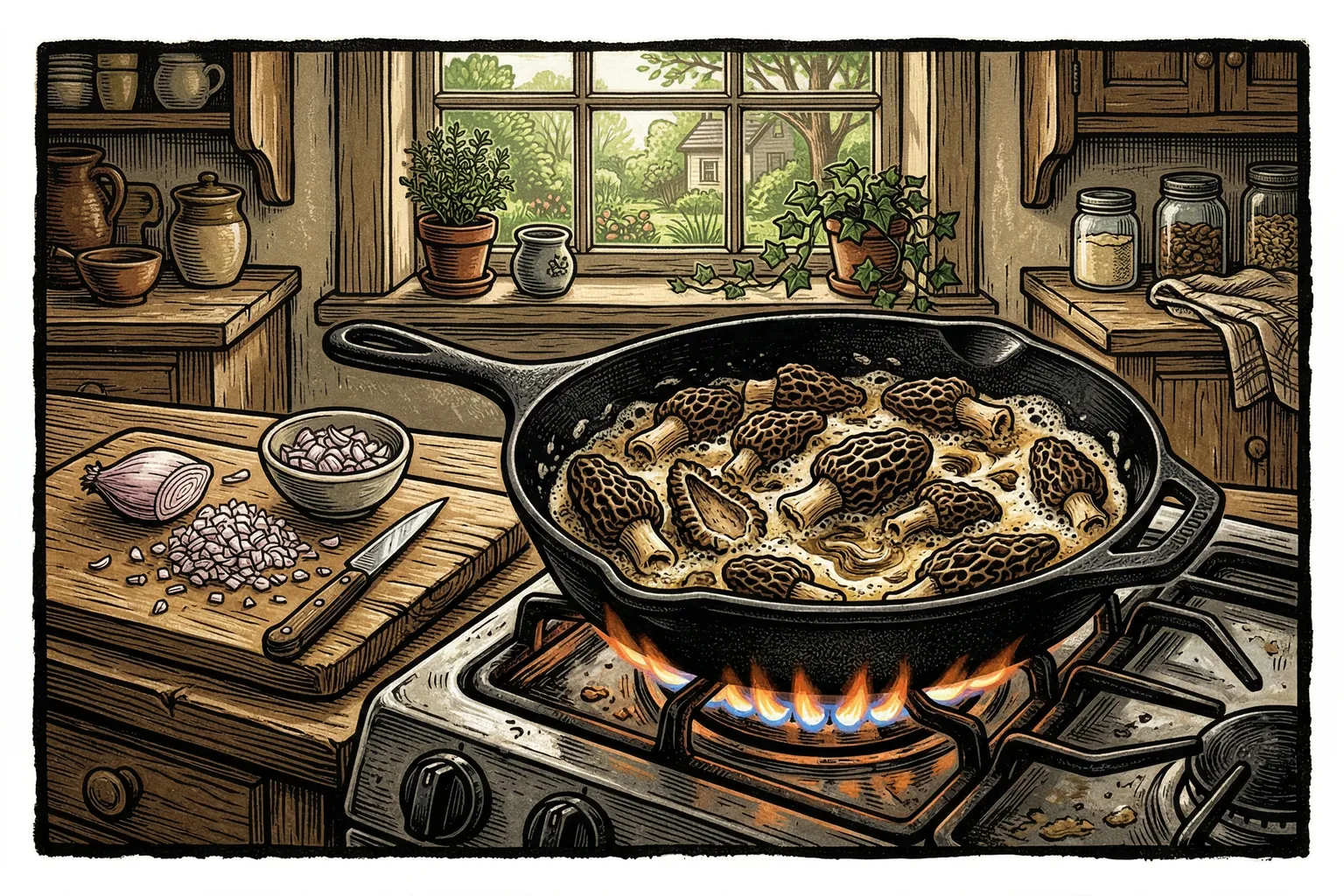
I slice the larger ones in half, lengthwise, so the hollow center is exposed. The small ones I leave whole. I set a cast-iron skillet on the burner, medium heat, and add butter. Real butter, not a lot, maybe two tablespoons for a half pound of morels. I let the butter melt and foam and just barely begin to calm down. There’s a moment, if you watch, when the foam subsides and the butter goes quiet and starts to smell like toast. That’s when the morels go in.
The sound is immediate. A hiss, then a gentle sizzle, then something softer as the mushrooms begin to give up their moisture. This is the part where you don’t rush. The morels will release water. Let them. Stir gently. Keep the heat at medium. What you’re doing is cooking the water off first and then letting the butter do its work, which is to brown the edges and concentrate the flavor into something deep and earthy and almost nutty.
I add one shallot, minced fine, about halfway through. Not at the beginning, because the shallot will burn before the morels are ready if you put it in too early. The shallot goes translucent in the butter and the smell changes, gets sweeter, rounder. A pinch of salt. A grind of pepper. That’s it. I don’t add garlic. I don’t add wine. I don’t add cream. Some people do, and I don’t judge them for it, but I have come to believe that a morel cooked in butter with a little shallot doesn’t need anything else. The mushroom is the point.
The whole thing takes maybe twelve minutes. You’ll know it’s done when the edges have turned golden brown and the morels feel light in the pan, not heavy with water. They should look slightly crisp at the ridges. They should smell like the best version of a forest you’ve ever imagined.
I eat them at my table by the window. Sometimes on toast, a thick slice of the sourdough I buy from the bakery on Xenia Avenue, the bread still warm enough to hold the butter. Sometimes just on a plate with nothing else. Bernard, who is indifferent to most of my cooking, appears in the kitchen doorway when I cook morels. I don’t know what he smells. Whatever it is, it interests him, which is more than I can say for most of what I make.
Sautéed Morels with Butter and Shallot
Half a pound of fresh morels, brushed clean. Two tablespoons unsalted butter. One medium shallot, minced fine. Salt and black pepper.
Slice larger morels in half lengthwise. Leave small ones whole. Heat a cast-iron skillet over medium heat. Add butter and let it foam, then settle. Add the morels in a single layer, or close to it. Don’t crowd the pan. Let them cook without stirring for a minute or two, then stir gently and continue cooking as they release their liquid. When the liquid has cooked off and the edges are beginning to brown, add the shallot. Cook another two or three minutes, until the shallot is translucent and the morels are golden at the ridges. Season with salt and pepper. Serve on warm toast or on their own. Enough for one person who is paying attention.
I think about the asparagus piece I wrote a few weeks ago, about the return of the first spring vegetable and how the farmers market begins to wake up after winter. Morels are the next chapter of that same story. They arrive a few weeks later, when the market is filling in, when the vendor tables have more color and the parking lot is starting to get crowded again. But morels have a different character than asparagus. Asparagus is reliable. It comes back every spring, it stays for a while, you get used to it. Morels aren’t reliable. They are conditional. They require specific rain and specific warmth and a kind of fungal luck that no one fully controls. You don’t get used to them. You get lucky.
There’s something I’ve been thinking about since Easter, since I wrote about the rituals we keep even when the table is smaller. Morel season is a ritual, too, but it’s one that belongs to the calendar, not the family. Nobody assigns it. Nobody sends a text to coordinate. It just happens, out in the woods and then at the market and then in my kitchen, and I get to be part of it by showing up on Saturday morning and buying what Hal brought.
I’ll go back next week if he’s there. The week after that, probably, the season will be winding down. By mid-May the morels will be gone, and the market will be full of strawberries and radishes and lettuce, and that will be its own kind of good. But right now, this week, I have a half pound of morels and a cast-iron pan and an evening with nowhere to be. Bernard is sitting in the doorway. The butter is starting to foam.
I’m not going to miss this.