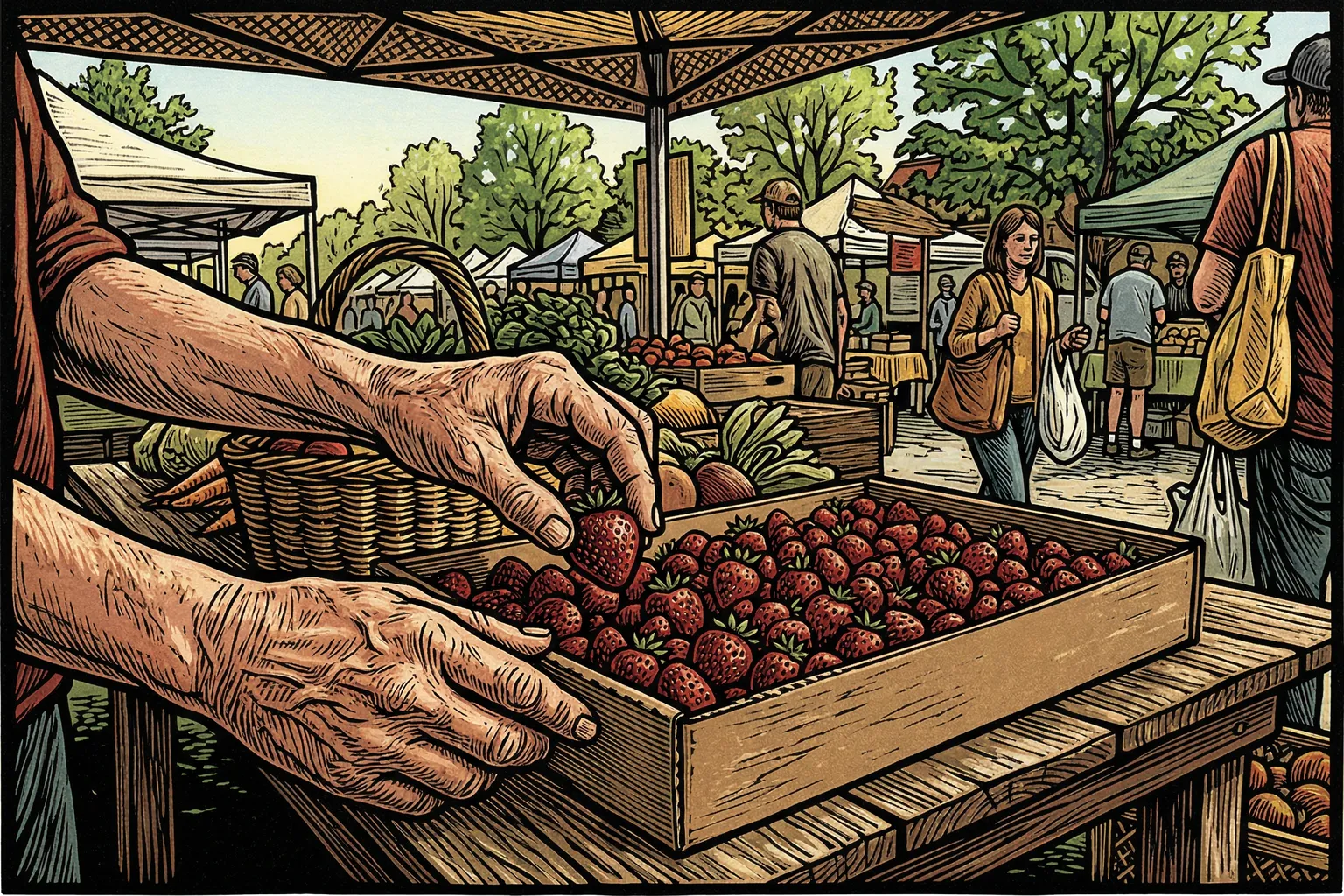
The woman next to me at the market picked one up and smelled it before she bought anything. She didn’t look around to see if anyone was watching. She just picked a strawberry out of the flat, held it close to her nose, and closed her eyes for about two seconds. Then she bought a quart. I thought: yes. That’s exactly right.
It was the last Saturday of May. The Yellow Springs Farmers Market was full in the way it gets when the season has truly turned, when the tables have more on them than the vendors can spread out neatly and people are walking slower because there’s too much to look at. The lettuce has been in for weeks now. The radishes. The first sugar snap peas. But what I’d come for, what I come for every year at the end of May, was on Karen Metcalf’s table in shallow cardboard flats: strawberries, small and red all the way through, picked that morning.
I’ve been buying strawberries from Karen for fifteen years. She farms twelve acres outside of Cedarville, and her strawberry patch is the thing she is known for at this market the way Hal is known for his morels, the way Linda is known for her asparagus. Karen’s berries are not large. They aren’t the size of your fist the way the ones at the grocery store are, the ones bred to ship well and sit on a shelf for a week and still look presentable in the plastic clamshell. Karen’s are the size of the end of your thumb, some of them, and they’re soft, and they won’t last more than two days in the refrigerator, and they taste like strawberries. That probably sounds like a strange thing to say. It isn’t. Most strawberries don’t taste like strawberries. Most strawberries taste like water with a faint memory of something sweet. Karen’s taste like the actual fruit: tart at the shoulders, sweet at the point, fragrant in a way that fills the car on the drive home.
I know this because I’ve been paying attention for fifteen years. That’s what patience gives you in the kitchen that convenience cannot: the ability to tell the difference.
There was a time when I bought strawberries in February. I’m not proud of this and I’m not ashamed of it either. I was at the Dispatch, working long days, and Melissa was eleven or twelve, and if my daughter wanted strawberries on her cereal in February, I bought strawberries in February. They came from California or Florida in those plastic clamshells, and they were firm and pale at the center and tasted like the refrigerated truck they’d spent three days riding in. I cut them up and put them in a bowl and Melissa ate them and was satisfied, because she was a child and didn’t know what she was missing.
I knew. I knew because my mother had known. Doris Hadley did not buy strawberries in February. She didn’t buy strawberries in April. She waited until the local ones came in, which in Zanesville meant the first or second week of June, and then she bought them by the flat from a man who sold them out of the back of his truck on Linden Avenue. I remember the flats on the kitchen counter, five or six of them, and the smell that filled the whole downstairs of the house, and my mother standing at the sink with a paring knife, hulling them one at a time into a colander. She’d put one in her mouth for every three she hulled. She told me this was quality control. I believed her.
What my mother did with those strawberries was simple and, I think now, nearly perfect. She made shortcake. Not the spongy yellow rounds you buy in the plastic sleeve at the grocery store. Biscuit shortcake, the real kind, made with flour and butter and a little sugar and buttermilk, split open while still warm. She put the berries on top, mashed slightly with a fork and a spoonful of sugar so they’d made their own juice, and then she spooned cold heavy cream over the whole thing. Not whipped. Just poured. The cream ran into the biscuit and mixed with the berry juice and the warm crumb, and you ate it with a spoon and it was the best thing in the world and also one of the simplest.
I make the same shortcake. I’ve been making it for forty years. I’ve adjusted it slightly, the way you adjust anything you’ve lived with that long. I use a little more butter than my mother did, because I like the biscuit richer. I add a pinch of salt that she didn’t add. I’ve tried it with whipped cream and with crème fraîche and once, in an ambitious moment at the Dispatch test kitchen, with mascarpone. They were all fine. I went back to the cold heavy cream. My mother was right about the cream.
The strawberries don’t need anything done to them except what my mother did: hull them, slice the big ones in half, leave the small ones whole, toss them with a tablespoon of sugar, and let them sit for twenty minutes. The sugar draws the juice out and makes a thin, sweet syrup that is, I believe, one of the best sauces in all of cooking, and it requires no skill, no technique, and no recipe. Just patience. Twenty minutes.
That’s the whole argument of this piece, if it has one. Patience. Not the grim, teeth-gritting kind, but the kind that comes from having done something enough times to know what you’re waiting for. I know what Karen’s strawberries taste like when they arrive in late May because I’ve been there fifteen years in a row, buying them on the first Saturday they appear, bringing them home in a paper bag on the passenger seat, eating the first one standing at the kitchen counter before I’ve even put my keys down. I know what they taste like because I’ve also eaten the ones from the grocery store in March, the ones that look right and taste like nothing, and I know the difference isn’t trivial. It’s the difference between feeding yourself and nourishing yourself.
I wrote a few weeks ago about morel season, about the brief window when something rare and conditional appears and you either show up for it or you don’t. Strawberries are different. They aren’t rare. They aren’t conditional in the same way. They’ll come every year, reliably, at the end of May or the start of June, and they’ll last for three or four weeks before the heat takes them. But the principle is the same: the best version of this fruit exists in a specific window, in a specific place, and you can have it if you’re willing to wait for it and unwilling to accept the substitute.
I think about this when I hear people say they don’t have time to cook. I understand what they mean. The hours are real. The tiredness is real. But some of what we’ve lost isn’t time. It’s knowledge. My mother knew when the strawberries came in because she’d been paying attention to the seasons her entire adult life. She knew what a ripe tomato smelled like because she’d grown them in the backyard and picked them warm off the vine. She knew when the corn was good because she’d shucked an ear at the stand and looked at the kernels before she handed over her money. This knowledge isn’t instinct. It’s accumulated. It comes from years of showing up, of buying and cooking and tasting and remembering. It’s what forty years in a kitchen gives you.
There’s a particular pleasure in eating something you waited for. It isn’t the same as the pleasure of eating something expensive or elaborate or technically impressive. It’s quieter than that. It’s the pleasure of alignment, of the right thing at the right moment, of your kitchen and the season arriving at the same point on the calendar. When I sit at my table by the window with a bowl of shortcake on a Tuesday evening in late May, the biscuit still warm, the cream pooling, Bernard doing his best to look uninterested from the kitchen doorway, I feel something that convenience cannot provide. I feel like I’m where I should be, eating what I should be eating, and that the waiting was part of the meal.
This is what I want to say to anyone who has stopped going to the farmers market, who has given up on seasonal cooking because it seems fussy or impractical or like something for people with more time. It isn’t fussy. It’s the opposite. It’s the simplest way I know to eat well: learn what grows near you, learn when it’s ready, and then get out of its way. Don’t improve the strawberry. Don’t complicate the shortcake. Don’t substitute the cream. Just be there when it happens.
Karen will have berries for three more Saturdays, maybe four. I’ll be there for all of them. I’ll buy a quart each time, bring them home, and eat some standing at the counter and save the rest for shortcake. On the last Saturday, when the flats are thinner and the berries are smaller and Karen says that’s about it for this year, I’ll buy an extra quart and make jam. Not much. Two jars, maybe three. Enough to open one on a January morning when the market is mostly bare and the kitchen feels far from anything growing, and to remember that the season will come back around again. It always does, if you know where to look and you’re willing to wait.
Biscuit Shortcake with the First Strawberries
For the biscuits: two cups all-purpose flour, one tablespoon sugar, one tablespoon baking powder, half a teaspoon salt, six tablespoons cold unsalted butter (cut into small pieces), three-quarters cup cold buttermilk.
Heat the oven to 425 degrees. Mix the flour, sugar, baking powder, and salt in a bowl. Add the butter and work it in with your fingers until the mixture looks like coarse meal with some pea-sized pieces remaining. Don’t overwork it. Pour in the buttermilk and stir with a fork until the dough just comes together. It will be shaggy. That’s right. Turn it out onto a floured surface, pat it into a round about an inch thick, and cut four biscuits with a drinking glass or a biscuit cutter. Place them on an ungreased baking sheet and bake twelve to fifteen minutes, until the tops are golden. Let them cool just enough to handle.
For the berries: one quart fresh strawberries, hulled. Slice the larger ones in half, leave the small ones whole. Toss with one tablespoon sugar. Let them sit for twenty minutes. They’ll make their own syrup.
Split each warm biscuit in half. Spoon the berries and their juice over the bottom half. Place the top half on the berries. Pour cold heavy cream over the whole thing. Not whipped. Just poured, straight from the container, enough to pool around the edges and soak into the biscuit. Eat with a spoon.
Enough for two people on a Tuesday night, or for one person who is having a very good day.