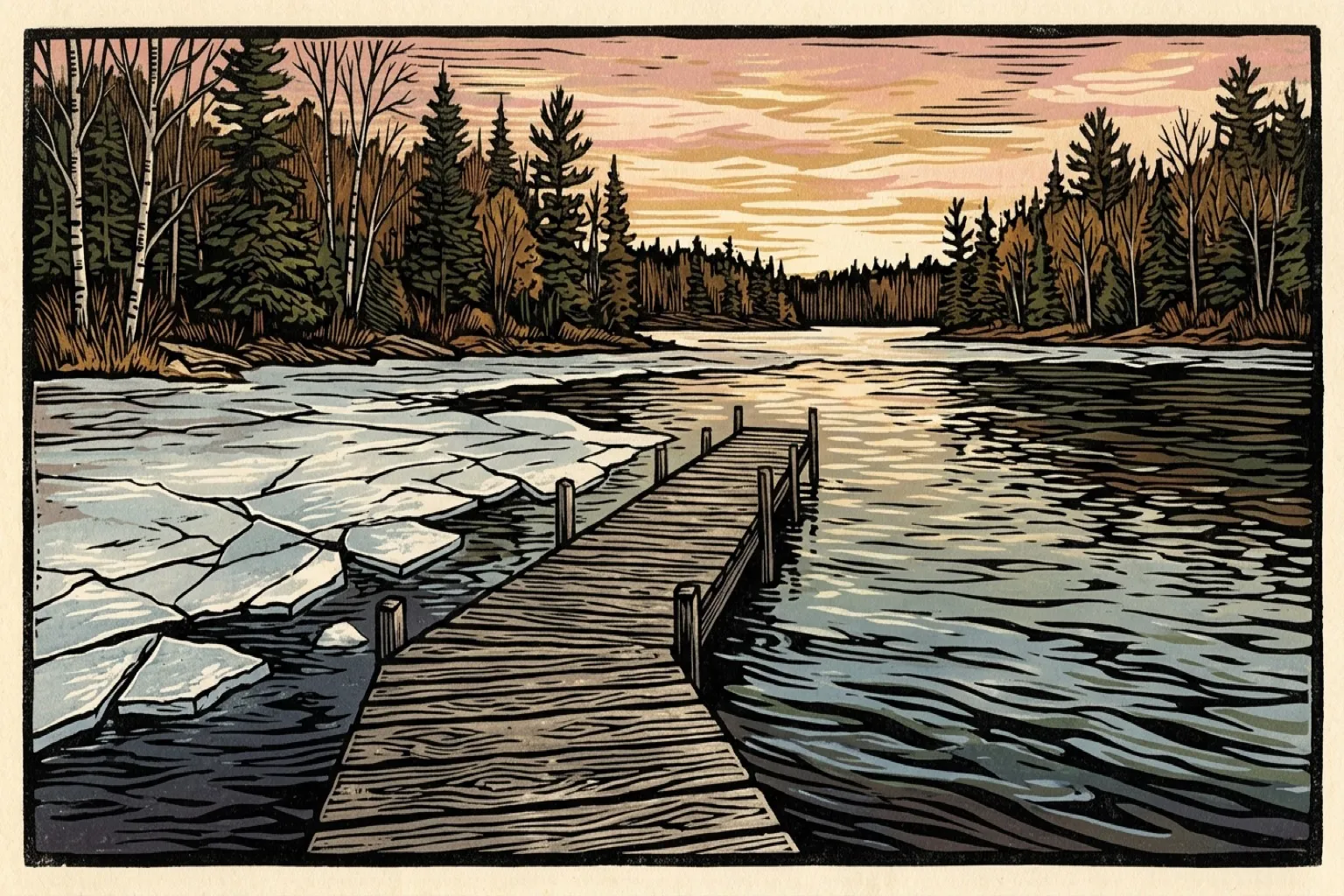
The ice goes out of the spring pond in sections. It does not melt from the edges inward, the way you might expect. It goes in patches, irregular, wherever the sun finds it longest, and for three or four days it is neither ice nor open water but something in between, gray and soft and unconvincing. Then one morning you walk out before six and the pond is open. All of it. The wood ducks will come back now.
That morning was last Tuesday. March 18. I know the date because I wrote it down, the way I have written it down for most of the twenty-two years we have lived on this property. Not in any formal way. Just a note in the back of the Filson notebook I keep on the desk in the barn. Ice out: March 18. Last year it was March 23. The year before, April 2nd. I am not drawing conclusions. I am keeping a record.
Patty came out while I was standing at the pond’s edge with a cup of coffee and asked what I was looking at.
Nothing yet, I said. But soon.
She went back inside. She has long since stopped expecting me to come in when I say I will.
There is a sequence to spring in northern Michigan that I have been watching for forty-plus years, since I was a boy on Lake Superior, and it still has the ability to move me in a way I find difficult to explain without reaching for language I distrust. So I will not explain it. I will tell you what happens.
The first thing you notice is the light. Not the temperature, not the birds, not the mud. The light. Sometime in late February it crosses a threshold, an angle of sun on late afternoon snow that reads differently than the winter light did. The shadows get longer in a way that means longer days, not shorter ones. That distinction sounds obvious. In practice, standing at the edge of a woodlot in the last hour before dark, it takes a moment to recognize. You feel it before you name it.
Then comes the smell. I am not a poetic man about smell, but the ground opening up in late March has a specific quality, dark and faintly mineral, like the inside of a stone wall, and you can catch it on certain south-facing slopes before the snow is even gone from the shade. That smell means something. My body knows what it means before my brain catches up. I have been tracking this particular phenomenon since I was sixteen years old with my uncle Walt in the Hiawatha National Forest, and I still can’t explain why it works on me the way it does. I just know that when I smell it, I stand still for a moment and breathe.
The third thing is the woodcock. Not their arrival, exactly, but the first evening display flight. The peent from the alders at the property’s edge, then the ascending spiral of wing chatter in the dusk. I almost always hear it before I see it. I have made a point of being outside at dusk in the last week of March for as many years as I can remember, because missing that first flight feels like missing something that cannot be recovered. Patty says I am not rational about this. She is right. There are a few things I do not intend to be rational about.
I played golf for the first time this year on a Saturday ten days ago. March 13. The course I play is a walking course twenty minutes from the house, forty-two dollars on weekdays, fifty-two on weekends if you count the cart you don’t need. It is owned by a man named Dale Ficht who has been running it since his father retired in 2003. The fairways are bent grass that gets slightly shaggy by mid-August and the greens are slow in April and faster by July and Dale does not talk to you much when you come in to pay but if you ask him about his irrigation system he will talk to you for an hour. I have been playing this course since 1997. I have played better courses. I have played courses in Scotland that would fold this one like a pocket knife. But I know this one the way I know the back road home, every rut, every drift.
The first round of the year is never about the score.
I walked eighteen that morning with a man named Terry Greve, who I have been playing with on Tuesdays since 2001. Terry is sixty-eight. He had a hip replacement in November and it was his first round back. We did not discuss his hip except to establish that it was holding. We did not discuss the score. We talked about a stretch of water on the Platte River that Terry had fished last October, about a buck he’d seen on his property in November that he’d decided not to shoot because he wanted to watch him through one more winter, about his oldest daughter’s new job in Portland. We talked about these things while walking because walking is when men talk.
The course was soft. This is the polite word for it. The cart paths, which we did not use, had heaved slightly from the frost, and the first three holes play through low ground where the water table rises in spring, and by the third green my boots were wet through. I did not care. The air was thirty-eight degrees and the sky was a particular flat white that northern Michigan gets in March, not gray exactly, not overcast exactly, just a white that diffuses everything and gives the light no shadows. The trees were still bare. You could see the shape of the land in a way you cannot see it in summer, the way the fairways slope left to right on holes five through eight, the drainage swale behind twelve that you forget is there until your ball finds it.
We finished in three hours and forty minutes. My score was 84. Terry shot 88 and was not unhappy about it.
I drove home with mud on my boots and wet socks and the particular contentment of a man who has spent four hours outside in the cold doing something that required nothing more significant than his attention. I sat in the truck for a moment before going in. The barn was lit from the inside, which meant Patty was in there watering her seedlings under the grow lights she sets up on the potting bench in early March. Through the window I could see the glow and her silhouette and the vertical lines of the grow light stands. She starts her tomatoes and peppers in March, does Patty, and the barn in early spring smells like damp soil and the faint green smell of new plants, which is a good smell to come home to.
There is something I want to say about this particular moment in the year, late March, the turn, and I am going to try to say it without reaching for metaphor.
At sixty-six, the return of the season is not abstract. I know how many of them I have left in a way I did not know at forty, or even at fifty-five. This is not morbid. It is arithmetic. And what that arithmetic does, for me at least, is sharpen things. The ice going out of the pond. The first round. The woodcock flight in the alder thicket at dusk. These things are not smaller because they are finite. They are, if anything, more precise. More visible. I notice the specific quality of the flat white light on March 13 in a way I am not sure I noticed it in 2005.
I do not know if this is wisdom. I suspect it is just what happens when you pay attention for a long time.
My father fished that aluminum Lund until he was seventy-one. He stopped not because he wanted to but because his balance had gotten unsteady, and he was a methodical man who understood risk. The last time I went out with him, the summer before he gave up the boat, we launched at Shiras Pool before six and fished until ten and didn’t talk much and caught five walleye and threw them all back, which was not something my father did routinely. He just didn’t want to clean them that day, he said. I have thought about that morning a hundred times. The walleye going back over the gunwale. The flat gray water of Superior in the early morning. My father watching them go.
He died in 2014. He would have been eighty-seven last November.
The wood ducks came back to the pond on Thursday. Two pairs, which is what we usually get. The male sits on the snag at the east end of the pond and considers himself very handsome, which he is. Patty and I watched them from the kitchen window for twenty minutes with our coffee. She had her notebook for plant records and I had my Filson notebook and we both wrote things down without discussing it.
Some mornings are like that. You just try to get them down accurately.