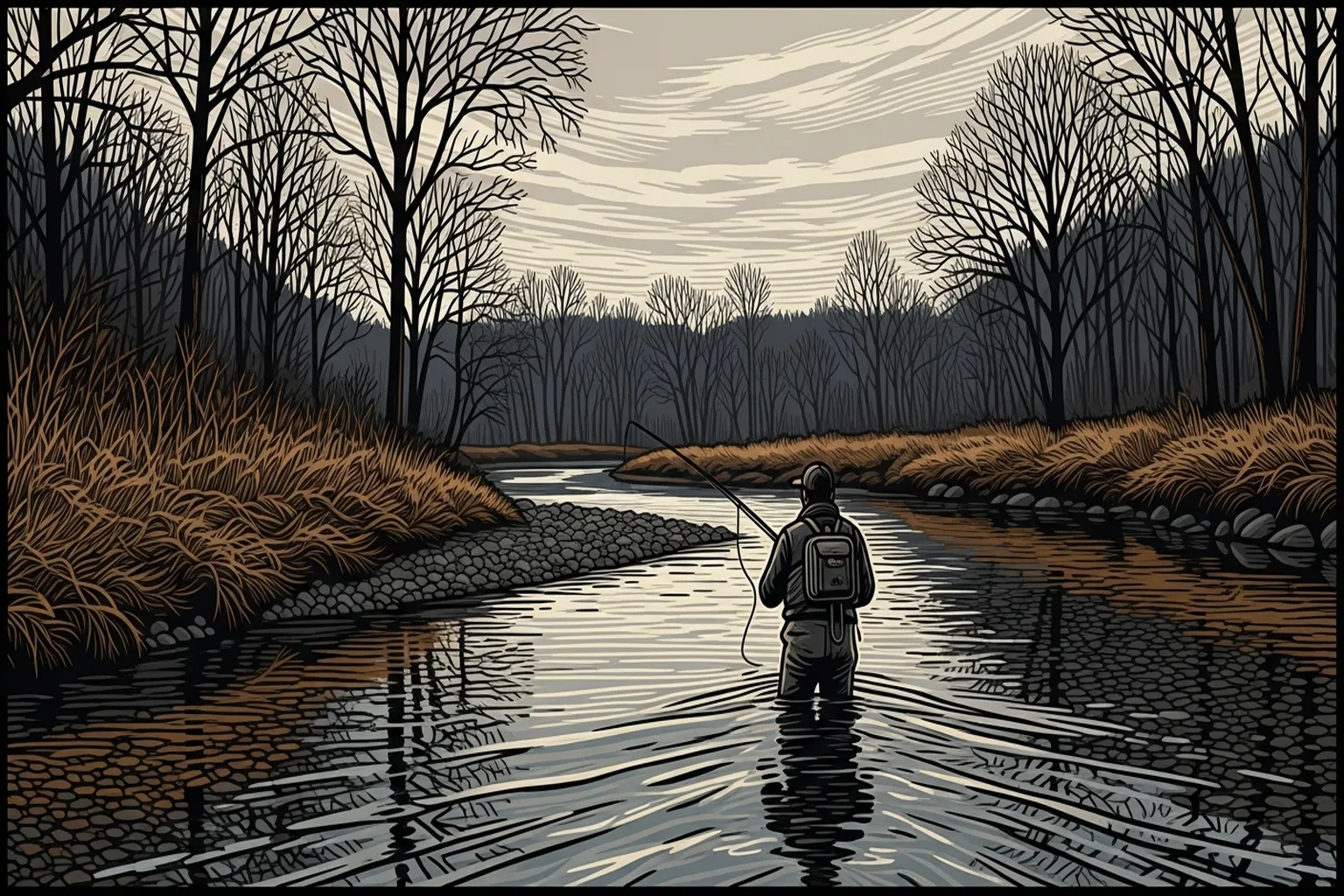
The AuSable tailwater below Mio runs cold in late March because the dam holds it cold. That’s the point of the tailwater: temperature stability, consistent flow, water that doesn’t behave the way free-stone rivers behave. The browns that hold in it are not thinking about the calendar. They are thinking about the same things they think about in October: temperature, oxygen, food. That the air above the river smells like thawing ground and the bank grass is still brown and flat from five months of snow weight is not their concern. It is mine.
I drove down from Traverse City on a Thursday morning, left before five, got to the Mio access by seven-fifteen. I have been making this drive for forty-one years. Long enough that the landmarks are involuntary: the turn past the Roscommon County line, the bend in the road where the river first appears through the alders, the billboard for a fireworks store that has been there since at least 2003 and never comes down. I know where I am without trying. This is one of the benefits of doing the same thing for forty-one years.
The truck thermometer read twenty-nine degrees when I pulled in. By the time I had the waders and boots sorted it was thirty-two. By the time I got to the water it might have been thirty-four. These are not details that would impress anyone who has not stood on a gravel bar in late March with wet wading boots and no hatch to show for it. They will know exactly what thirty-two feels like when they are already holding a rod and deciding whether to rig up on shore or just start walking.
The gear had been in the back of the barn since November fourth. I remember the date because I remember when I last used it, which is how I track time now — by the last time I did things. The Simms waders were hung on a peg and had developed, over the winter, a faint mildew smell that they do not fully lose until the first time you sweat in them. The wading boots were stiff. The vest was a thing to investigate before putting it on, because over winter a vest accumulates its sediment: tippet spools with two feet of material left on them, a fly box I thought I had lost in September, a neck gaiter from 2014 that I keep meaning to replace. I replaced it last week. First new gear I bought in three years. I am that kind of fisherman.
The Sage — the nine-foot five-weight I have been fishing since 1988 — was in its case in the rod locker, right where it goes. I do not worry about the Sage. I strung it up in the parking lot in the gray pre-morning light, threading the line guides by feel and habit, and it felt the same as it always feels, which is to say like an extension of the arm that happens to be made of graphite.
I did not expect a hatch. This is the honest baseline for late March on the tailwater. The water temperature at the access gauge read forty-four degrees. Baetis — blue-winged olives — will come off in the low-to-mid fifties, reliably, in afternoon light. At forty-four, you are not waiting for hatches. You are fishing subsurface, a lightly weighted pheasant tail or a small soft-hackle, dead-drifted along the seam where the faster water meets the slow. You are figuring out where the fish are. You are reminding your casting arm that this is what it does.
There is a section of water below the first bend, maybe three hundred yards from the access, where the river widens and the current braids around a mid-channel gravel bar. On a tailwater with regulated flow, this bar moves very little from year to year. I have fished the left channel of that braid since the early nineties. I know the depth at the upstream entry and the depth at the downstream end, where you turn and work back. I know that in moderate spring flow — it was running about four hundred cfs that Thursday — the right channel is effectively unfishable unless you know the specific wading line. I know the specific line. This knowledge is worth more than most things I learned in school and I do not say that as a joke.
The cold is a different thing than cold air. Air at thirty-two degrees requires a jacket. Water at forty-four degrees requires a certain acknowledgment. The first step into moving current after a winter on flat ground is always a negotiation. Your ankles find the rocks. Your feet calibrate. The current pushes and the legs push back, and for the first few minutes something in the legs that has been dormant since November is coming back online. This takes longer at sixty-six than it did at forty-five. I notice this. It is not alarming. It is information.
What took longer Thursday was the balance on uneven bottom. I wade with a staff now, a carbon fiber Folstaf that folds to sixteen inches and lives in the back pocket of my vest. I started using it three seasons ago, not because I fell but because I noticed I was wading more conservatively than I needed to, leaving fishable water on my left to stay on the safer line to my right. The staff opened water back up. This is what good gear does: it compensates for the thing that has changed without pretending the change didn’t happen.
My knees were fine. My left ankle, which I turned on a root three seasons ago, reminded me it exists on the larger rocks in the mid-channel. Not pain. Just a presence. The body keeps notes.
I caught nothing until nine-forty. A brown trout, twelve inches, on the soft-hackle, in the head of the braid where the current stalls momentarily before separating. It took hard and ran briefly and I brought it to hand in about twenty seconds and held it in the current long enough to confirm it was a brown and not a steelhead holdover, which sometimes you get in that section. It was a brown. I released it. It was gone before I could get my hand out of the water.
I caught two more before noon. Neither was large. I was not fishing for large. In late March on the tailwater you are fishing to be fishing, which is a distinction that sounds like something you’d find stitched on a pillow but is in fact the honest description of what is happening.
By twelve-thirty the light had gotten higher and the hatch temperature was still nowhere close and I waded out and walked back to the truck. My legs were tired in the specific way that wading tires legs — a deep fatigue in the quads and the small stabilizing muscles of the ankle that flat-ground walking never reaches. It is not a bad fatigue. It is the fatigue of having done a thing that required something specific of the body, and the body gave it.
I ate a sandwich in the truck cab with the heat running and the windows fogging and looked at the river for a while. It did not tell me anything. It ran the way it ran.
The Hexagenia limbata hatch will come in late June if the temperatures cooperate, and the big browns will come up after dark, and the fishing will be as good as fishing gets anywhere in the Midwest. I have been there for that hatch. I intend to be there for it again. Between now and then there will be a dozen trips, most of them like Thursday: cold, quiet, fishable in a technical sense but not in the storybook one. That is most of what fishing is. The hatch evenings are the exception. The forty-four-degree mornings with one twelve-inch brown are the rule.
I pulled out of the access at one-fifteen. The drive home takes the same landmarks in reverse: the fireworks billboard, the Roscommon County line, the familiar turn. By the time I got to the house, Patty was in the garden turning her first beds, which she does as early as the ground allows. She looked up when I came through the gate.
Any luck, she said.
Some, I said.
She went back to the beds. I went in to change out of the waders.
That’s more or less the whole calculation.