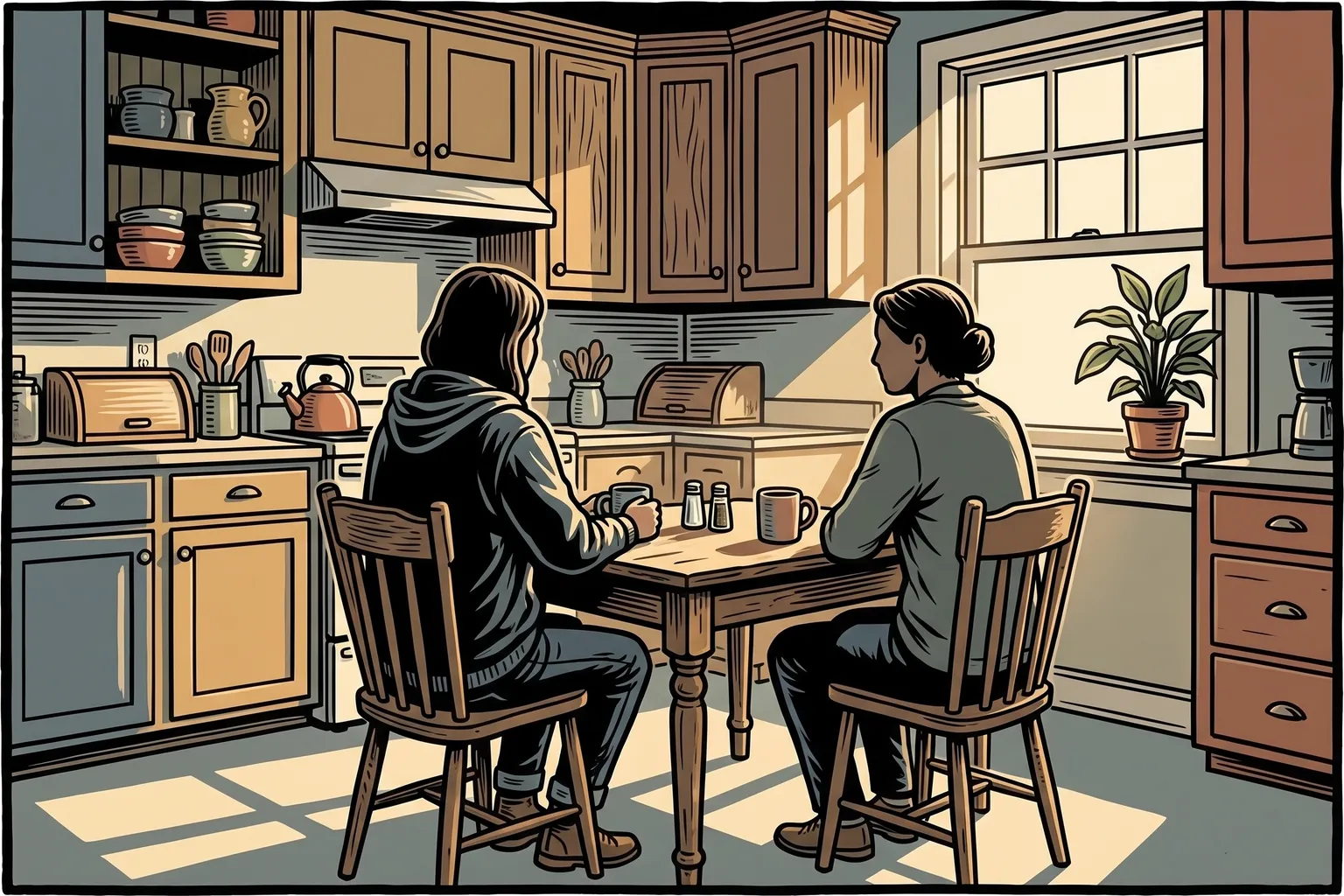
Her name was Vera. She was seventy-four years old, and she had been circling the conversation for six years.
I met her in a Wednesday morning group in Columbus, about ten years back. The group was for adult children in the middle of caring for their aging parents, which sounds like it has nothing to do with what I’m about to tell you. But grief groups, and support groups, and rooms where people sit in folding chairs and tell the truth, are never about the announced subject. They’re about the thing you didn’t know you were carrying until you sat down and someone asked.
Vera’s thing was her daughter Nora.
Not that they didn’t talk. They talked every Sunday at two o’clock. They talked about Nora’s children, Vera’s bad hip, whether the hydrangeas were going to survive the summer. They talked, in other words, about everything except what Vera needed to say.
What did she need to say? She needed to say: I am not who I was. I’m seventy-four and I get frightened sometimes in a way I didn’t at sixty-four. Not of dying. Of needing. Of becoming the person who needs things. I need you to know this without me having to prove it by falling. I need you to call me sometimes like you want to, not just to check in. I need to know that when I am less, you won’t love me less. And I want to know you now, the person you actually are, not just the version of you that’s managing me.
She had never said any of that. What she’d said was: the hip is better. The hydrangeas are touch and go.
I’ve thought about Vera a lot since then. Not just because of what she told me, but because she isn’t unusual.
Most aging parents and most adult children are circling some version of this conversation right now. They’re having the logistics conversation, the one about wills and powers of attorney and what happens when the house needs to be sold. Those conversations happen because they’re about things. They’re about paperwork. Paperwork doesn’t require you to admit that something has changed inside you.
The other conversation requires that. And so it doesn’t happen.
Years go by. A long time can go by.
I’ve been trying to understand why for a while now, since before I was writing about it, since the years when I sat with people every week who were living inside this and had no map.
Here’s what I’ve come to.
The first reason is that starting the conversation means naming the change. And naming the change means giving it a shape you can’t take back. Once you’ve said it out loud, it exists in the world in a way it didn’t before. A woman I knew years ago had been more forgetful than she used to be, and she hadn’t told her son. She said: if I say it out loud, it’s real. I understood that completely. Language isn’t just description. Language is commitment.
The second reason is that most of us grew up in families where you didn’t name what you needed. You hoped someone noticed. You managed. My mother communicated love through a warm dinner and a clean kitchen. The interior life wasn’t a topic. So the people who are now in their sixties and seventies, and the ones now past that, learned early that needing was something you kept private. Contained. Something that didn’t burden the people you loved.
The third reason is the story. There’s a story you’ve been living inside for forty years, a story about who you are in relation to your children. You were the parent. The capable one. The person who handled it. Saying “I need something from you now” reorders the story. And some part of you isn’t ready for the reorder, even when you are.
All of this is understandable. None of it is a reason.
Because here’s what I keep coming back to: the cost.
Not the cost of having the conversation. The cost of not having it.
Vera told me that her daughter Nora didn’t know any of this. Didn’t know her mother got frightened sometimes. Didn’t know she craved more than the weekly check-in. Didn’t know that her mother had so much left to give, and to receive. Nora thought things were fine. Vera had done too good a job of performing fine.
What happens in that gap is loneliness. Not the dramatic kind. The quiet kind. Two people who love each other, sitting in the same room, neither one knowing the other.
That’s the cost. Quiet, ordinary years of not being known by the people you most want to know you.
Vera did eventually have the conversation with Nora. She called on a Thursday, not waiting for Sunday. She said: I need to talk to you about something, and I need you to not worry, and I need you to just listen.
She said what she needed to say. Not everything, not perfectly. But enough.
Nora cried. That surprised Vera. Nora said she hadn’t known. She’d wanted a closer relationship but didn’t know how to get there without feeling like she was pushing in. She’d thought her mother had what she needed.
They talked for an hour and forty minutes. Vera timed it afterward.
She told me: I didn’t know you could get a year’s worth of something in an afternoon. I didn’t know it worked that fast.
That’s the part I want you to sit with for a minute.
The conversation doesn’t have to be perfect. It doesn’t have to be complete. You don’t have to say everything you’ve been holding for six years. You have to say one true thing and mean it and let it land.
You aren’t asking your children to carry you. You’re asking them to know you. That’s a different thing.
There’s a conversation I still haven’t had myself. I know what it’s about. I know roughly how it would go. There’s a drive I haven’t made, back to a place I haven’t let myself return to since my father’s funeral twelve years ago, and there are things connected to that drive that I haven’t said out loud yet to the people who would want to hear them. I know what’s in the way. I do. I just haven’t cleared it yet.
I’m working on it.
I say this not to make the piece about me. I say it because the people who write about this, and the people who spent thirty years sitting with others through it, have the same conversation waiting for them. The one that keeps getting moved to next month. The one where something has to be said and keeps not getting said.
The question isn’t whether you can do this. You can. The question is what you’re waiting for, and whether whatever it is will look, in ten years, like a reason or like an excuse.
You already know which one it is. That’s why you’re reading this.