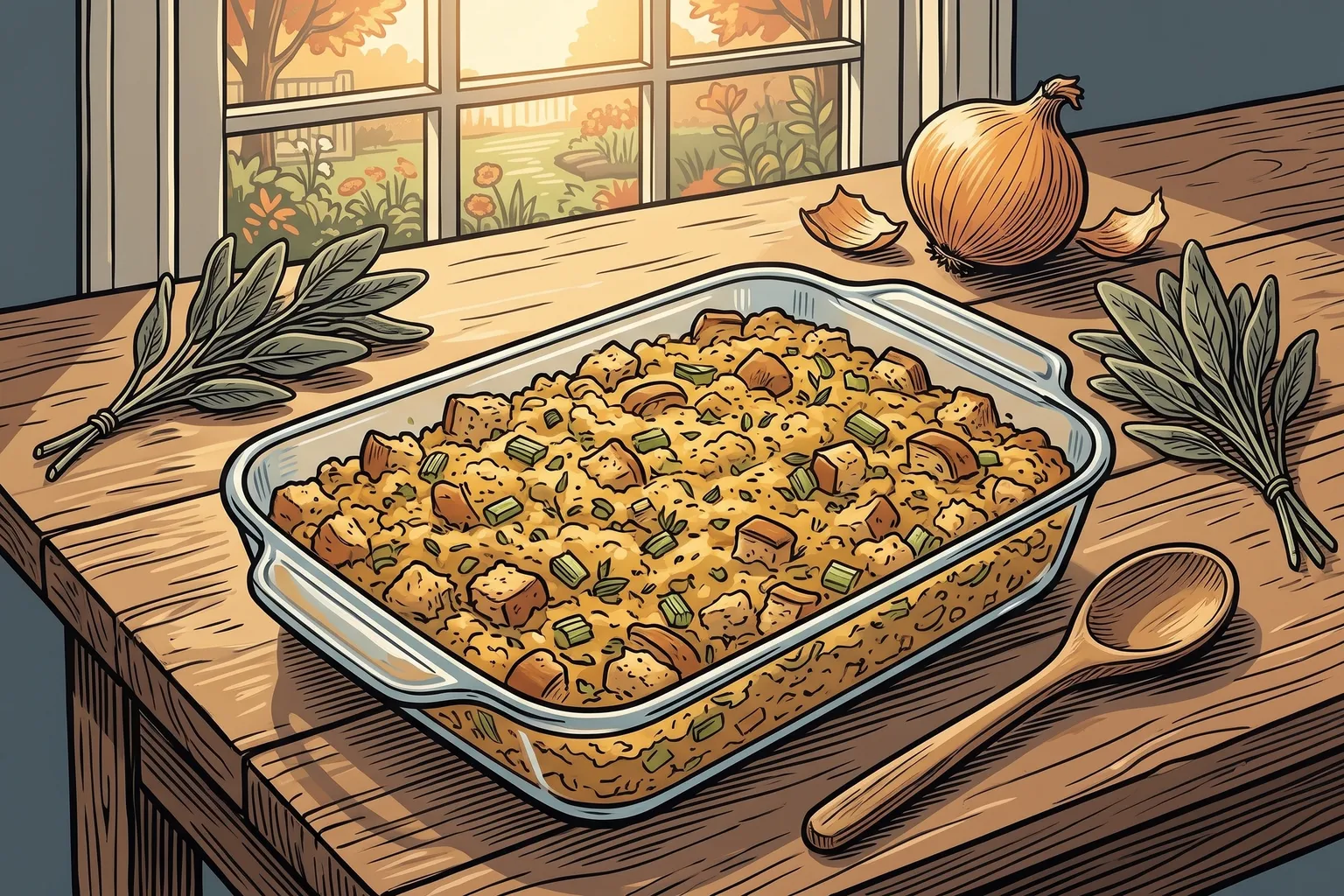
There’s a moment at Thanksgiving, right before the dressing comes out of the oven, when the whole house smells like it. Not like turkey, though the turkey’s been in there for hours. The dressing has its own smell: butter and onion going soft together, sage carrying over everything, the particular warmth of wet bread giving up its moisture to heat. If you grew up in a house where someone made dressing the same way every year, you know exactly what I’m talking about. Your nose knows it before the oven door opens.
My mother Doris made hers in a glass casserole dish, the nine-by-thirteen with the lid, in the oven alongside the turkey for the last hour. She didn’t cook it inside the bird. She said it got too soggy that way, that you couldn’t get a crisp top if the bread was sitting in cavity drippings for three hours, and she was right. The top of Doris’s dressing got a little crust on it, golden, almost like the top of a good pan of scalloped potatoes, and that contrast between the crisp top and the soft, dense interior was the whole point. I didn’t understand that the crust was intentional until I was grown and tried to make it myself and couldn’t figure out why mine came out uniformly soft all the way through.
I hadn’t left the lid off. That was the thing.
There’s a reason dressing is the dish families defend hardest at Thanksgiving. You can negotiate the turkey. If the turkey is dry, it’s dry, and everyone’s had a dry turkey and survived. The sides are mostly negotiable too. Someone brings a green bean casserole you don’t want, you take a polite spoonful and move on. But dressing is different. Dressing is the dish people identify with the meal itself, the one they’d go to the trouble of correcting if someone got it wrong. I’ve known people who would eat a mediocre Thanksgiving in silence without complaint until someone changed the dressing, and then they’d have something to say.
Part of this is because dressing is so regional that there’s essentially no consensus on what it’s supposed to be. If you grew up in the South, odds are good it’s cornbread dressing, and the idea of using white sandwich bread strikes you as eccentric at best. The debate between cornbread and bread-based dressing tracks pretty closely onto the Mason-Dixon Line, and both camps hold their position with the conviction of people who have been told since childhood that theirs is the correct version. There’s also the matter of what goes in it beyond the bread. Sausage is common in some families, essential in others, heretical in a few. Oysters have their partisans, particularly in older New England traditions, though I grew up in central Ohio and nobody in Zanesville was putting oysters in the dressing, at least not anyone I knew. And then there’s the naming itself: dressing if it cooks in a pan, stuffing if it cooks inside the bird. Some people use the words interchangeably regardless of method, which drives certain people absolutely to distraction.
My mother’s was bread. White bread, the basic sandwich kind, torn into rough chunks, left out overnight to dry a little so it wouldn’t turn to paste in the pan. Butter, two sticks, which I now understand to be the correct amount even though it seemed like a lot when I was helping her as a child. Yellow onions, two large ones, cooked slowly in the butter until they were soft and translucent and just starting to go golden at the edges, which takes longer than you think it will. Celery. Sage, dried, from the jar on the shelf. A little thyme. Salt and pepper. Chicken broth, enough to make it wet but not soupy, the mixture holding together when you pressed it with a spoon. Eggs to bind it. That was the whole thing. It was not complicated. It was just very good.
What I didn’t have, for years, was her quantities. She didn’t use a recipe. She had made it so many times that she did it by feel: she added broth until it looked right, added sage until it smelled right, pressed the mixture with a spoon and adjusted. When I asked her to show me, she showed me, but what she showed me was the method, not the formula. The quantities were in her hands and not transferable by watching.
This is the gap I keep running into, with her food and with the food of that whole generation of home cooks. The knowledge is real. The food is real. The recipe, in the written-down, with-precise-measurements sense, often isn’t. It lived in the person who made it. When that person is gone, what you have is an approximation, a reconstruction, a guess confirmed by memory. You make it, you taste it, you adjust until it’s close, and then you decide that close is what you’re going for, because exactly is no longer available.
Doris died in November of 2011. I made the dressing myself that first year, at my own house in Yellow Springs, and I got it close enough that my daughter Melissa said it tasted right, which is what I needed to hear. But I knew where it was off. It was a little drier than my mother’s had been, and I think the difference was that I’d used low-sodium broth and been conservative with it, because I was nervous. Doris had not been nervous. She’d been making that dressing for forty years and she knew exactly how wet to make it. I was making it for the third time and I didn’t trust myself yet.
What I know now, having made it for fifteen Thanksgivings since, is that dressing is a dish that forgives you as you learn it. You can make it too dry and fix it next year. You can overdo the sage and dial it back. You can figure out, over time, that your mother was right about everything: the two sticks of butter aren’t excessive, the lid needs to come off for the last twenty minutes, and the right amount of broth is the amount that makes the whole thing hold together when you press it without any broth pooling at the bottom of the bowl. You build toward knowing it the way you build toward anything, by doing it wrong a few times, understanding what went wrong, and making the adjustment.
The families who fight about the dressing are really fighting about something else, which is who gets to carry the dish. Someone has to take it on once the person who always made it is gone. That person has to decide how close to stay to the original and how much is theirs now to change. It’s a small inheritance, in the scheme of things. But it’s not nothing. I’ve been thinking about this more than usual lately, knowing that families are sorting out all kinds of arrangements around the holidays, figuring out who goes where and who carries what. Lorraine had a letter about it recently, from a reader whose adult children had divided up the holiday calendar without asking, and the question underneath the scheduling question was really this one: when the table moves, do the dishes move with it, and do they taste the same when they get there?
Doris’s dressing goes to whatever table I’m at. That’s the rule I’ve made for myself. I’m not sentimental about much in the kitchen, but I’m sentimental about this.
Doris’s Bread Dressing
Serves 10 to 12. This cooks in a pan, not the bird, which is why the top gets golden. Don’t skip leaving the lid off at the end.
What you need:
1 large loaf (about 1 pound) white sandwich bread, torn into rough 1-inch pieces and spread on a sheet pan overnight to dry out
1 cup (2 sticks, 8 ounces) unsalted butter
2 large yellow onions (about 3 cups when diced), diced medium
6 stalks celery (about 2 cups when diced), diced medium
2 teaspoons dried sage
1 teaspoon dried thyme
1 teaspoon dried marjoram
1 and 1/2 teaspoons kosher salt, plus more to taste
1/2 teaspoon black pepper
3 large eggs, beaten
2 to 3 cups chicken or turkey broth, low-sodium if you can find it
What you do:
Heat your oven to 350 degrees F. Butter a 9-by-13-inch baking dish.
Melt the butter in a large skillet over medium heat. Add the onions and celery and a pinch of salt and cook, stirring occasionally, until they’re very soft and the onions are translucent and just starting to go golden at the edges. This takes about 20 minutes. Don’t rush it. The sweetness you’re developing here is the whole foundation of the dish.
Add the sage, thyme, and marjoram and stir for another minute, until the herbs bloom in the butter and you can smell them.
Put the dried bread pieces into a large bowl. Pour the butter and vegetable mixture over the bread and toss everything together. Add the salt, pepper, and beaten eggs and toss again. Now add 2 cups of the broth and stir until the bread has absorbed most of it. You want the mixture to hold together when you press a handful of it between your palms, but you don’t want any broth pooling at the bottom of the bowl. If it seems dry, add the remaining broth a little at a time.
Taste for salt. It needs more than you think.
Spread the mixture into the buttered baking dish. Cover tightly with foil. Bake for 30 minutes covered, then remove the foil and bake another 20 to 25 minutes, until the top is golden, the edges have pulled away slightly from the dish, and an instant-read thermometer inserted into the center reads 165 degrees F.
Let it sit for 10 minutes before you serve it. The inside will be soft and a little custardy. The top will have a crust. This is what you want.