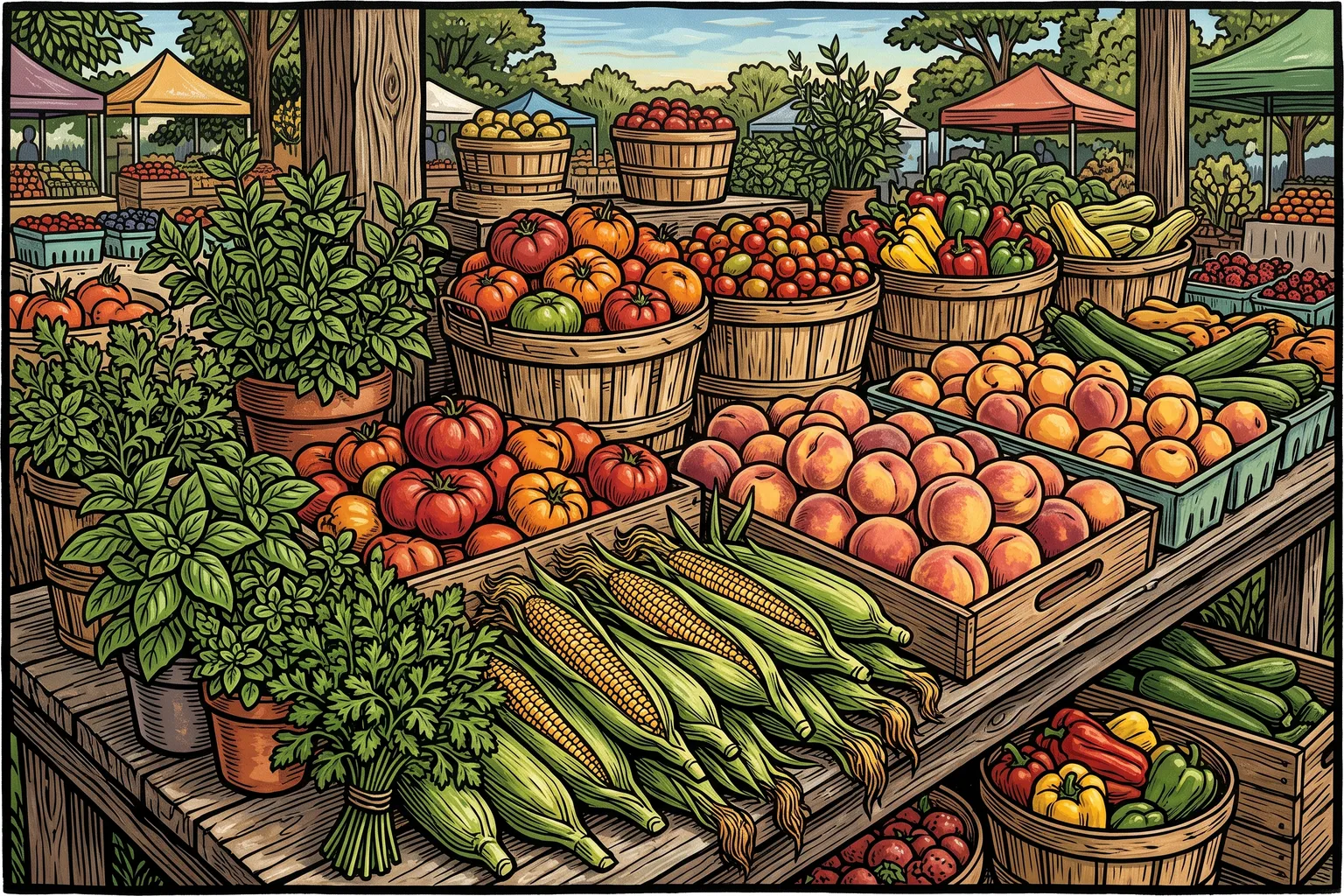
The first thing I noticed, the first Saturday of July, was that the table had changed.
It’s the same table I go to every week at the Yellow Springs Farmers Market, run by a family from outside Xenia that I’ve been buying from for fifteen years. In May it’s asparagus. In June it’s strawberries, then the first zucchini, then snap peas. But in July the table gets heavy. The tomatoes arrive, not in a shy trickle but in a wave: Brandywines, Green Zebras, Black Krim, the small orange ones whose name I always forget and ask about every year. The stone fruit shows up a week or two behind them, peaches and then nectarines, piled in wooden flats. And if the summer has been right, if the rain came when it should have and the heat arrived on schedule, there is corn.
When all three things are on the table at once, I stop planning meals. I look at what’s there. What’s there is the meal.
July is the month I make summer salad recipes that are actually dinner. Not side-dish salads, not the limp handful of greens that accompanies something else. The kind of salads that are the whole point of sitting down. I’ve been making them this way for years, and the reason has everything to do with what July asks for. The heat tells you something about what your body wants. It doesn’t want heavy. It doesn’t want long cooking times or warm plates or the oven running for an hour. It wants cold fat and acid and something sweet and something that crunches. A July salad, done right, is all of those things.
Winter salads work differently. They’re built around what keeps: roasted beets, braised lentils, grain salads that improve overnight. They have heft. You make them for comfort, for the specific pleasure of eating something dense and nourishing when the light has gone gray by four in the afternoon. I love a winter salad. But this isn’t what we’re talking about. This is July.
What July asks for is restraint with the cooking and generosity with everything else. Good oil. Something sharp. The best tomatoes you can find, which in July at a decent farmers market are the best tomatoes you will find all year. Ripe stone fruit that doesn’t need doing anything to. The coldest bowl you have. These aren’t diet-food salads or performance salads or the kind of thing you bring to a gathering to prove something. They’re the salads I make for myself on a hot evening when I have no desire to turn on the stove, and that I wouldn’t be embarrassed to put in front of company.
Here are three of them.
Tomato and Torn Bread Salad
The first thing you need is good bread. Not necessarily fancy bread, but real bread, the kind with some chew to it and a crust that resists. The sourdough from the bakery on Xenia Avenue is what I use. Day-old is better than fresh. The bread needs to be able to soak up tomato juice and olive oil without dissolving into paste, which fresh bread will do and day-old bread won’t.
The second thing you need is patience about the tomatoes. They need time. This is the part I had to learn.
I make this salad two hours before I eat it, not twenty minutes. The tomatoes need to sit in salt and give up their juice, and the juice needs to get into the bread, and the bread needs to absorb all of it before you dress the whole thing. If you skip the waiting, you have bread and tomatoes. If you wait, you have something that tastes like it was made with intention.
Cut or tear one and a half pounds of ripe summer tomatoes into rough pieces. Different sizes are fine, actually better. A large Brandywine cut into six chunks and a handful of small cherry tomatoes halved will give you more textural variation than uniform slicing would. Put them in a wide bowl and add three-quarters of a teaspoon of fine salt and a tablespoon of red wine vinegar. Toss and let them sit for thirty minutes, at least. You’ll see juice collecting in the bottom of the bowl. That’s what you want.
While they sit, tear eight ounces of day-old bread into rough chunks, anywhere from one to three inches. Lay them on a sheet pan and drizzle them with a few tablespoons of olive oil. Slide them into a 375-degree oven for about ten minutes, until the edges are gold but the centers are still a little soft. You don’t want croutons. You want bread that has dried out just enough to absorb without falling apart. Let them cool.
Add the bread to the tomatoes and toss everything together. The bread will start pulling up the tomato juice immediately. Add a third of a cup of very good olive oil, more salt if it needs it, and a large handful of fresh basil leaves torn into pieces. Let the whole thing sit at room temperature for another thirty to forty-five minutes before you serve it.
Eat it at room temperature, not cold. Cold dulls the tomatoes. This is a meal for two as a main course or for four as a generous side, though I find it becomes the main course more often than not.
I have been making versions of this salad since the early nineties. A colleague at the paper, a woman who grew up in Calabria and found the Ohio winters genuinely alarming, showed me the principle of it one July afternoon in the parking lot after a press event: salt the tomatoes first, give them time, use the juice. Everything else I’ve adjusted over the years. The current version is the one I’ve settled into.
Peach and Corn Salad with Feta and Mint
The corn at the Yellow Springs Farmers Market comes in waves. The first wave, in early July, is the sweetest. It’s been my experience that early corn, grown by someone who knows what they’re doing, doesn’t need cooking. It’s sweet enough raw, and raw corn in a salad has a crunch that cooked corn can’t replicate.
This salad came together for me on a July afternoon about four years ago when I had two ears of corn, two peaches that needed eating by that evening, and a wedge of feta in the refrigerator from earlier in the week. I made it, ate it standing at the counter, and then made it again three days later for Melissa when she was passing through town with the kids. The kids refused it on the grounds that it contained two separate foods touching each other, which I have made my peace with.
Husk four ears of corn and cut the kernels off the cob. I do this in a wide bowl, standing the ear on end and running a knife down the sides, which keeps the kernels from scattering across the counter and captures whatever juice runs from the cob. You want about two cups of kernels.
Slice two or three ripe peaches into wedges, then cut each wedge in half so you have pieces roughly the same size as the corn kernels. Add them to the bowl. Crumble three ounces of feta over the top. Add a large handful of fresh mint leaves, torn if they’re large. In a small jar, combine three tablespoons of olive oil, two tablespoons of fresh lemon juice, half a teaspoon of honey, a pinch of salt, and a few grinds of black pepper. Shake it and pour it over the salad.
Toss gently. The peaches bruise if you’re rough with them. Taste for salt before serving, because feta varies and sometimes it contributes more than you expect.
This one needs to be eaten within an hour of making it. The peaches soften and the corn loses its snap if it sits too long. Make it when you’re ready to eat it. It’s fast enough that this isn’t a problem.
I’ve tried adding arugula to this, and I’ve tried it with fresh lime instead of lemon, and I’ve tried it with a handful of toasted pepitas. None of those versions improved on the original. Sometimes the first version you land on is the right one.
White Bean and Tuna Salad with Herbs
This is the one I make when I want dinner and I don’t want to go to the market. Everything for it lives in the pantry and the refrigerator, with the exception of the herbs, which in July are growing in the pot on the back step that I’ve been maintaining with varying success since 2019. If you want to think carefully about what belongs in a pantry that makes meals like this possible on any given night, I wrote about that here.
Good tinned tuna matters here. Not the tuna in water from the supermarket shelf, which is fine for certain things but not this. I want oil-packed tuna, ideally from a small producer, with some texture left to it. The co-op in Yellow Springs carries two or three options. When I’m traveling, I bring a few tins home. It’s the kind of thing that doesn’t spoil and makes a real difference to the meal.
Drain and rinse two fifteen-ounce cans of white beans, cannellini or great northern. Put them in a wide, shallow bowl while they’re still slightly damp. Drain one five-ounce tin of good oil-packed tuna and break it into large flakes over the beans. Add one large celery stalk, sliced thin on the diagonal. Add the juice of one lemon and three tablespoons of the oil from the tuna tin, plus another tablespoon from the bottle if the tuna wasn’t very oily. Add a quarter of a medium red onion, sliced very thin, and two tablespoons of drained capers.
The herbs: a generous handful of flat-leaf parsley, chopped rough. A few sage leaves if you have them, sliced fine. These are optional but the parsley isn’t. Salt and black pepper to finish.
Let this sit for fifteen minutes before eating. The beans will absorb the lemon and oil and the whole thing will come together. It doesn’t need more time than that. Fifteen minutes is enough.
I eat this at least twice in a typical July. It goes well with a piece of bread and a glass of something cold, and it’s the kind of meal I put on the table and feel quietly satisfied about, not because it’s impressive but because it’s exactly what it should be. If you’re putting together a meal for two and want a sense of how I think about pairing things, the piece I wrote on easy dinner recipes for two covers some of the same ground from a different angle.
And if you want something to set out before you eat, a few things from a cheese board alongside this salad makes a July dinner that needs nothing else.
What July Actually Gives You
None of these salads are difficult. That’s the point, or part of it. July isn’t the month for difficulty. It’s the month when the farmers market does most of the work for you, when the tomatoes arrive so ripe that anything you do to them is mostly getting out of their way, when the peaches are so good that combining them with corn and feta feels almost too easy.
The farmers I buy from at the Yellow Springs market have been doing this work all spring. The soil prep, the transplanting, the irrigation decisions when the rain didn’t come on schedule, the judgment calls about when to harvest. By the time those tomatoes make it into my paper bag on a Saturday morning, they have had a great deal of thought applied to them. My job is to not ruin them.
A cold dinner on a hot evening. Bread soaked in tomato juice. Sweet corn eaten raw. Good tuna from a tin I’ve been saving for the right moment. I have been making these meals in July for most of my adult life, and the pleasure of them hasn’t diminished at all.
I fill my bags at the market and come home and make cold food for a hot night. That is summer cooking. That’s all it needs to be.