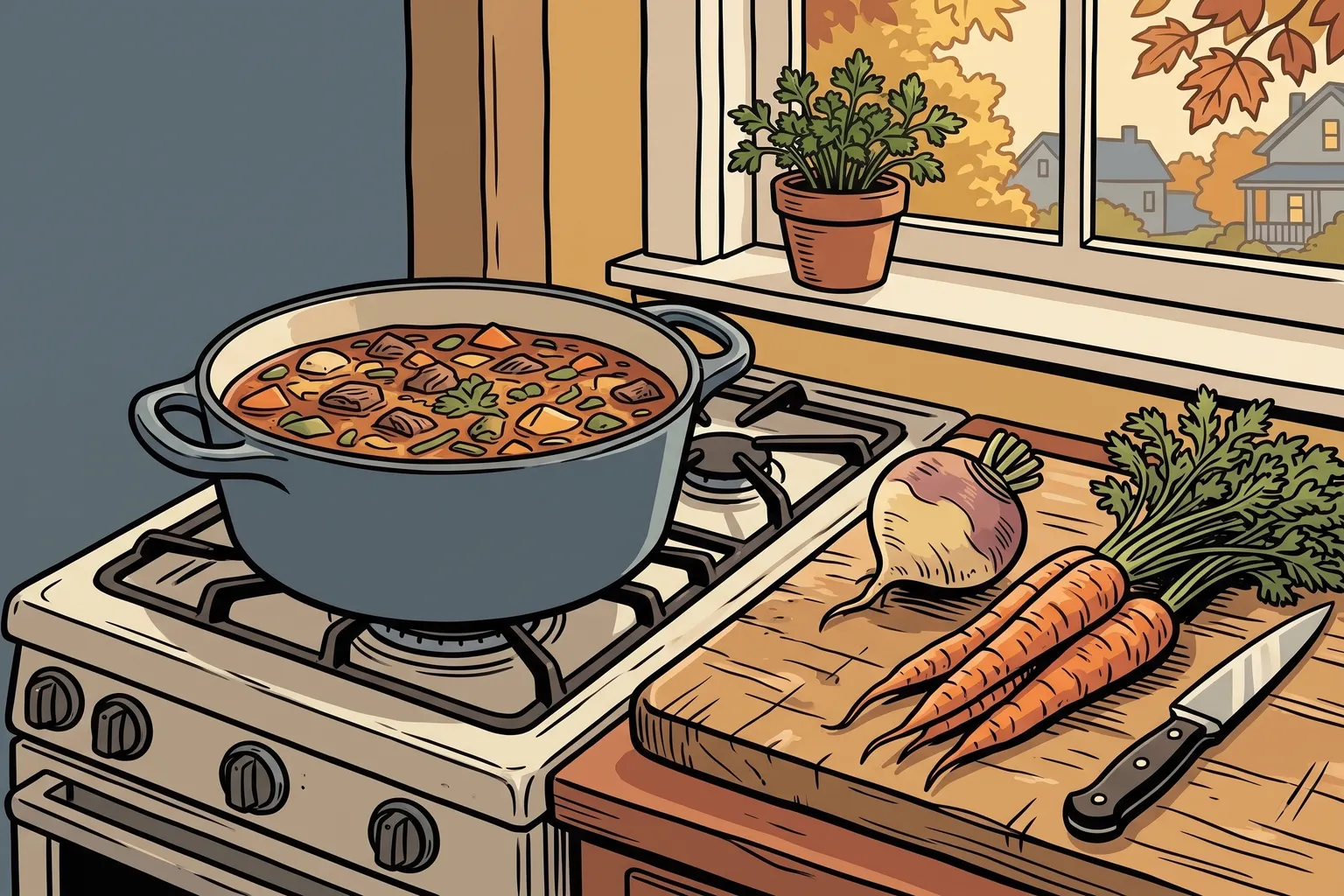
October has a smell to it in Yellow Springs, the particular combination of fallen leaves and dry cold and wood smoke from someone’s fireplace two blocks over that starts around the first week and settles in. I notice it every year the way you notice the first of anything, even when it’s not actually new, and every year it means the same thing: time to get out the soup pot.
Not any soup pot. The soup pot. The heavy enameled Dutch oven, cream-colored and deep, that I lift down from the high shelf and set on the counter on some Saturday in early October and look at for a moment before I start. It has been there since May, waiting, which is to say it’s been everywhere since May: at the back of a cabinet, slightly inconvenient, slightly in the way. In October I stop working around it.
The soup I make in it is my mother’s, or my version of my mother’s, which is a different thing and also the only thing available. Doris Hadley made vegetable beef soup on Saturday mornings in Zanesville, Ohio, from roughly October through March, every year of my childhood that I can remember. I have been trying to write it down accurately for twenty-three years. I’m not there yet. I might be getting closer.
What I know for certain: she started it early. Seven in the morning, sometimes earlier. The sound of the pot being set on the burner was part of Saturday. She used a cheap cut of beef with the bone still in, a chuck or sometimes something from the plate she’d get from the butcher on Third Street, and she browned it in the dry pot until the bottom was genuinely dark, not medium-brown but dark, and the fat had started to render and the kitchen smelled like meat in a way that cleared the head. Then she added water. Not broth. Water. She was a Depression-era cook by inheritance if not by experience, and broth was something you made, not something you started with.
What I’ve been working out over two decades: the bones. She may have added bones separately, in addition to the bone-in roast. I think she did. A beef knuckle or marrow bones from the same butcher, because the soup she made had a body to it that a chuck roast alone doesn’t produce, even browned deeply, even cooked for four hours. I’ve been adding marrow bones for eight years now and I think it’s right. I can’t prove it. I can’t ask her. I’m working from smell memory and the way the fat looks when you skim it the next morning, and both of those tell me the bones are correct.
The vegetables came in order, and the order matters, though she never said so explicitly. She just started with the onion because that’s where everything starts, and then the celery, and later the carrots, and the potatoes went in last because they fall apart if they cook too long. Somewhere in the middle came canned tomatoes, whole ones she broke up with her hand over the pot. No fresh tomatoes in October. She wasn’t dogmatic about this; it just wasn’t October food. The tomatoes went in when the beef had been cooking for a while, long enough that the broth was already starting to taste like something.
The thing I still can’t resolve: turnip. I have a memory of something root-vegetable-adjacent in the soup that wasn’t potato. It could have been parsnip. It could have been rutabaga. It could have been nothing and I’ve invented it whole, assembled from the general impression that her soup was a complicated thing with layers to it. I’ve added a turnip for twenty years now, cut small, put in with the carrots, and the soup tastes like what I remember. That’s the best evidence I have. The recipe may be wrong. The soup is good, and at sixty-eight I’ve decided that’s enough of a reason.
Thyme. Dried, from a tin, shaken in with a certainty I haven’t fully earned but am working toward. She never measured. She seasoned with her hands, a flat-palmed technique I’ve watched in my memory so many times that I can see how her wrist moved but not how much ended up in the pot.
The soup was done when it was done. By three in the afternoon it was ready, and it had been making the house smell like itself for eight hours, and sometimes we’d have it for a late lunch and sometimes for dinner and sometimes it sat overnight and got better and we had it for Sunday lunch instead. The overnight version is the better version. This is one of the few things I’m completely certain of.
I make it now on the first or second Saturday of October, in my kitchen on Corry Street with the east windows that get the morning light and the Wolf range that runs hotter than the Zanesville stove did and that I’ve been compensating for since I bought it. I get to the Dayton Farmers Market on the Wednesday beforehand for the last good carrots and whatever turnips or parsnips the stand I like has left. By October the tomatoes are finished but the root vegetables are coming in, the ones that look modest and cook slowly and are what I want.
Saturday morning, seven or seven-thirty. Coffee first. Then the pot comes down.
I don’t make this for the ritual of it, exactly, or at least that’s not the whole story. I make it because it’s October and because soup built this way, with time and good bones and vegetables that go in at the right moment, is the correct answer to October. It was her answer. It is mine now, even if mine isn’t quite hers yet.
The gap between the two is smaller than it was ten years ago. I notice this every year. Some sequence I’d been getting wrong has quietly corrected itself. The patience I didn’t have at forty-five I have now. I salt the pot earlier than I used to, not at the end, and the vegetables season differently all the way through. That was a late lesson, probably fifteen years in.
There’s still something I’m missing. I’m almost certain it’s in the browning. She browned the meat with a confidence and a heat that I replicate accurately now, I think, but there’s a particular moment before the crust forms when the smell shifts from raw fat to something deeper, and I’m not sure I’ve ever held that moment long enough. Too much worry about burning. She didn’t worry about burning. The pot was hers and she knew it the way you know something you’ve been doing for thirty years, and I’m working my way toward that knowledge, and October is when I practice.
If you asked me for the recipe, this is what I’d tell you.
Saturday Vegetable Beef Soup
Buy a chuck roast with bone in, roughly three pounds. If your butcher has marrow bones, get two of those as well. A knuckle bone works too. You’re after the gelatin, which is what gives the soup its body when it sits overnight.
Don’t add anything to the pot when you start. Get it hot, medium-high, and put the beef in dry. Let it sit. Don’t move it. You want a real crust, dark brown going toward black at the edges, and this takes longer than you expect, maybe eight minutes a side. When you turn it, leave it again. Brown the marrow bones the same way, though they won’t go as dark. Take everything out when it’s done.
In the fat that’s rendered, add a large onion cut in rough chunks, not fine. Let it go until it’s soft and beginning to color, another ten minutes. Then add three or four stalks of celery. Put the beef and the bones back in the pot.
Add enough cold water to cover everything by two inches. Bring it to a simmer. A simmer, not a boil. A boil makes the broth cloudy and adversarial. Low and patient, lid on but not sealed, just resting.
Let it go for an hour. Salt it now, generously, not at the end. Add three or four carrots cut in good-size pieces, and a turnip cut the same way, or a parsnip if that’s what you have. One more hour on low.
Open a 28-ounce can of good whole tomatoes, the kind worth having in the house year-round, which I’ve written about before. Squeeze each one by hand to break it up, doing this over the sink rather than the pot. The juice sprays and will ruin your shirt otherwise. Add the tomatoes and all the juice to the pot. Add dried thyme, generously. Taste the broth and adjust the salt.
Add the potatoes last, cut in chunks, medium-size. They’ll take forty-five minutes and they’re done when a fork goes through without resistance. By this point the soup has been cooking for three hours at minimum, possibly four. The broth should be dark and specific. Taste it again.
What I’d recommend, and strongly: let the pot cool and refrigerate it overnight. The fat solidifies on top and you can lift it off clean in the morning. The flavors settle into each other. The potatoes will have absorbed the broth and be something better than they were the night before. Reheat it slowly the next day on low heat, thirty minutes or so, with the lid on.
Eat it with bread. A rough sourdough is what I’d use, something with a crust that earns the word, though any good bread will do. A handful of fresh parsley at the table if you have it. Scatter it over each bowl just before serving. She grew parsley on the kitchen windowsill in a clay pot, and I keep it there too, and it was the only fresh herb she used and I’ve kept that rule. The parsley goes on at the end.
This is not exactly her soup. It is, at this point, undeniably mine. I’ve decided to be content with that. Every October I take another step toward getting it right.