The first time I saw Lisbon, I was fifty-seven and George was alive and we had taken a detour on our way to the Azores because he wanted to see the Jerónimos Monastery and I wanted to eat a pastel de nata at the bakery in Belém where they’ve been making them since 1837. We did both. The monastery was extraordinary. The pastry was better.
I went back alone in the fall of 2024, five years later and a different person, because I couldn’t write honestly about retirement in America without addressing the country that kept coming up in every conversation. Portugal. Always Portugal. At dinner parties, at airports, in emails from readers. Someone would say, “Have you thought about Portugal?” with the particular enthusiasm of a person who has read three articles and bookmarked a real estate listing in the Algarve.
I had thought about it. And I’d been. So I went back to see whether what I remembered was real or whether I’d been carrying around a postcard version of a country that deserved a closer look.
It deserved a closer look.
Lisbon, Which Earns Its Hills
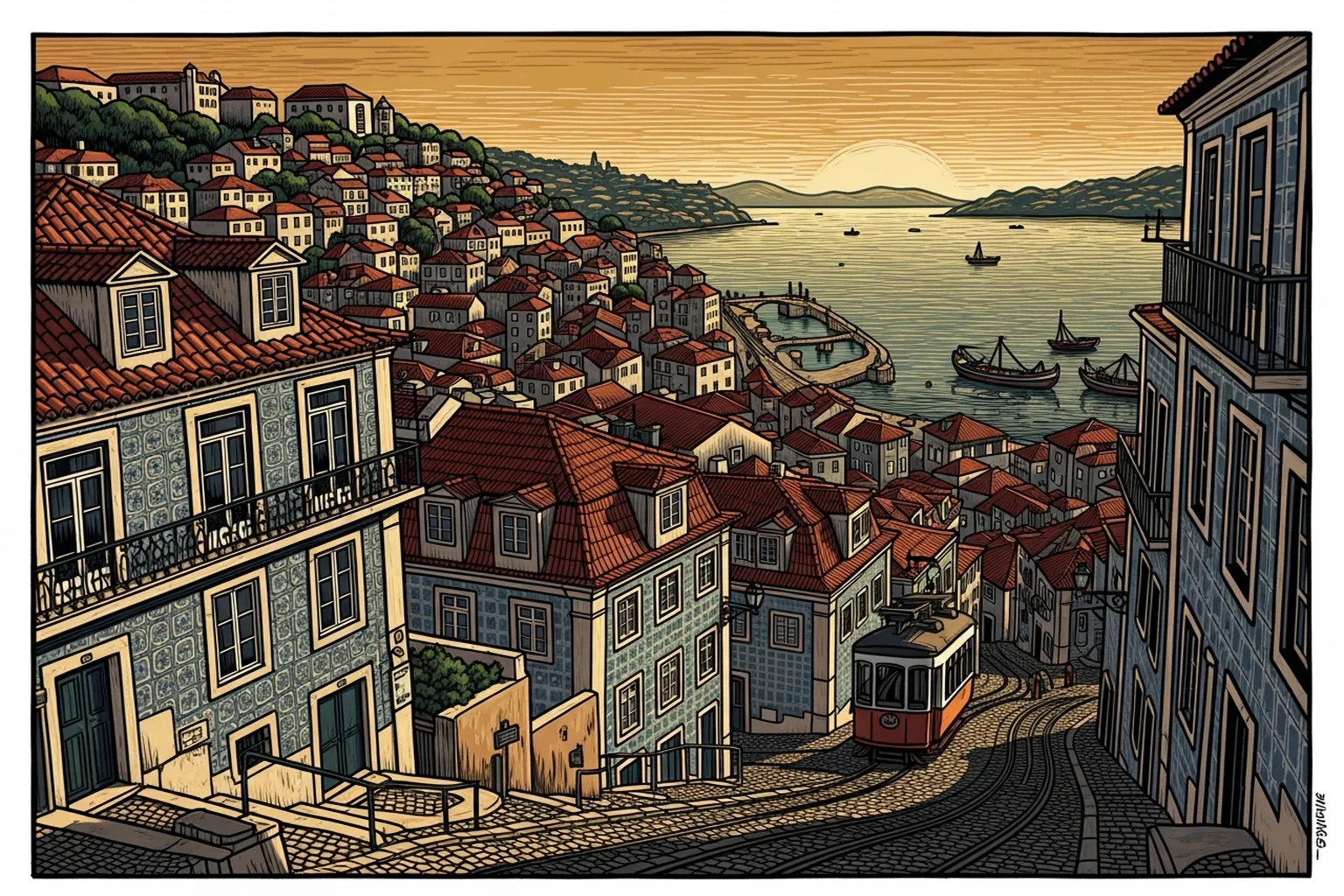
Lisbon is built on seven hills, and you will feel every one of them. I stayed in Graça, the neighborhood above Alfama that the guidebooks haven’t quite caught up to, and I walked down to the river every morning through streets so steep that the cobblestones have grooves worn into them by centuries of feet doing exactly what I was doing. The light at eight in the morning on the Tagus River has a quality I’ve only seen one other place, which is the central coast of California. Warm, golden, specific. It makes the tile facades of the old buildings glow in a way that photographs can’t reproduce. I tried. The photographs are good. The light was better.
Lisbon is a city that functions at a human pace. The trams are slow. The coffee is taken standing at a counter, quickly, because the Portuguese treat espresso the way Americans should treat espresso: as a thing you drink, not a thing you sit with for two hours while occupying a table meant for four. Lunch is the big meal. The restaurants fill at one and empty by three. By four, the city enters a period of quiet that an American might mistake for laziness but is actually civilization.
I walked for five days. I walked through the Alfama, where the fado houses sit on corners so narrow that you can hear the singing from two streets away. I walked through Príncipe Real, where the Saturday market sells cheese and wine and ceramic tiles and the old trees in the garden cast the kind of shade that makes you reconsider your schedule. I walked along the river to the Mercado da Ribeira, where the food stalls serve grilled fish and bread and wine for less than I’d pay for a sandwich in Portland.
A couple could rent a decent apartment in Lisbon for €1,200 to €1,800 a month, as of 2025. That’s up from five years ago. Lisbon is no longer the bargain it was in 2015, and anyone who tells you otherwise is working from old data. But by American standards, particularly for someone coming from San Francisco or New York or Seattle, the math still works. A good dinner for two with wine runs €40 to €60. A monthly transit pass is about €40. Groceries are roughly half what they cost in any major American city.
Porto and the Douro
I took the train from Lisbon to Porto, which takes about three hours and costs €25 to €35 depending on the train, and which passes through countryside that looks like what would happen if Tuscany and Northern California had a conversation and agreed on a color palette.
Porto is smaller than Lisbon, grittier, and in some ways more honest. Lisbon has learned to perform for tourists. Porto hasn’t bothered. The Ribeira district along the Douro River is a UNESCO World Heritage site that looks like someone stacked pastel buildings on a cliff and dared gravity to object. The river below is wide and slow and reflects the port wine lodges on the opposite bank in Vila Nova de Gaia, where you can taste wine that has been aging in barrels since before you were born.
I ate grilled sardines at a small restaurant near the Foz do Douro, where the river meets the Atlantic. The sardines were served on bread, which soaked up the oil, and the bread was as important as the fish. A glass of vinho verde cost two euros. The waiter didn’t rush me. Nobody rushed anybody. I sat for an hour and watched the fishing boats and wrote in my notebook and thought about George, who would have ordered the same thing and then asked the waiter three questions about the wine in his careful, engineering-precise Portuguese that he’d been studying from a textbook on the plane.
Porto is more affordable than Lisbon. Apartments rent for €800 to €1,400 a month. The food is cheaper. The city is walkable if you don’t mind hills, and you shouldn’t mind hills, because the hills are the reason the views exist.
The Douro Valley, an hour east by car, is one of the most beautiful river valleys in Europe and I’m not being polite about it. Terraced vineyards climbing from the river to the sky, quintas with tile roofs catching the morning light, a silence that isn’t empty but full. George and I drove through it in 2019 and he pulled over three times just to look. He was not a man who pulled over to look at things. The Douro changed him for an afternoon. If you’re considering Portugal and you haven’t seen the Douro, you haven’t seen Portugal.
The Algarve, Where the Light Does Something
The southern coast is where most American retirees end up, and I understand why. The Algarve has three hundred days of sunshine per year, beaches backed by sandstone cliffs that turn orange at sunset, and a cost of living that makes the rest of Western Europe look like a pricing error.
I spent three weeks there in 2019 and went back for ten days in 2024. The towns I liked best were Lagos, which has a walled old town and a harbor and the kind of energy that comes from a place that has been a working port for five hundred years, and Tavira, which is quieter, smaller, and sits on a river instead of the ocean and has a Roman bridge that people still walk across to get to the market.
A couple can live in the Algarve on $2,500 to $3,500 a month, including rent, and live well. Not lavishly. But well: a good apartment, fresh food from the market, dinners out twice a week, wine that costs four euros a bottle and tastes like it should cost thirty. The expat community is large and English-speaking, which is both an advantage and a warning. It’s possible to live in the Algarve for years and never learn Portuguese, and the people who do this are missing something essential about the country they chose to live in.
The Silver Coast and the Quiet Life
North of Lisbon, the Silver Coast stretches from Ericeira to Nazaré along a coastline that gets real Atlantic weather: wind, waves, fog that rolls in and sits on the cliffs like it’s thinking about something. This isn’t the sun-soaked Algarve. This is Portugal for people who like weather with personality.
Ericeira is a fishing village that has become a surf town without losing its village core. Caldas da Rainha, inland, is a market town with hot springs and a ceramics tradition and the kind of daily life that doesn’t change when the tourists leave because the tourists haven’t arrived. Óbidos, a walled medieval town, is beautiful in the way that makes you suspicious, but I walked it on a Tuesday in November and it was real. People live there. Children go to school there. The walls aren’t a set.
The Silver Coast is where I’d look if I were serious. Rents run €700 to €1,200 a month. The proximity to Lisbon (an hour by car) means access to a major international airport. And the coastline, with its cliffs and fishing boats and that particular Atlantic light, has a quality that the Algarve’s sunshine doesn’t: it makes you pay attention. Good weather is pleasant. Complicated weather is interesting.
The Practical Things, Because They Matter
Portugal’s D7 visa is the path most American retirees use. It requires proof of passive income, from pensions, Social Security, investments, or rental income, meeting a minimum threshold tied to the Portuguese minimum wage (roughly €870 per month for the primary applicant as of 2025, though the practical amount you’ll want to demonstrate is higher). The application process involves paperwork, patience, and a willingness to engage with Portuguese bureaucracy, which operates on its own timeline. Plan for it to take longer than you expect. Then add a month.
The Non-Habitual Resident tax program, which for years offered a flat 10% tax rate on foreign pension income, was discontinued for new applicants as of January 2024. If you’ve read older articles recommending Portugal for its tax advantages, check the dates. The tax situation for new arrivals is different now, and you should consult a tax professional who understands both Portuguese and American tax obligations before making any financial decisions. Glenn Suttner, who writes about retirement finances for this magazine, would tell you the same thing.
Healthcare in Portugal is strong. The public system, the Serviço Nacional de Saúde, provides coverage to legal residents, though wait times for specialists can be long. Most expats carry private health insurance, which runs €100 to €300 per month depending on age and coverage, and which gives access to private hospitals and clinics that are modern, well-staffed, and shockingly affordable compared to American medical care. I spoke with an American couple in Lagos who told me their total healthcare costs, including insurance, prescriptions, and two specialist visits, came to about $4,000 for the year. They had been paying $18,000 annually in the States.
The language is real. Portuguese isn’t Spanish, and assuming it is won’t endear you to anyone. But the Portuguese, in my experience, are patient with foreigners who try, and most younger people in Lisbon and Porto speak English. In the Algarve, English is common. In smaller towns, less so. Learning at least basic Portuguese before you go is both practical and respectful. George studied it on the plane. I’ve been working on it since. Neither of us was ever good at it, but the trying mattered more than the fluency.
What I Think About It, Honestly
Portugal isn’t a solution to the problems of American retirement. It’s a different set of circumstances in a different country with a different language and different food and different bureaucracy and a different relationship to time. If you go expecting America with better weather and cheaper wine, you’ll be disappointed. If you go expecting Portugal, you won’t be.
What I found, in five visits over six years, is a country that is genuinely beautiful, genuinely affordable, and genuinely welcoming in a way that isn’t performed for tourists but is simply how the culture works. The Portuguese are reserved until they’re not, and when they’re not, the warmth is real. I was lost in the Alfama on a Tuesday evening and a woman walked me four blocks to the street I was looking for and then pointed to a restaurant and said, “Eat there,” and I did and it was the best meal of the trip.
I found a country where the pace of life matches the pace I want my life to have. Where lunch takes an hour because it should take an hour. Where the light on the river in the morning is reason enough to get up and walk to the bridge and stand there with a coffee and watch the boats.
I’m not selling Portugal. I’m describing what I saw. If it sounds like the kind of place you’d want to live, go for two weeks in February, not in June. February will tell you the truth. Walk the streets. Take the train from Lisbon to Porto. Eat the sardines. Sit by the Douro at sunrise and see if the light does to you what it did to me.
And then come home and think about it for six months before you do anything. This isn’t a decision you make from a brochure. It’s a decision you make from experience, and experience takes time.
Bring good shoes. The cobblestones are serious.