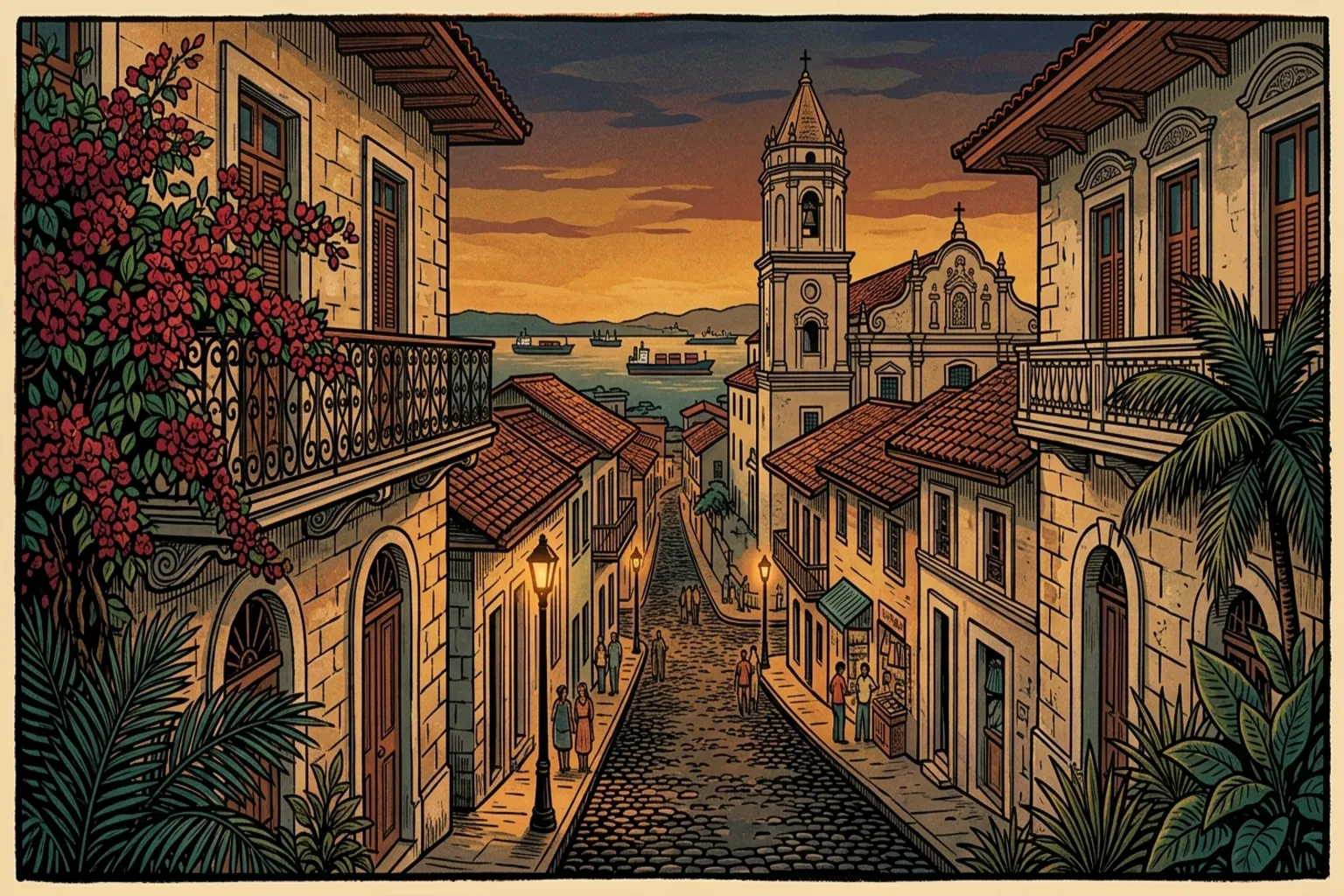
The taxi from Tocumen International Airport takes about forty-five minutes to reach Casco Viejo, depending on traffic, and the traffic is usually significant. Panama City stacks itself against the Pacific in a way that makes the approach disorienting if you’ve prepared yourself for Central America: the skyline is almost Manhattan-adjacent, glass towers crowding the waterfront, construction cranes suggesting the towers aren’t done coming. Then the driver turns south along the Cinta Costera and the Pacific opens to the right and you get the first real look at what this city actually is, which is something built fast in a place that was, for a long time, the point where everything had to stop and wait.
I went to Panama in March 2025, three weeks, alone. I had written briefly about Boquete in a piece on the cheapest places to retire the year before, and several readers wrote back to say I had undersold it. That’s a charge I take seriously. I went to see.
The walk through Casco Viejo at dusk is genuinely lovely, and I want to be honest about this because I had arrived with some skepticism, having read enough retirement-promotion writing about Panama to know that “lovingly restored colonial neighborhood” is often shorthand for “you will pay European prices in a country with a $15,000 per capita income.” That is true of Casco Viejo. The restaurants are excellent and cost what you’d pay in San Francisco. The renovated colonial buildings are striking, and some of them are now condominiums listing north of $400,000. The neighborhood is a UNESCO World Heritage Site, founded in 1673 after the original Panama City was destroyed by pirates, and at six in the evening the light falls on the red tile roofs and stone facades in a way that justifies every photograph you’ve ever seen. I walked the eight blocks from Plaza Independencia to the tip of the peninsula and watched the ships queued to enter the canal, enormous things riding low with freight, and felt the specific contentment of being in a place that knows exactly what it is.
What Casco Viejo actually is, at this stage, is a neighborhood whose transformation is nearly complete. The Panamanians who lived there before the renovations mostly can’t afford to live there now. You see this in the streets just outside the UNESCO zone, in houses that haven’t been restored, and it’s not unusual for gentrification anywhere, but it’s especially visible in a city where the glass-tower financial district is three miles away and the working-class neighborhoods are within sight of both. I’m not going to pretend this doesn’t complicate the picture, because it does. Panama has one of the highest income inequality rates in Latin America, and if you’re an American retiree on a fixed income who comes here and finds the cost of living manageable, it’s worth sitting with why that is.
This is the thing the retirement brochures skip, and I think they should stop skipping it.
The next morning I took the Metro to the financial district. The fare is $0.35, the trains come every two minutes during rush hour, and the system is clean, air-conditioned, and elevated above the street congestion that would otherwise consume an hour of your morning. It was, when it opened in 2014, Central America’s first metro. I rode it with people going to work, and at that hour the cars were full, and I stood and held a pole and watched the city slide past through the windows and thought: this is a real city. Not a retirement hamlet. Not an expat resort. A functioning, complicated, hot, ambitious city.
Panama City’s lowland heat is worth understanding before you go. The Pacific side sits near sea level and the temperature runs in the mid-80s to low 90s for most of the year, with humidity that makes the actual temperature a theoretical figure. I’m comfortable in heat; I spent years in Southeast Asia for work and I’m not delicate about this. Panama City in March was still enough to send me back to the hotel by noon. You get used to it, people told me, and I believe them, and I also believe that “you get used to it” is what people say about things they have made peace with rather than things they actually enjoy.
Healthcare in Panama City is genuinely good. Four JCI-accredited hospitals operate there, including Hospital Punta Pacifica, which is affiliated with Johns Hopkins Medicine International and has held that accreditation since 2011. About 90 percent of the specialists at private hospitals trained in the United States. A knee replacement that runs $35,000 or more at home costs around $13,000 here. I don’t need a knee replacement, but I know people who do, and I know what that number means when you’re deciding where to live.
The Pensionado program is where Panama has a real and specific advantage over almost every other retirement destination I’ve considered. The program operates under a 1987 law, Law 6, and the requirements are simpler than the promotional materials make them sound: a monthly pension of $1,000 from a government, an international organization, or a private company, as a true lifetime pension. The income has to be a pension, not IRA withdrawals or investment distributions. If you meet that threshold, Panama grants you immediate permanent residency, not a temporary visa that converts later. Done.
What Law 6 gives you in exchange is a set of discounts that are statutory and enforced. Twenty-five percent off restaurant meals. Fifty percent off hotels on weekdays. Twenty-five percent off airline fares. Twenty percent off doctor visits. Thirty percent off public transportation. These aren’t courtesy discounts that any business can ignore if the line is long; they’re written into the law and the fines for non-compliance are real. The consumer-protection agency ACODECO enforces them. I tested a few. They work.
Panama taxes no foreign-source income, which for a retiree living on Social Security and a pension is a fact worth underlining. The currency is the US dollar. No exchange rate to watch, no conversion math, no moment six months in when you discover your purchasing power has shifted. And the flight from Miami is three hours.
I have written about retiring in Costa Rica and retiring in Portugal, two other countries that are serious about attracting retirees. Panama is less charming on arrival than either, and more practical than both.
I spent the second half of the trip in Boquete, in the highlands of Chiriquí Province, six hours by bus from Panama City or an hour by air. Boquete sits at about 3,900 feet above sea level in a valley surrounded by coffee farms and cloud forest, and the temperature there is almost never wrong. The average runs somewhere between 65 and 72 degrees year-round. I didn’t use air conditioning once. I needed a jacket in the evenings, which after four days in the Pacific lowlands felt like a direct favor from the geography.
Boquete is a small town, and there’s an American and Canadian retiree community there that is visible, organized, and worth a clear-eyed look. There are weekly farmers markets, Tuesday coffee meetups, a network of Facebook groups covering everything from plumber recommendations to road conditions on the way to Volcán. The retirees I spoke with were, almost without exception, practical people who had arrived with realistic expectations and found the reality workable. One, a retired school administrator from Tucson who’d been there four years, said the thing she hadn’t expected was how much Spanish she’d need, and how glad she was to have learned it, and that anything medically serious still meant a trip to Panama City. She said this without complaint, as a statement of fact, the way someone who has figured out how something actually works talks about it.
A furnished two-bedroom apartment slightly outside the town center rents for $800 to $1,000 a month, often with water and internet included. A couple living well in Boquete, meaning fresh food, restaurant meals a few times a week, adequate health coverage, and occasional travel, spends somewhere between $2,200 and $3,000 a month, before Pensionado discounts. The coffee is outstanding and costs almost nothing, because you’re in the valley where it’s grown.
Here is what I think is worth saying plainly, because the retire-in-Panama pieces I’ve read mostly avoid it: the life you can build in Boquete or in Panama City’s expat neighborhoods is genuinely good, and it’s partly good because you are arriving with American dollars in a country where American dollars go further than they go in America. The reason they go further is that most of the people who live there aren’t working with American dollars. This isn’t a reason not to go. It’s a reason to go thoughtfully. To learn enough Spanish to be a real participant in where you are. To understand that the expat community, comfortable and well-organized as it is, isn’t Panama. The farmers at the Boquete market are Panama. The driver who took me up to the Quetzal Trail on a Tuesday morning, who knew every bird call in the cloud forest, is Panama. The woman at the produce stand who spent ten minutes teaching me the names of root vegetables I’d never seen is Panama.
The expat bubble is easy to live in. That’s both its appeal and its limitation.
What actually appeals to me about Panama, having thought about it carefully: the combination of things I rarely find together. A highland climate that needs neither air conditioning nor heating most of the year. Healthcare that approaches the quality I’d want without the price that makes me think about it every time I use it. A visa structure that doesn’t require purchasing property or navigating endless recertification. A currency I already use. A flight home to California that connects through Miami and takes most of a day, not most of two.
The infrastructure gaps outside the capital are real. The internet can be unreliable in parts of Chiriquí. Some roads announce themselves more confidently than they deliver. And the inequality that’s visible in any Central American city is visible here, which isn’t Panama’s problem to solve for you, but it is your problem to see.
Still. I went prepared to be skeptical, and I came back with more notes than I’d expected and a longer list of genuine reasons than I’d anticipated. The retirement case for Panama isn’t a brochure case. It’s a real one, and it holds up when you walk around in it.
That counts for something.