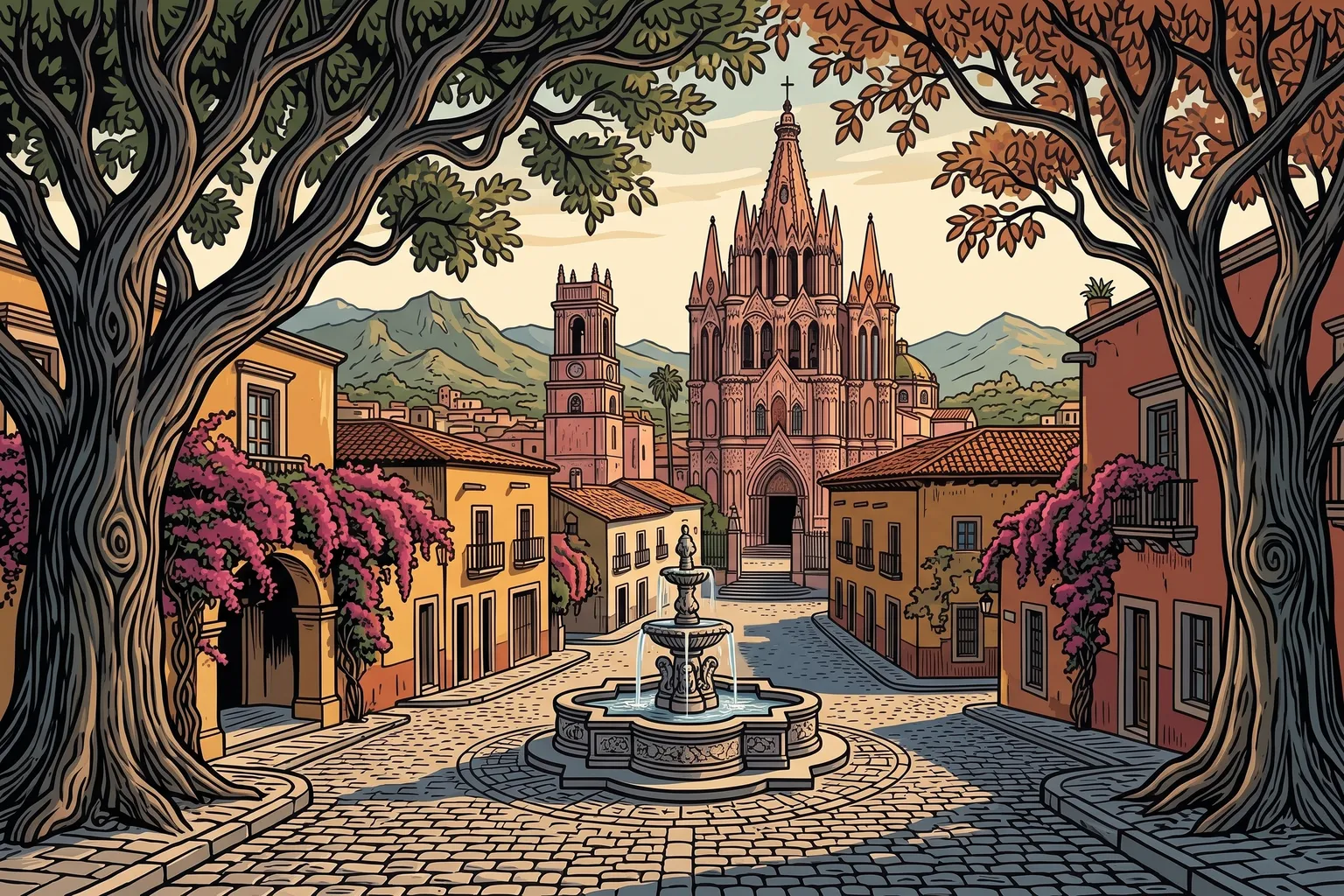
The plaza in San Miguel de Allende on a Tuesday morning does not look like a retirement destination. It looks like a plaza. Two women sell flowers from plastic buckets near the Parroquia. A man in an apron hoses the cobblestones in front of his shop. Students cut through in groups of three on their way somewhere they aren’t hurrying to. Two dogs are asleep in the shadow of the church’s pink stone towers, which have looked the same since approximately 1880, and the dogs look like they know it and have decided this makes the spot permanent.
I went to Mexico in September, two weeks, alone. September is the tail end of rainy season, which means the tourists are mostly gone and the towns belong to the people who live in them. That’s when you learn the most about a place.
Since the Panama piece ran, I’ve received more reader letters asking about Mexico than about any other country. More than Costa Rica. More than Portugal. The readers who wrote weren’t asking abstractly. “My daughter lives in San Miguel.” “My husband spent a year in Oaxaca in the eighties and has never stopped talking about it.” “A friend moved to Lake Chapala in 2019 and says it’s the best decision she ever made.” These are letters from people with a specific pull toward a specific place, and what they wanted me to do was go and report back honestly.
Here’s the report.
San Miguel de Allende
San Miguel sits at about 6,200 feet in the Sierra Madre foothills of Guanajuato state, which means September is mild during the day and legitimately cool at night. The elevation also gives the light the particular quality of high-altitude places: very clear, very direct, making the pink and ochre colonial facades look like something from a painting someone would dismiss as unrealistically saturated.
The expat community here is large and old. People have been moving to San Miguel from the United States since the 1940s, and the infrastructure that has accumulated around them over eighty years is visible (Source): English-language yoga studios, a binational arts center, a hospital with English-speaking staff, a pair of English-language bookstores. This makes it easy. Whether that’s the argument for San Miguel or against it depends entirely on what you’re looking for.
What surprised me was how much of the town is simply Mexican. The weekly market near the Mercado Ignacio Ramírez is not a tourist market; it’s where people in San Miguel buy tomatoes and dried chilies and new sandals and small plastic saints and buckets. I spent an hour in it and spoke no English. I watched a woman negotiate the price of avocados with a vendor with the cheerful firmness of someone who has been doing this for forty years. They settled on something they both found acceptable. She walked away with the avocados in a plastic bag. The vendor turned to the next person in line without breaking stride.
That transaction is San Miguel, really. The expats and the Mexicans have been conducting a long negotiation about how to share a town, and mostly they’ve figured it out.
What I’d tell you honestly: Guanajuato state carries a Level 3 travel advisory from the U.S. State Department, meaning Reconsider Travel (Source). San Miguel de Allende proper has been relatively stable within the state. But the broader regional picture requires ongoing attention, not a single check before you buy a plane ticket. You ask current residents. You read current advisories, not the ones from two years ago. This is true of a lot of places worth living.
Lake Chapala
Lake Chapala is the largest lake in Mexico, set in a basin in Jalisco state about an hour south of Guadalajara. The town most expats live in is Ajijic, on the north shore, and Ajijic is something particular: a retirement community that is genuinely Mexican rather than something dropped on top of Mexico.
The English-language newspaper, the Ojo del Lago, has been publishing here since the mid-1980s. The Lake Chapala Society has been helping expats work through the residency process, the tax questions, and where to find a good plumber since 1955. There are American Legion posts and bridge clubs and every kind of English-speaking professional service you’d want, and none of it feels like the kind of expat bubble that exists in some places, because it has been here too long to feel foreign anymore.
The lake itself justifies the trip before anything else. At about 5,100 feet, the climate is what the locals call the land of eternal spring, accurate enough that I arrived in September and didn’t need either a jacket or sunscreen in the same afternoon. The light on the lake in the late afternoon, the mountains stacked behind it, the white herons picking through the shallows: this is why people move here and don’t leave.
Jalisco state carries a higher advisory than Yucatan in certain regions (Source), and you should read the current State Department guidance carefully and distinguish between specific municipalities. The Lake Chapala corridor is one of the most closely watched by expat communities, and the information from people who have actually lived there for several years is more current than anything written a year ago. Ask them. Not the forums full of people planning to move there. The people who moved three years ago and are still there.
Merida
Merida is in the Yucatan and it is hot. This needs to be said plainly, because some of the writing about Merida manages to describe the colonial grandeur and the food scene and the walkable centro and bury the heat somewhere in a subordinate clause. September in Merida is 95 degrees by noon. The humidity is what you’d expect from a city on a limestone shelf in the tropics. I reorganized my day around it: walking at six in the morning when the streets were empty and cool, sitting in the Gran Museo del Mundo Maya in the afternoon with its extraordinary Mayan collection and air conditioning, going out again after six when things had dropped to something manageable.
What Merida has that the other three towns don’t: it feels like a real Mexican city. Not a Mexican city adapted for Americans. A city with its own economy and its own cultural life and a food scene that has nothing to do with what tourists order. The Mercado Lucas de Gálvez on a weekday morning is not a craft market; it’s where people in Merida buy things. The woman who sold me a paper cup of agua de chaya from a bucket on a folding table was conducting about four conversations simultaneously and never lost track of any of them.
The Paseo de Montejo on a Sunday, when the boulevard closes to cars, fills with cyclists and families and kids on rented bikes, and the old nineteenth-century mansions on either side look like exactly what they were: the houses of people who got wealthy growing henequen and wanted the whole town to know it. I walked the length of it and stopped at the Monumento a la Patria and sat on a bench for a while and thought about staying longer.
Yucatan state holds a Level 1 advisory from the State Department, the lower end of the Mexican advisory spectrum (Source). Merida has a consistent reputation as one of the safer major cities in the country. In my experience there, the reputation felt warranted. That still doesn’t mean you skip the research. It means you do the research and keep finding things pointing in the same direction.
On healthcare: IMSS Bienestar is Mexico’s current federal public health program, having absorbed the previous INSABI and Seguro Popular systems. It’s described officially as public, universal, and free for people without existing social security coverage. Whether legal foreign residents can enroll on equal terms with Mexican nationals requires direct verification through the program’s registration system. Most expats in Merida use IMSS voluntary enrollment for a comprehensive safety net, or purchase private insurance. Either option runs a fraction of comparable U.S. premiums, though the specifics depend on age and what you need covered.
Oaxaca
I left Oaxaca for last, which was the right call, because by the time I got there I had spent eleven days paying attention and I knew what I was looking at.
Oaxaca city sits at 5,100 feet in a highland valley in the Sierra Madre del Sur, and September is its green season. The hills surrounding the city are the specific shade of green that only appears when four months of rain have been arriving reliably, a color so saturated it looks implausible in photographs and completely natural when you’re standing in it. The air after the afternoon rain smells of copal from the churches and corn from everywhere else and the particular mineral smell of water on old stone, which I can’t describe better than that except to say that if you’ve smelled it, you know.
The expat community here is smaller than in the other three towns, which changes the daily texture considerably. My Spanish worked harder in three days in Oaxaca than in the previous eleven combined. The Mercado Benito Juárez and Mercado 20 de Noviembre are where people in Oaxaca buy things. In the Mercado 20 de Noviembre, vendors grill meat in the central aisle and the smoke hangs in the late-afternoon light and you eat standing up or at a shared table and the food is better than you were prepared for.
I had mole negro one afternoon at a small spot on Calle Tinoco y Palacios. About ninety pesos. I sat at a corner table with my notebook and ate it slowly and wrote a few things down, a practice I’ve kept up since before I had any reason to call it a practice, and the woman running the place topped off my agua fresca twice without being asked.
There’s a smaller infrastructure here for English-speaking expats, which is either a feature or a drawback depending on how much you want the place to meet you halfway. I think it’s mostly a feature. The people I talked with who had moved to Oaxaca spoke of the city with an affection that is different from the affection people have for San Miguel or Lake Chapala. Less “this works well” and more “this surprised me completely.”
Oaxaca state has complex internal geography when it comes to security. The city and the central valley are generally stable. Read the current State Department advisory and specifically distinguish between the city proper and the more remote mountain areas, because a state-level designation can obscure significant variation.
The Residency Question
Mexico offers two main paths for foreign residents: a Temporary Resident Visa, valid for one to four years and renewable, and a Permanent Resident Visa after four cumulative years of temporary residence. Both require proof of financial self-sufficiency. The specific income thresholds are set in multiples of Mexico’s UMA (Unidad de Medida y Actualizacion) and are updated periodically.
Check the current requirements directly with the Secretaría de Relaciones Exteriores or a Mexican consulate before you plan around any number you’ve read. The thresholds are designed to confirm you can support yourself, not to block out the middle class. Everyone I talked with who had gone through the process said an immigration attorney made it manageable, and several said it was less complicated than they’d expected. That’s not a guarantee. It’s a consistent report.
For cost-of-living comparisons across international retirement destinations, this earlier piece covers the numbers more fully than I can here.
The Part Nobody Says Plainly
Mexico is not a simple retirement decision. Anyone who makes it sound like one is leaving something out.
The security situation is real and varies dramatically by state and by municipality and it changes. A single assessment from three years ago isn’t reliable today. You need current advisories, current information from current residents, and honesty with yourself about your risk tolerance and your ability to adapt.
The healthcare picture is improving and uneven. Public options exist and are expanding; private insurance is available and affordable by American standards. Most expats end up with some combination of both, and the right combination varies by city.
What Mexico has that almost no other international retirement destination offers: proximity. If something goes wrong at home, you’re on a two-to-four-hour flight. If you need a trial month before committing, you can do that without crossing an ocean. If you decide it’s not right, you haven’t bet everything on a guidebook.
I came home from September with a feeling I know from good travel: that I understood something I hadn’t understood before, and that the understanding changed the question I’d been asking. The question isn’t whether Mexico works. It works, in the right town, for the right person, approached with clear eyes about what you’re choosing and what you’re not.
The question is which town. Four of them made the case to me. One of them might make it to you.